

Reflecting light,
the moon shines.
Between buildings,
the moon shines.
Through clouds,
the moon shines.
The moon shines,
hope rises.
The moon shines,
hope abides.
The moon shines,
hope lives.
16 October 2013
Manhattan, New York
Reflecting light,
the moon shines.
Between buildings,
the moon shines.
Through clouds,
the moon shines.
The moon shines,
hope rises.
The moon shines,
hope abides.
The moon shines,
hope lives.
16 October 2013
Manhattan, New York
I wrote my first Yelp review today. I know I should have written reviews in the past, but they never happened. For some reason, today’s came out.
 A friend and I planned to meet for coffee. She asked if I minded coming downtown and suggested a couple options.
I chose 12 Corners and am glad I did.
I was a first time customer. My friend has a frequent caffeinater card. It is clear why.
The coffee is great. I need to learn if it is fair trade.
The blackberry bran muffin was amazing.
But what really set 12 Corners apart for me was the service. The friendly staff treated everyone with kindness and went out of their way to create an atmosphere of hospitality and welcome.
A good day. I will be back.
See you along the Trail.
Satpal Singh, chairperson of the World Sikh Council – American Region, recently published a reflection in response to the September 21 attack on Dr. Prabhjot Singh. His article, entitled, “Our Resolve in the Face of Terror and Hate,” tells of the work of Dr. Singh for a better community and analyzes the nature of hate crimes.
Such crimes are attacks against a person or a particular place. They are also attacks against a whole community. Satpal Singh puts it this way:
Beyond the death of innocents, their ‘victory’ lies in shaking the foundation of a free society. It manifests in a sense of fear in the society, with everyone looking over his or her shoulders. It manifests in a sense of suspicion of others, including neighbors, especially of those who look different. And even more perniciously, the terrorist victory lies in creating hate among people, and heightening the divisions within a society.
We deny hate its victory when we control our suspicions, build community, and overcome fear with love. Dr. Singh demonstrates this in his response to the attack he endured as reported by The Times of India:
“If I could speak to my attackers, I would ask them if they had any questions, if they knew what they were doing. May be invite them to the gurdwara where we worship, get to know who we are… Make sure they have an opportunity to move past this as well.”
Satpal Singh expresses a similar resolve and vision:
May God enlighten the attackers and bring peace and understanding to their mind. Let the light of love pierce through the clouds of hate and illuminate our hearts with universal love and harmony.
God made this world a wonderful place for all of us to live in peace and happiness. Let us not allow the terrorists to undermine the house of God.
Amen.
See you along the Trail.
Filed under Antiracism, Current Events, New York
The signs, posted by the NYPD, dot West 110th Street (also known as Central Park North) between Fifth Avenue and Central Park West (also known as Frederick Douglass Boulevard).
They offer a modest reward for information leading to the arrest of individuals involved in an attack that took place in that area on September 21. But the signs serve as a larger call to action as well. They call us to address the discrimination and hate that apparently fuel this particular incident and related violence.
The signs include a photo and note that more than one person may have participated in the attack. But they give few other details. Other sources do. The Huffington Post fills in details:
Dr. Prabhjot Singh, who is Sikh and wears a turban and a beard, was attacked at 8:15 p.m. while walking along 110th Street near Lenox Avenue in upper Manhattan. An unknown suspect or suspects shouted anti-Muslim statements, knocked the professor down and punched him numerous times in the face.
The Gothamist provides more information:
Dr. Singh has a Sikh beard and was wearing a turban. He described the attack: “I heard ‘Get Osama’ and then ‘terrorists,’ and then the next thing I felt was someone moving past me, ripping at my beard and then hitting me in the chin.”
Dr. Singh added that he tried to run away but was punched in the face and other parts of his body. Even when he was on the ground, he was punched and kicked. His jaw was fractured, but Dr. Singh credits a passerby for helping him. He said, “There’s no doubt in my mind it was a bias-related event.” The police are investigating the crime.
Simran Jeet Singh, a friend and colleague of Dr. Singh notes that the police are investigating the incident as a hate crime.
In the aftermath of the August 5, 2012 shooting at the Sikh Gurdwara at Oak Creek, Wisconsin that claimed seven lives, including that of the gunman, Simran Jeet Singh and Dr. Prabhjot Singh wrote an op-ed about hate crimes directed against Sikhs for The New York Times.
They raised two important points about Sikhs and hate crimes. They note a lack of data about the extent of anti-Sikh hatred:
The F.B.I. currently classifies nearly all hate violence against American Sikhs as instances of anti-Islamic or anti-Muslim hate crimes. As a result, we do not have official statistics on the extent of hate crimes in which Sikhs are targeted, despite a long history of such violence.
They also note that “mistaken identity” factors in many of the attacks on Sikhs. As happened in the case of Dr Singh, Sikhs are targeted as Muslims. A recent study by “researchers at SALDEF (Sikh American Legal Defense and Education Fund) and Stanford University found that 70% of Americans misidentify turban-wearers as Muslim (48%), Hindu, Buddhist or Shinto. In fact, almost all men in the U.S. who wear turbans are Sikh Americans, whose faith originated in India.”
The Huffington Post reports an outrage endured by another Sikh, Jagjeet Singh. It did not involve overt physical violence. But it was cruel and demeaning and rooted in prejudice and ignorance:
The ACLU wrote a letter on Wednesday to decry the shocking treatment of Jagjeet Singh, a practicing Sikh, at the hands of the Mississippi Department of Transportation and the Pike County Justice Court.
Singh was pulled over in January for a flat tire, and was harassed by the state’s Department of Transportation officers who wrongly assumed that his kirpan, a small spiritual sword that is a religious article for Sikhs, was illegal. They taunted him as a “terrorist” and arrested him for refusing to obey “an officer’s lawful command,”reports the ACLU.
On his March 26th court date, Judge Aubrey Rimes of the Pike County Justice Court ejected him from the courtroom stating that Singh would not be allowed to re-enter unless he removed “that rag” from his head.
Singh’s attorney confirmed that Rimes expelled him due to his turban.
Physical attacks. Shootings. Harassment. Discrimination. All based on who a person is or who a person is perceived to be.
Such acts of hate and bigotry have no place in the United States of America. They violate our sisters and brothers most directly. But they also violate our values and in so doing, they violate who we want to be.
There are steps we can take as a society and as individuals to address this situation.
As a society, we can urge law enforcement to track violence against our Sikh brothers and sisters. We can further urge law enforcement to enforce existing laws. We can also also hold events to meet one another, learn from one another, and build community.
Each of us will need to decide what steps we will take. I plan to learn more about the Sikh faith and to meet more Sikhs. I have asked my colleague Christine Hong to introduce me to Simran Jeet Singh. I will share what I learn. I will speak out about discrimination and violence against my sisters and brothers. I will work to break the hold of violence on human hearts. I will remain open to see where this journey leads.
The signs along W. 110th Street call us to action. How will you respond?
See you along the Trail.
Filed under Antiracism, Current Events, New York
It started with a post by my colleague Christine Hong who does interfaith work for the Presbyterian Church (U.S.A.). She wrote a profound reflection on how important that work is following a hate crime attack on Dr. Prabjhot Singh in New York. I reprint her post with her permission.
Interfaith work is not fluffy. It is advocacy on the deepest level. The more authentically we engage in conversation and life with our neighbors of different faith traditions the more we become aware that interfaith work saves lives. Interfaith education and service not only bridges communities but it also prevents hate crimes and tackles the felt needs of humankind. The interfaith community works to seek justice, not selectively, but holistically. It is a community holding onto one another in order to thrive and survive in a world that often seems to be quickly unraveling.
This past weekend the PC(USA) brought together 60 Presbyterians along with panels of ecumenical and interfaith guests to think through the writing of an interfaith stance for the church. One of our panelists was Simran Jeet Singh, a doctoral student at Columbia University, a peacemaker, and an advocate for the Sikh community. Singh encouraged Presbyterians to build love into the foundation of our interfaith stance. The love Singh spoke of champions justice and lives courageously and hopefully into the future.
I received an email from Simran yesterday. After he had spent the day offering Presbyterians encouragement and affirmation for our interfaith efforts he came home to find that his friend and colleague at Columbia University, Dr. Prabhjot Singh, had been the victim of a hate crime. On Saturday night Dr. Singh was attacked in Manhattan. His attackers yelled “Get Osama” and “terrorist” as they beat him.
Reading Simran’s note and his Huffington Post blog on the incident broke my heart. It reaffirmed for me that what we are doing is of the utmost importance. Not only because we are working at understanding the dynamics of interfaith engagement as Presbyterians, but because our friends like Simran and Dr. Prabhjot Singh are hurting. Our encouragers, those who challenge us to be bold, dynamic, and cultivate peace are living in a world, our mutual world, where they fear physical harm because of the color of their skin and articles of faith. This should matter to us. It should hurt us because they are hurting.
Interfaith work is advocacy on the deepest level. It is advocacy not only for faith communities at large but also for the people we share our lives with on the daily: our neighbors, friends, and families. In a very real sense interfaith work is also advocacy for ourselves, for our shared world and future. Interfaith work is the accompaniment of faith communities who, like us, want to raise their children in a world where violence is not the way human differences are handled. Interfaith work will break your heart, but if we can move past the fluff and remember that what we do saves lives, it will also start to mend it.
I give thanks for Christine and Simran and Dr. Singh and all who engage in interfaith work. I pray for healing for Dr. Singh. I pray that the hurts endured by my brothers and sisters because of their articles of faith or the color of their skin will hurt me enough that I will find ways to engage more deeply in heart-breaking, heart-mending interfaith work.
See you along the Trail.
Filed under Antiracism, Current Events, Human Rights, New York, Presbyterian Church (U.S.A.)
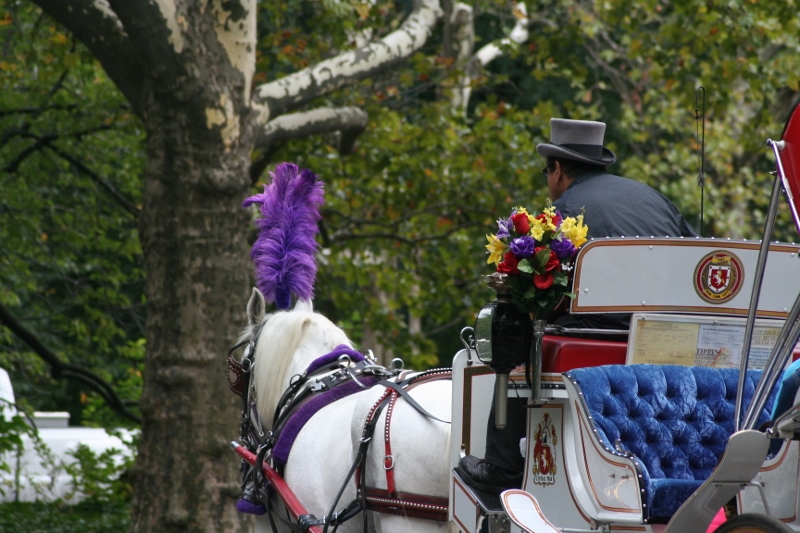
There are some flowers,
but mostly there is that
plume.
Central Park
Manhattan, New York
14 September 2013

Above and below the water line,
purple flowers grace
Bethesda Fountain
in Central Park.
31 August 2013
Anyone for tennis, wouldn’t it be nice?
Cream first posed the question in 1968. Today I came up with an answer.
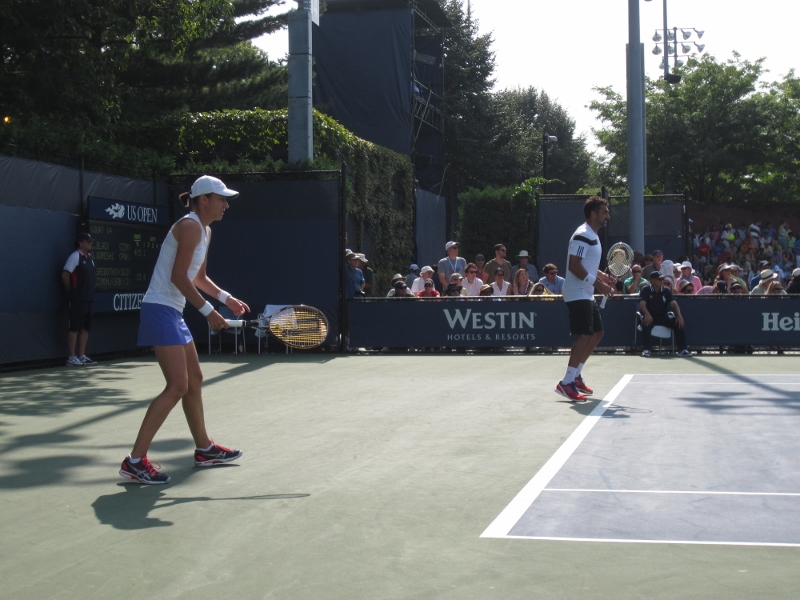 Many, many pounds and long ago, not as long ago as 1968 but long ago nonetheless, I enjoyed playing tennis. I never played competitively but I played regularly. Each evening I would jump on my bike and ride to the Grove City College tennis courts. Perhaps as many as 12 or 15 of us gathered. Our abilities varied, but we would play until dark.
Today – on a day when we held our breath while leaders of the United States pondered whether to attack Syria – on a day when colleagues faced serious illness – on a day when my heart and mind ranged many places – my son Eric and I attended the U.S. Open.
We watched men’s singles, men’s doubles, mixed doubles, women’s singles, and women’s doubles. We saw a bit of everything.
We saw a number of seeds win. And we watched an upset of the top seeded mixed doubles team.
I came to realize that doubles is an amazing, fast-paced, and exciting.
I learned that my old doubles strategy of serving the ball into the back of my doubles partner is not used by any of the top players.
We cheered. We laughed. We wandered through the grounds of the USTA Billie Jean King National Tennis Center.
It was nice!
See you along the Trail.
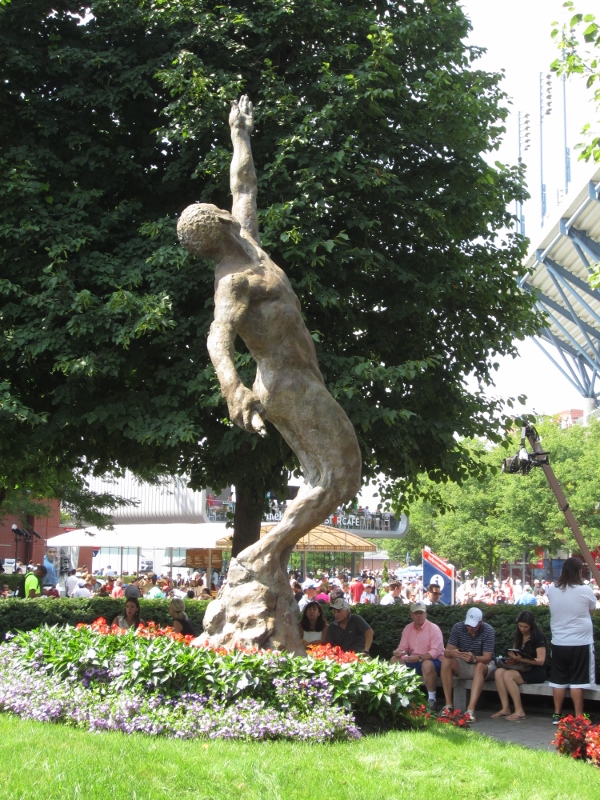
Purple flowers
surround the statue of Arthur Ashe.
30 August 2013
USTA Billie Jean King National Tennis Center
Queens, New York
The Dodgers have long since left Brooklyn, although my friend Jose insists they will return. That may happen someday.
 But baseball – part of our past in so many ways – remains part of our present in Brooklyn. A couple of strong throws and good relays away from Coney Island’s famed Cyclone, the Brooklyn Cyclones play. Affiliated with the New York Mets, the Cyclones play in the Class A Short-Season New York-Penn League. Interestingly enough, teams come from seven states, not just New York and Pennsylvania.
The Cyclones were league co-champions in their first season, 2001. They have not achieved such success since.
The team puts on a show: four mascots (as opposed to two umpires), cheerleaders, hot dog races, and more entertain fans between and during innings. Promotional giveaways happen often. I got a hat and a drawstring bag tonight. MCU Park puts fans right on the edge of the action. It also provides views of Coney Island rides, the beach, and the ocean. An awesome atmosphere.
And they play baseball.
Tonight, at the invitation of one of my summer interns, Marissa, and her father Bill, I joined members of Fourth Avenue Presbyterian Church and Bay Ridge United Church and watched the Cyclones beat the Vermont Lake Monsters 6-4.
Each team manufactured their runs from base-hits (and a couple doubles) and aggressive base running. Two spectacular catches took place in the outfield with a Cyclone player running into the wall and holding the ball. Errors and walks also played a role. The Lake Monster outfielders threw out two Cyclones at the plate. A Cyclone outfielder, trying for a play at third, threw the ball into the stands.
Vermont opened the scoring. The Cyclones came back and took the lead. I the eight, Vermont scored three times and went ahead. The Cyclones answered with three runs and retook the lead. They then held on defense to win the game.
They play baseball. And that is very, very good.
See you along the Trail.
 Along the Graybeard Trail