John 11:17-35
I Thessalonians 4:13-14
Grief and Hope
26 January 2020
The First Presbyterian Church of Whitestone
The Rev. Mark Koenig
Record albums. Do you remember them? Do you have any of them? Younger folk, do you know what I am talking about?
The word album to describe audio recordings appears to have come into use in the early 20th century. Early recordings were made on cylinders. In flat discs came into use. Record players were made with a flat surface on which the discs were placed. A needle sat on the grooves. The flat surface turned, sound came out of the speaker.
Recordings were made with a speed regulator that showed the speed when the recording machine was running. This allowed for other recordings to be copied at the same speed. And they could be played back at the same speed.
As with many new products, it took some time to create consistency. Around the turn of the century, the new recording industry settled on 78 rpm – revolutions per minute. Music historian Oliver Read writes: “The literature does not disclose why 78 rpm was chosen for the phonograph industry, apparently this just happened to be the speed created by one of the early machines and, for no other reason continued to be used.”[i]
The 78s as they came to be called could hold about 5 minutes of music. Albums were born in the early 20th century as individual records were collected in a bound book resembling a photograph album. Record albums continued to evolve until after 1948, they were made as single 12-inch records, pressed in vinyl, played at 33 1/3 rpm. They are now enclosed in a paper sleeve and put within a light cardboard cover that is uniquely decorated.[ii]
Music may be recorded on audio tape as cassettes. When I was in college, the music industry flirted briefly with something called 8-track tapes. I’m not sure how those worked. I confess I did not do any research about them. Compact discs were first released in 1982.[iii] All those media are referred to at times as albums.
Music fans often have their favorite media. My friend Alonzo, for example, insists the only way to listen to music is on vinyl record albums.
About four days ago, Alonzo posted a photo of himself on Facebook. He held an album that featured rapper Big Bank Hank. His face showed sorrow. On the caption, Alonzo wrote: “Oh no! I can’t believe he is dead.”
Denise, a mutual friend, gently wrote, “Big Bank Hank died in 2014, Alonzo.”
Alonzo admitted that he had forgotten. He cited old age as the cause. That worries me because he is much younger than I am. He went on to say, “It still hurts.”
Denise replied, “Grief hits when grief hits.”
Grief hits when grief hits.
For Jesus, grief hit as he stood outside the tomb of his friend Lazarus, brother of his friends Mary and Martha who lived in Bethany.
Jesus knew Lazarus would die. Mary and Martha sent him a message telling of their brother’s illness. Jesus stayed where he was for two days.
Then he told his disciples that Lazarus had died and they would go to Bethany. The disciples wondered about the timing and about going to Judea where the people were not all that pleased with Jesus and his message. But Jesus insisted.
Upon arriving in Bethany, Jesus and the disciples learned that Lazarus had been dead for four days. In separate conversations, Mary and Martha both said that if he had been there, Lazarus had would not have died.
Mary was weeping. Family friends were weeping. Jesus was “disturbed” and “moved” but he asked to be taken to the tomb, located in a cave.
There Jesus wept.
He had to know what would come next. Or at least have had some idea what might come next. He would have the stone before the cave removed. He would tell Lazarus to come out. Lazarus would come out.
Knowing that, Jesus wept.
Grief hits when grief hits.
We all know grief. We have experienced loss and grief individually and as a community over the past couple months. We know grief. It is how we respond to loss. Grief is our reaction and response to a broken bond of belonging. We grieve because we love. In many ways, grief is love when the person or ability or pet or musician or whomever or whatever it might be we love is gone.
We grieve loved ones who have died. We grieve our abilities vanishing through illness or age. We grieve children and family members leaving home. We grieve the paths we didn’t walk. We grieve things we did and things we failed to do. We grieve the suffering of humanity and the damage we inflict on God’s creation.
Grief acknowledges our values. We grieve to honor who and what is dear to us.
People share common elements in grief. We may weep as Jesus wept. We may ask questions. We may deny what happened. We may become angry, angry at ourselves, angry at our circumstances, angry at the loved one who died, even angry at God. We may try to bargain with God. Mary and Martha did a bit of this when they said to Jesus, “If only you had been here.” We may feel paralyzed and unable to function. We may blame ourselves. Guilt may threaten to overwhelm us. We may become overly social. We may want to withdraw completely.
Lutheran minister Granger Westberg did a great deal of research into grief. He notes that “no two people face even the same kind of loss in the same way”.[iv] Siblings grieve the death of a parent in different ways. Community members grieve the death of a beloved friend in different ways. We need to recognize that reality and allow one another the space to grief that each of us requires.
Ellen served as a chaplain at a women’s prison in Cleveland. When she first came to town, she would worship with Noble Road where Tricia and I served. Ellen could stay for most of our service before she had to leave to reach the prison. She often sat with Sean, our older son. Then she met Bob and I had the privilege of officiating at their wedding. After they had been married about a year, Ellen died. Unexpectedly. Too young. Of natural causes. I had the responsibility to officiate at her memorial service.
The Noble Road community gathered with ministers and elders from the presbytery and some people who worked at the prison, I said that we all loved Ellen, we all grieved for her loss, and no two of us would grieve the same way.
As a couple months passed after the service, I noticed that Ellen’s close friend Diana had missed a number of meetings and events that we should have attended together. Finally, I decided to call her. When I asked how she was, she replied that she was grieving. Then she said, “I am grieving in my own way. No two of us grieve in the same way. Did you listen to your sermon at all, Mark?”
Supporting family members and friends who grieve involves allowing them to take the lead. Listening. Gently asking questions. Meeting their requests and the needs they identify. Holding the space and providing the time they need to grieve.
Grief is the raggedy emotion. We never know what might snag our hearts and minds and cause us to grieve. It may be when we listen to music. It may be at holidays. Or dates that were important to us and the one we loved. Or when we see something that reminds us of a loved one. Or when we realize again that we cannot do something we once loved. We do not know what might lead us to grieve.
C.S. Lewis, the British lay theologian and author of The Screwtape Letters and The Chronicles of Narnia and more, never expected to marry. In 1950, he began a correspondence with American author, Joy Davidman. They were writers, they wrote each other letters. Joy moved to London in 1953. Lewis found her a place near his house. Three years later, the British government chose not to renew her visitor’s visa. In April 1956, Lewis and Joy married. A civil marriage so she could stay in the country. They continued to live in separate houses. As Joy walked across her kitchen in October of that year, she tripped and broke her leg. At the hospital, she received a diagnosis: bone cancer had metastasized from breast cancer. Facing tragedy, C.S. Lewis realized he loved Joy deeply and completely. They had a church wedding and lived together for almost four years – until her death.[v]
When Joy Davidman died, C.S. Lewis grieved. Grieved profoundly. He did not like grieve any better than anyone ever has. Lewis thought that grief might be lessened if he intentionally avoided the places he and Joy had frequented. In his walks, he went only those places where they had never been together. He switched grocery stores, tried pubs, walked only along streets and paths that he and Joy had never taken. But it didn’t work. Lewis discovered that Joy’s absences was “like the sky, spread over everything.”[vi] He could not escape grief. He had to grieve.
The Rev. Dr. Gordon Boak served as pastor of the church I attended in high school. I was a bit disillusioned when his daughter told me that he had never studied in Scotland. Still he was a good man and pastor. He played an important role in my faith development. When asked how a person might get over grief, Dr Boak responded that we never get over grief. We don’t get around grief. We don’t get under grief. We get through grief. We only get through grief by grieving.
When we suffer loses, we grieve. It is a price of love. We cry. We rage. We meditate. We sleep. We eat. We don’t eat. We talk. We find a counselor. We remember. We tell stories. We pray. We don’t pray. We do what we need to work through our grief.
From Blackfeet singer, songwriter, Jack Gladstone I learned what the Indigenous peoples of the Great Plains know about how bison survive the brutal snow and ice storms that whip across the land. When a blizzard comes, bison face the storm and then start walking into the storm. In so doing, the bison minimize their exposure and the damage they receive from the blizzard.[vii]
I don’t know if Dr. Boak or C.S. Lewis knew about bison or the wisdom Indigenous people share. But they made the same point. Face the storm. Only through our grieving can we move forward in life. Things will never be the same after loss. But by God’s grace, we can rebuild and life can be good again.
Is this easy? Of course not. It is hard painful work. We will need to rely on one another at times.
Our grief will last, in one form or another, forever. But so will our faith.
The Apostle Paul reminds us of a dimension of grief that followers of Jesus have. To the Thessalonians, to all followers of Jesus, to us, Paul writes: “But we do not want you to be uninformed, brothers and sisters, about those who have died, so that you may not grieve as others do who have no hope. For since we believe that Jesus died and rose again, even so, through Jesus, God will bring with him those who have died.”[viii]
Through Jesus Christ, we have hope as we grieve. Hope for resurrection and reunion. Hope that, even though we may not feel it with certainty at times, God sustains us and supports us. Hope that we can turn to one another in our grief for comfort and strength.
You may have heard me quote my friend the Rev. Dr. Margaret Aymer. On many occasions. She is a New Testament scholar and a seminary professor. I quote her often.
Today I am not going to quote Margaret, but I am going to quote her husband, Laurent Oget. An immigrant born in French Guiana. A computer geek, although wizard might be a better word. A musician, Laurent plays most of the different styles of saxophone.
While I was finishing this sermon yesterday, Laurent posted on Facebook. He had recently learned that Jean, a Canadian friend of his, had died. When he posted, Laurent’s grief took the form of anger. Jean died of cancer. Laurent had some strong things to say against cancer. He used a couple of colorful metaphors in doing so. Accurate metaphors. Metaphors I agree with. But too colorful to quote in church. If you have had a loved one die from cancer, or maybe die from or suffer from any disease, you may have said something equally similar.
After his anger Laurent, the musician, segued to hope. He knows the strength of community. He asked everyone who knew Jean to raise a glass of red wine in his honor. Then he asked everyone who read his post to tell our friends that we love them.
I did not know Jean. I suspect that is my loss. I do not drink red wine.
So church, to honor Jean and because it is true, I love you. Each of you. All of you.
In the face of loss, we grieve for who and what we love. And that may be hard. And grief will hit us when grief hits us. And the only way to deal with grief is to grieve. But as we grieve, we remember the hope that is ours through Jesus Christ. Thanks be to God.
Amen.
[i] Oliver Read, The Recording and Reproduction of Song, (Indianapolis, IN: 1952), pp. 12, 14, 15,.
[ii] https://en.wikipedia.org/wiki/Album served as the source for most of the information from the beginning of the sermon to this point.
[iii] https://en.wikipedia.org/wiki/Compact_disc
[iv] Granger Westbrook, Good Grief: A Companion for Every Loss, updated and expanded edition (Minneapolis, MN: Fortress Press, 2018), p. 29.
[v] https://en.wikipedia.org/wiki/Joy_Davidman#Life_with_C._S._Lewis
[vi] C.S. Lewis, A Grief Observed (London: Faber and Faber, 1961), pp. 11-12.
[vii] https://www.jackgladstone.com/faces-the-blizzard.html
[viii] I Thessalonians 4:13-14.



 Summer 2016. A Brooklyn Cyclones game with members of First Chinese Presbyterian Church. I have no idea of the score but in the eighth inning the end-of-game fireworks went off. We looked at each other in surprise. From the row behind me and about three seats to my left, Will Tsang said, “Work that into a sermon, Mark.” (The photo is from that night and was taken by Doreen Cheung.)
 The Plague was written by Albert Camus, who as my friend Alonzo Johnson
  As I reflect upon this anniversary, it occurs to me that I failed to mention one of the most important aspects of my relationship with Boxster. In a world filled with supporters of the Yankees and the Mets, Boxster shared my fondness for the Pirates. Miss you, buddy.
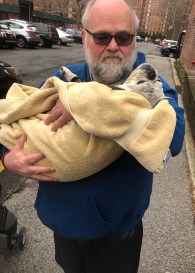 Then Nicole offered me the most incredible gift. She asked if I would like to meet them in the parking lot as they went back to their apartment. Of course, I said yes.

 Along the Graybeard Trail