The plan had been for this one to be the February 23 playlist with the last three songs marking the anniversary of the raising of the flag on Mount Suribachi.
Walking. Morningside Gardens. Joe Hill – Paul Robeson Bring It on Home to Me – Sam Cooke I Feel a Song – Gladys Knight & The Pips Rocking Chair Blues – Ray Charles It Hurts Me Too – Keb’ Mo’ Ring the Alarm – Beyonce Ebony Eyes – Stevie Wonder Rhythm Child – Carlos Jones and the Plus Band I Wish I Knew How It Would Feel to Be Free – Nina Simone Behind Enemy Lines – Dead Prez Love Revolution – Lenny Kravitz Three Miles Down – Gil Scott-Heron Harriet Tumban/Steal Away – Kim & Reggie Harris Freedom Road – The Blind Boys of Alabama Complexion – Kendrick Lamar Navajo Code Talkers – Jack Gladstone Ira Hayes – Peter LaFarge
This one proved a bit of a challenge. It started with remembering the killing of Malcolm X on February 21; then Nina Simone songs were added to mark her birthday on February 21; and finally, songs that John Lewis liked and songs by the SNCC Freedom Singers were added to honor his birthday also on February 21. No doubt some important events were missed. As the list was being developed, a cold was also brewing, combining that with some laziness, it took two days to work through the playlist.
Walking. Morningside Gardens. The Malcolm X Jazz Suite – Terence Blanchard The Opening Melody for Laura Theme for Elijah Blues for Malcolm The Nation Malcolm’s Theme Betty’s Theme Malcolm Makes Hajj Malcolm at Peace Perpetuity Malcolm’s Theme To Be Young, Gifted and Black – Nina Simone Mr. Bojangles – Nina Simone I Wish I Knew How It Would Feel to Be Free – Nina Simone Revolution – Nina Simone Backlash Blues – Nina Simone Respect – Aretha Franklin Happy – Pharrell Williams Ain’t Gonna Let Nobody Turn Me Round – The SNCC Freedom Singers Which Side Are You On? – The SNCC Freedom Singers This Little Light – The SNCC Freedom Singers
Walking. Penn Station. Morningside Gardens. Kenji – Fort Minor Summer of ’42 – Kishi Bashi Love’s Been Good to Me – Nina Simone Day Dreaming – Aretha Franklin In New Orleans – Lead Belly Part of My Life – India. Arie How Many More Years – Howlin’ Wolf Born to Fight – Tracy Chapman The Roadie Song – Aaron Neville Where Are the Keys to the Kingdom? – Sweet Honey in the Rock God Is Love – Marvin Gaye For Once in My Life – James Brown Oh Freedom – The Princely Players Fix Me Jesus – Bobby McFerrin Joshua Fought the Battle of Jericho – Paul Robeson Sing a Message to You – Earth, Winfd & Fire Sandra’s Smile – Blood Orange Might River – Mary J. Blige Stand Up – Cynthia Erivo
Walking. Morningside Gardens. Run, Run, Mourner Run – Sweet Honey in the Rock Drift Away – Dobie Gray Rock Steady – Aretha Franklin Deep River – Paul Robeson My Brother, My Brother – Aaron Neville Mean Old Bedbug Blues – Bessie Smith Airegin – Miles Davis You’re the Man – Marvin Gaye Breathin – 2Pac Heaven – John Legend Why? (The King of Love Is Dead) – Nina Simone Whisper You Love Me – Diana Ross & The Supremes Fight for Your Rights – Chili Most I Am Not My Hair – India.Arie
Walking. Penn Station. Morningside Gardens. Nature of a Sista’ – Queen Latifah When Doves Cry – Prince You Can’t Hurry Love – Diana Ross & The Supremes Hey Now, Hey Now – Cab Calloway Strength, Courage & Wisdom – India. Arie The One That Got Away – Carter Anderson Two Hearts – Earth, Wind & Fire Rock Island Line – Little Richard with Fishbone School Day – Chuck Berry What a Little Moonlight Can Do – Billie Holiday Turn over a New Leaf – John Lee Hooker Join the Band – Ranky Tanky 634-5789 – Wilson Pickett Wholly Holy – Aretha Franklin ELEMENT – Kendrick Lamar Love and Affection – Joan Armatrading The Party’s Over – Della Reese You Never Can Tell – Aaron Neville
Matthew 5:13-20 Where is the salt? 9 February 2020 The First Presbyterian Church of Whitestone The Rev. W. Mark Koenig
Whenever I hear our passage from Matthew, I have flashbacks to the Great Salt Panic of 2015. You remember that, don’t you? No? Here’s a refresher.
Tricia, Eric, and Essie came to New York to celebrate the holiday with Sean and me. We decided to eat at my apartment because I had a full-size oven. Tricia did the cooking. At some point, she opened the food pantry and asked, “Where is the salt?”
The salt.
Silence hung in the air as I framed my response. Years ago, I gave up adding salt to food. I did not give up salty foods. If you attended our October feast and counted the pretzels I ate, you know that. But I have not added salt to food either in cooking or on my plate for many years.
Where is the salt? Not in my apartment.
This posed a problem to whatever Tricia was making. She called Sean. On his way uptown, he stopped at a Duane Reade and bought some salt. Thanksgiving dinner proved a success. And that container of salt remains in the pantry. A full shaker sits on the table. Waiting for Tricia or the kids to come and use them.
Salt has a long and interesting history. It was once traded for gold. The early Chinese used coins of salt and in Europe some Mediterranean people used cakes of salt as currency.[i] During the time of the Roman Empire, and throughout the Middle Ages, salt carried such value that it was sometimes called “white gold.” Roman soldiers sometimes received pay in with salt instead of money. Because “sal” is the Latin word for salt, the soldiers monthly allowance became called “salarium”. Linguists say the process took a couple steps, but “salarium” eventually became “salary” in English.[ii] This then leads to the phrase that a worker is “worth her … salt.”
In India, the colonizing British passed a Salt Act in 1882 that prohibited Indians from collecting or selling salt. The Indian people could only purchase salt from the British. Who exercised a monopoly over salt’s manufacture and sale … and who benefited from the tax. As is the case with most economic injustice, the people living in poverty suffered the most although everyone needed salt.[iii]
To challenge British rule, Mohandas Gandhi determined to break the Salt Act. He organized a 240-mile march to the sea in March of 1930. There marchers would make their own salt. Thousands of people marched to the sea where, in defiance to the empire, they made salt. The movement grew. Millions more began to break the Salt Act. The British arrested some 60,000, including Gandhi. At the Dharasana Salt Works, nonviolent protestors were brutally beaten by police. The British released Gandhi from prison in January of 1931. The Salt Act was not abolished. But Gandhi participated as a negotiator at a conference on India’s future. Those negotiations did not go well. But sixteen years later India and Pakistan received independence. The door to that independence pushed open by nonviolent direct action over salt.[iv]
My Uncle Pete lives near Syracuse. He reminds me of the role that salt played in the history of the city. Millions of years ago, a sea covered central New York. As the sea evaporated, it left behind deposits of salt. The Onondaga people who lived in the area knew something was going on with some of the water in the area. Salt production began in the 1770s and continued until about 1900. During much of that time, Syracuse was a major, if not the major salt, producer in the United States.[v] Uncle Pete will proudly tell you that Syracuse is “The Salt City.”
Salt melts ice. Softens water. Creates a solution that when gargled can soothe a sore throat. Flavors food and beverages. I remember as a child my grandparents encouraging me to use salt to brush my teeth.
At the time Jesus lived, salt flavored food. Salt helped purify or cleanses meats through the removal of blood. It was used to help heal or cleanse certain ailments. And it preserved certain foods—meat or fish among them. The use of salt as a preservative was essential until the invention of refrigeration. The people who lived in first century Palestine knew all these uses for salt.[vi]
Salt also had ritual and symbolic uses at the time. People used salt in offerings and sacrifices. The Hebrew Scriptures refer twice to a “covenant of salt.” In one instance, this covenant is made between God and the priests. In the other, God makes such a covenant with the kings. According to the New Oxford Annotated version of the New Revised Standard Version of the Bible, this image most likely refers to the perpetual nature of the covenant because of salt’s preservative nature.[vii]
“You are the salt of the earth.” When the people who heard them from Jesus, they recognized he had said something important. He provided the people with an understanding of who they were and how they were to be.
“You are the salt of the earth.” They carry meaning for us today. With these simple words, Jesus tells us who we are and how we are to live.
It is important that we pay close attention to the words. We need to understand why Jesus said and what Jesus did not say.
Jesus does not say, “If you want to be salt, you have to do this, that, and the other thing.” Jesus does not say, “I will call you salt, if I see you behave in these ways.
Like the Beatitudes we considered last Sunday, Jesus’ words bring no requirement or conditions. “You are the salt of the earth.” They are blessing. Affirmation. Commissioning. They were blessing, affirmation, and commissioning for those who heard the Sermon on the Mount. They were blessing, affirmation, and commissioning for those who have read the Sermon on the Mount. They are blessing, affirmation, and commissioning for us. “We are the salt of the earth.”
Yes, Jesus goes on to say that “if salt has lost its taste, how can its saltiness be restored? It is no longer good for anything, but is thrown out and trampled under foot.”[viii]
Clearly Jesus never spent a winter in Western Pennsylvania. We trampled salt under foot many days. It was good. Often it was essential.
As I researched today’s sermon, I came across several authors who raised the question of “can salt lose its saltiness?” Or flavor or taste as some other versions of the Bible translate the term.[ix]
They answer salt does not. And if you have ever taken a sled down a blocked-off street in Western Pennsylvania and ended up in a snowbank where the salt truck had been, you would know. It still tastes like salt. These scholars believe that Jesus knew that salt does not lose its saltiness. And those who heard Jesus knew that salt does not lose its saltiness. They believe that by talking about “salt that has lost its taste,” Jesus underscores the reliability and resilience of the blessing he has bestowed. Lutheran pastor David Lose says Jesus tells his people, tells us: “You are the salt of the earth! That’s the way it is and that’s the way it will stay. Period.”
With this image, Jesus affirms our worth. We matter to Jesus. We matter to God. We have great value. God has gifted us and put us in this world to uses those gifts as well as we are able to flavor life with God’s justice, kindness, and love. The salt of the earth, we help preserve and bring healing and offer flavor according to God’s will. It is who we are. It is what we do.
What does it look like to live as salt?
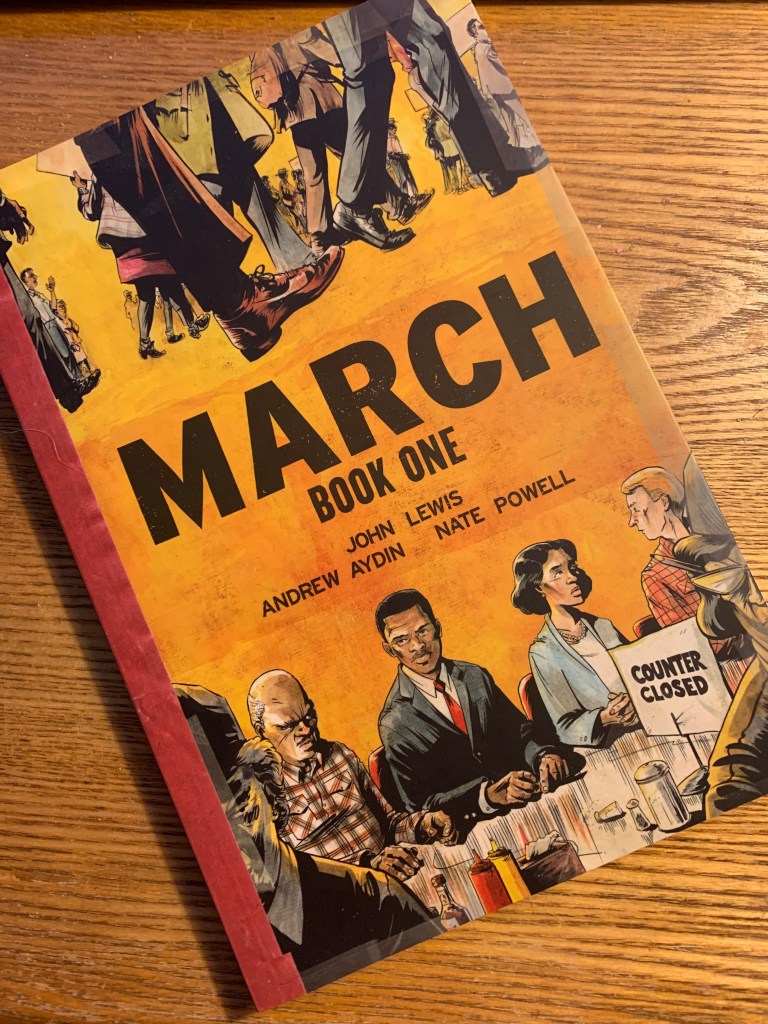
Congressman John Lewis from Georgia is a man of profound and deep faith in Jesus Christ. At one point, he considered entering the ministry. In his graphic novel, March: Book One, Lewis writes that as he cared for the chickens on his family’ farm, he preached to the chickens.[x] He participated in the Nashville Student Movement[xi] and became chairman of the Student Nonviolent Coordinating Committee in 1963.[xii] He was one of the original Freedom Riders.[xiii] He spoke at the March on Washington, before the Rev. Dr. Martin Luther King, Jr. and after the Rev. Dr. Eugene Carson Blake, stated clerk of the United Presbyterian Church.[xiv]
March: Book One
On March 7, 1965, civil rights activists began a march from Selma to Montgomery in Alabama to call for full voting rights for all people. John Lewis led the march. The marchers crossed the Edmund Pettis Bridge in Selma. There state troopers and a posse organized by the county ordered them to disperse. When the marchers did not, the “law enforcement” officials, including some on horseback, attacked with nightsticks and tear gas. Many marchers received severe beatings and injuries, including John Lewis.
Jump forward in time almost 55 years. On December 28, 2019 Congressman Lewis shared the news that he has Stage IV pancreatic cancer. He began his statement about the illness with these words: “I have been in some kind of fight – for freedom, equality, basic human rights – for nearly my entire life. I have never faced a fight quite like the one I have now.”[xv]
This past Thursday, the annual National Prayer Breakfast took place in Washington, DC. Congressman John Lewis (D-Ga.) received the invitation to deliver the closing benediction. He accepted, even though his fight against cancer meant that he had to appear by video.
As he spoke, Congressman Lewis quoted his friend and colleague, the Rev. Dr. Martin Luther King Jr., who said, “I have decided to stick with love, for hate is too heavy a burden to bear.” Congressman Lewis spoke of the brutal beating he endured in Selma. And then said, “But I never hated the people who beat me because I chose the way of peace, the way of love, and the way of nonviolence. For the God Almighty helped me.” His benediction ended with an admonition to the attendees, and to all the nation, to “go in peace, go in love, and we commit to treating each other as we would treat ourselves. Amen.”[xvi]
Peace.
Love.
Treating each other as we would treat ourselves.
That is how we live as salt, church. That is how we live as salt.
We may not have similar experiences to Congressman Lewis. But we have daily opportunities to live in peace, to love, and to treat each other as we would treat ourselves. We can love individually and as a congregation. We can love individuals and we can act for justice, love expressed in the public arena.
The First Presbyterian Church of Whitestone is the salt of the earth. We pray for one another, for our community, and for people and circumstances around God’s world. Aid people recovering from disasters. Support efforts to address gun violence and welcome refugees and provide food and water to the world. Help children in the Philippines enjoy a Christmas meal.
Individually, we can love and live in peace and treat people as we would like to be treated. We can love our neighbors – the people who live around us. We can help each other as we face challenges of life. Our work or our life at school can be done in kindness and in peace. We can listen patiently and prayerfully to one another in the pews around us, help meet each other’s needs, and serve Jesus together. And then we can do the really challenging ministry – loving our family, the people closest to us. That’s how Jesus commissions us to live.
Where is the salt? It’s you. It’s me. It’s us. By God’s grace, we are the salt of the earth. Amen.
Walking. Morningside Gardens. Thunder – Nuttin’ But Stringz My Life – Mary J. Bilge Crosstown Traffic Jimi Hendrix Real Real – Nina Simone Juneteenth – Cast of Black-ish Dizzy Atmosphere – Dizzy Gillespie Wholy Holy – Marvin Gaye Been in the Storm – Ranky Tanky We Shall Walk through the Valley – The Princely Players A Change Is Gonna Come – The Neville Brothers Left in the Dark – Carter Anderson Glory of Love – Otis Redding You’ll Have to Swing It – Ella Fitzgerald I Love the Rain – Lenny Kravitz Weepin’ Willow Blues – Bessie Smith Feelings Flowing – Smokey Robinson Wading Through – Terence Blanchard
Walking. Morningside Heights. Unless otherwise noted, all songs are by Ladysmith Black Mambazo. Nkosi Sikelel ‘IAfrica House of Exile – Lucky Dube Mandela – Hugh Masekela Nelson Mandela – Special AKA Izithembiso Zenkosi Kubi Ukungalaleli Uphi Umhlobo Yimani Silgugu Isiphambano Limnandi Izulu Ayanqikaza Amagwala Isimanga Salomhlaba Ungikhumbule Udia Nge’nduku Zabanye Lifikile Ivangeli Induku Zethu Isono Sami Sentombi Nomathemba Mdube Inkanyezi Nezazi Shosholoza Halala South Africa Thula Thula Go Well and Peace Be with You Nkosi Sikelel ‘IAfrica