Category Archives: First Presbyterian Church of Whitestone

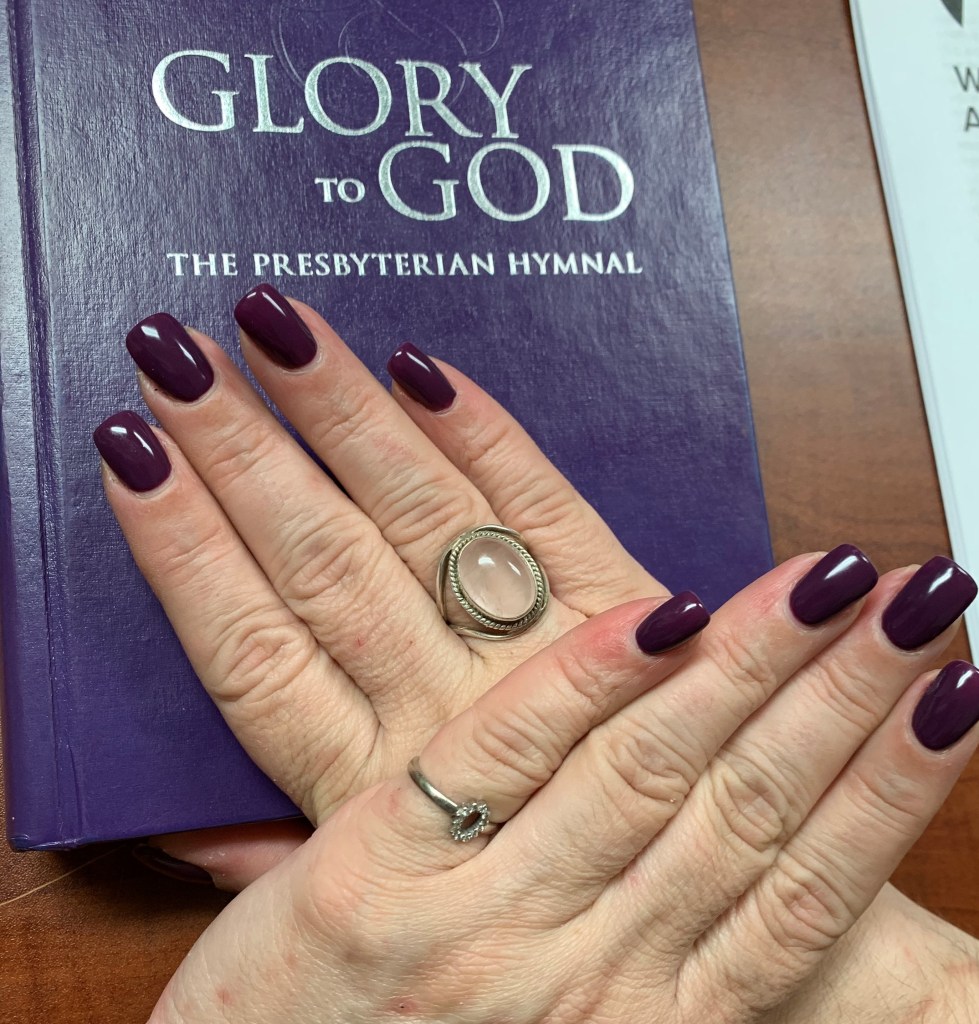
Purple, not flowers, fingernails & hymnal

10 March 2020
First Presbyterian Church of Whitestone

Leave a comment

Filed under First Presbyterian Church of Whitestone, Friends

Where’s the salt?

Matthew 5:13-20
Where is the salt?
9 February 2020

The First Presbyterian Church of Whitestone
The Rev. W. Mark Koenig

Whenever I hear our passage from Matthew, I have flashbacks to the Great Salt Panic of 2015. You remember that, don’t you? No? Here’s a refresher.

Tricia, Eric, and Essie came to New York to celebrate the holiday with Sean and me. We decided to eat at my apartment because I had a full-size oven. Tricia did the cooking. At some point, she opened the food pantry and asked, “Where is the salt?”

The salt.

Silence hung in the air as I framed my response. Years ago, I  gave up adding salt to food. I did not give up salty foods. If you attended our October feast and counted the pretzels I ate, you know that. But I have not added salt to food either in cooking or on my plate for many years.

 Where is the salt? Not in my apartment.

This posed a problem to whatever Tricia was making. She called Sean. On his way uptown, he stopped at a Duane Reade and bought some salt. Thanksgiving dinner proved a success. And that container of salt remains in the pantry. A full shaker sits on the table. Waiting for Tricia or the kids to come and use them.

Salt has a long and interesting history. It was once traded for gold. The early Chinese used coins of salt and in Europe some Mediterranean people used cakes of salt as currency.[i] During the time of the Roman Empire, and throughout the Middle Ages, salt carried such value that it was sometimes called “white gold.” Roman soldiers sometimes received pay in with salt instead of money. Because “sal” is the Latin word for salt, the soldiers monthly allowance became called “salarium”. Linguists say the process took a couple steps, but “salarium” eventually became “salary” in English.[ii] This then leads to the phrase that a worker is “worth her … salt.”  

In India, the colonizing British passed a Salt Act in 1882 that prohibited Indians from collecting or selling salt.  The Indian people could only purchase salt from the British. Who exercised a monopoly over salt’s manufacture and sale … and who benefited from the tax. As is the case with most economic injustice, the people living in poverty suffered the most although everyone needed salt.[iii]

To challenge British rule, Mohandas Gandhi determined to break the Salt Act. He organized a 240-mile march to the sea in March of 1930. There marchers would make their own salt. Thousands of people marched to the sea where, in defiance to the empire, they made salt. The movement grew. Millions more began to break the Salt Act. The British arrested some 60,000, including Gandhi. At the Dharasana Salt Works, nonviolent protestors were brutally beaten by police. The British released Gandhi from prison in January of 1931. The Salt Act was not abolished. But Gandhi participated as a negotiator at a conference on India’s future. Those negotiations did not go well. But sixteen years later India and Pakistan received independence. The door to that independence pushed open by nonviolent direct action over salt.[iv]

My Uncle Pete lives near Syracuse. He  reminds me of the role that salt played in the history of the city. Millions of years ago, a sea covered central New York. As the sea evaporated, it left behind deposits of salt. The Onondaga people who lived in the area knew something was going on with some of the water in the area. Salt production began in the 1770s and continued until about 1900. During much of that time, Syracuse was a major, if not the major salt, producer in the United States.[v] Uncle Pete will proudly tell you that Syracuse is “The Salt City.”

Salt melts ice. Softens water. Creates a solution that when gargled can soothe a sore throat. Flavors food and beverages. I remember as a child my grandparents encouraging me to use salt to brush my teeth.

At the time Jesus lived, salt flavored food. Salt helped purify or cleanses meats through the removal of blood. It was used to help heal or cleanse certain ailments. And it preserved certain foods—meat or fish among them. The use of salt as a preservative was essential until the invention of refrigeration. The people who lived in first century Palestine knew all these uses for salt.[vi]

Salt also had ritual and symbolic uses at the time. People used salt in offerings and sacrifices. The Hebrew Scriptures refer twice to a “covenant of salt.” In one instance, this covenant is made between God and the priests. In the other, God makes such a covenant with the kings. According to the New Oxford Annotated version of the New Revised Standard Version of the Bible, this image most likely refers to the perpetual nature of the covenant because of salt’s preservative nature.[vii]

“You are the salt of the earth.” When the people who heard them from Jesus, they recognized he had said something important. He provided the people with an understanding of who they were and how they were to be.

“You are the salt of the earth.” They carry meaning for us today. With these simple words, Jesus tells us who we are and how we are to live.

It is important that we pay close attention to the words. We need to understand why Jesus said and what Jesus did not say.

Jesus does not say, “If you want to be salt, you have to do this, that, and the other thing.” Jesus does not say, “I will call you salt, if I see you behave in these ways.

Like the Beatitudes we considered last Sunday, Jesus’ words bring no requirement or conditions. “You are the salt of the earth.” They are blessing. Affirmation. Commissioning. They were blessing, affirmation, and commissioning for those who heard the Sermon on the Mount. They were blessing, affirmation, and commissioning for those who have read the Sermon on the Mount. They are blessing, affirmation, and commissioning for us. “We are the salt of the earth.”

Yes, Jesus goes on to say that “if salt has lost its taste, how can its saltiness be restored? It is no longer good for anything, but is thrown out and trampled under foot.”[viii]

Clearly Jesus never spent a winter in Western Pennsylvania. We trampled salt under foot many days. It was good. Often it was essential.

As I researched today’s sermon, I came across several authors who raised the question of “can salt lose its saltiness?” Or flavor or taste as some other versions of the Bible translate the term.[ix]

They answer salt does not. And if you have ever taken a sled down a blocked-off street in Western Pennsylvania and ended up in a snowbank where the salt truck had been, you would know. It still tastes like salt. These scholars believe that Jesus knew that salt does not lose its saltiness. And those who heard Jesus knew that salt does not lose its saltiness. They believe that by talking about “salt that has lost its taste,” Jesus underscores the reliability and resilience of the blessing he has bestowed. Lutheran pastor David Lose says Jesus tells his people, tells us: “You are the salt of the earth! That’s the way it is and that’s the way it will stay. Period.”

With this image, Jesus affirms our worth. We matter to Jesus. We matter to God. We have great value. God has gifted us and put us in this world to uses those gifts as well as we are able to flavor life with  God’s justice, kindness, and love. The salt of the earth, we help preserve and bring healing and offer flavor according to God’s will. It is who we are. It is what we do.

What does it look like to live as salt?

Congressman John Lewis from Georgia is a man of profound and deep faith in Jesus Christ. At one point, he considered entering the ministry. In his graphic novel, March: Book One, Lewis writes that as he cared for the chickens on his family’ farm, he preached to the chickens.[x] He  participated in the Nashville Student Movement[xi] and became chairman of the Student Nonviolent Coordinating Committee in 1963.[xii] He was one of the original Freedom Riders.[xiii] He spoke at the March on Washington, before the Rev. Dr. Martin Luther King, Jr. and after the Rev. Dr. Eugene Carson Blake, stated clerk of the United Presbyterian Church.[xiv]

March: Book One

On March 7, 1965, civil rights activists began a march from Selma to Montgomery in Alabama to call for full voting rights for all people. John Lewis led the march. The marchers crossed the Edmund Pettis Bridge in Selma. There state troopers and a posse organized by the county ordered them to disperse. When the marchers did not, the “law enforcement” officials, including some on horseback, attacked with nightsticks and tear gas. Many marchers received severe beatings and injuries, including John Lewis.

Jump forward in time almost 55 years. On December 28, 2019 Congressman Lewis shared the news that he has Stage IV pancreatic cancer. He began his statement about the illness with these words: “I have been in some kind of fight – for freedom, equality, basic human rights – for nearly my entire life. I have never faced a fight quite like the one I have now.”[xv]

This past Thursday, the annual National Prayer Breakfast took place in Washington, DC. Congressman John Lewis (D-Ga.) received the invitation to deliver the closing benediction. He accepted, even though his fight against cancer meant that he had to appear by video.

As he spoke, Congressman Lewis quoted his friend and colleague, the Rev. Dr. Martin Luther King Jr., who said, “I have decided to stick with love, for hate is too heavy a burden to bear.” Congressman Lewis spoke of the brutal beating he endured in Selma. And then said, “But I never hated the people who beat me because I chose the way of peace, the way of love, and the way of nonviolence. For the God Almighty helped me.” His benediction ended with an admonition to the attendees, and to all the nation, to “go in peace, go in love, and we commit to treating each other as we would treat ourselves. Amen.”[xvi]

Peace.

Love.

Treating each other as we would treat ourselves.

That is how we live as salt, church. That is how we live as salt.

We may not have similar experiences to Congressman Lewis. But we have daily opportunities to live in peace, to love, and to treat each other as we would treat ourselves. We can love individually and as a congregation. We can love individuals and we can act for justice, love expressed in the public arena.

The First Presbyterian Church of Whitestone is the salt of the earth. We pray for one another, for our community, and for people and circumstances around God’s world. Aid people recovering from disasters. Support efforts to address gun violence and welcome refugees and provide food and water to the world. Help children in the Philippines enjoy a Christmas meal.

Individually, we can love and live in peace and treat people as we would like to be treated. We can love our neighbors – the people who live around us. We can help each other as we face challenges of life. Our work or our life at school can be done in kindness and in peace. We can listen patiently and prayerfully to one another in the pews around us, help meet each other’s needs, and serve Jesus together. And then we can do the really challenging ministry – loving our family, the people closest to us. That’s how Jesus commissions us to live.

Where is the salt? It’s you. It’s me. It’s us. By God’s grace, we are the salt of the earth. Amen.


[i] https://mypages.iit.edu/~smart/smitcha1/lesson1.htm

[ii] https://www.npr.org/sections/13.7/2014/11/08/362478685/from-salt-to-salary-linguists-take-a-page-from-science

[iii] https://www.history.com/topics/india/salt-march

[iv] Ibid

[v] https://exploringupstate.com/story-syracuse-salt/

[vi] https://politicaltheology.com/the-politics-of-saltiness-matthew-513-20-amy-allen/

[vii] https://en.wikipedia.org/wiki/Covenant_of_salt

[viii] Matthew 5:13

[ix] http://www.workingpreacher.org/craft.aspx?post=1543; https://politicaltheology.com/the-politics-of-saltiness-matthew-513-20-amy-allen/; and http://words.dancingwiththeword.com/2014/02/you-are-salt-of-earth.html?m=1

[x] John Lewis, Andrew Aydi, Nate Powell, March: Book One  (Marietta, Georgia, 2013), pp. 26-28.

[xi] Ibid, pp 75-121

[xii] https://snccdigital.org/people/john-lewis/

[xiii] John Lewis, Andrew Aydi, Nate Powell, March: Book Two (Marietta, Georgia, 2015), pp. 32-33.

[xiv] https://en.wikipedia.org/wiki/March_on_Washington_for_Jobs_and_Freedom#/media/File:March-on-washington-jobs-freedom-program.jpg

[xv] https://johnlewis.house.gov/media-center/press-releases/rep-john-lewis-undergoing-cancer-treatment

[xvi] https://sojo.net/articles/personal-prayer-day-national-prayer-breakfast

Leave a comment

Filed under Current Events, Family, First Presbyterian Church of Whitestone, Human Rights, New York

Grief and Hope

John 11:17-35
I Thessalonians 4:13-14
Grief and Hope
26 January 2020
The First Presbyterian Church of Whitestone
The Rev. Mark Koenig

Record albums. Do you remember them? Do you have any of them? Younger folk, do you know what I am talking about?

The word album to describe audio recordings appears to have come into use in the early 20th century. Early recordings were made on cylinders. In flat discs came into use. Record players were made with a flat surface on which the discs were placed. A needle sat on the grooves. The flat surface turned, sound came out of the speaker.

Recordings were made with a speed regulator that showed the speed when the recording machine was running. This allowed for other recordings to be copied at the same speed. And they could be played back at the same speed.

As with many new products, it took some time to create consistency. Around the turn of the century, the new recording industry settled on 78 rpm – revolutions per minute. Music historian Oliver Read writes: “The literature does not disclose why 78 rpm was chosen for the phonograph industry, apparently this just happened to be the speed created by one of the early machines and, for no other reason continued to be used.”[i]

The 78s as they came to be called could hold about 5 minutes of music. Albums were born in the early 20th century as individual records were collected in a bound book resembling a photograph album. Record albums continued to evolve until after 1948, they were made as single 12-inch records, pressed in vinyl, played at 33 1/3 rpm. They are now enclosed in a paper sleeve and put within a light cardboard cover that is uniquely decorated.[ii]

Music may be recorded on audio tape as cassettes. When I was in college, the music industry flirted briefly with something called 8-track tapes. I’m not sure how those worked. I confess I did not do any research about them. Compact discs were first released in 1982.[iii] All those media are referred to at times as albums.

Music fans often have their favorite media. My friend Alonzo, for example, insists the only way to listen to music is on vinyl record albums.

About four days ago, Alonzo posted a photo of himself on Facebook. He held an album that featured rapper Big Bank Hank. His face showed sorrow. On the caption, Alonzo wrote: “Oh no! I can’t believe he is dead.”

Denise, a mutual friend, gently wrote, “Big Bank Hank died in 2014, Alonzo.”

Alonzo admitted that he had forgotten. He cited old age as the cause. That worries me because he is much younger than I am. He went on to say, “It still hurts.”

Denise replied, “Grief hits when grief hits.”

Grief hits when grief hits.

For Jesus, grief hit as he stood outside the tomb of his friend Lazarus, brother of his friends Mary and Martha who lived in Bethany.

Jesus knew Lazarus would die. Mary and Martha sent him a message telling of their brother’s illness. Jesus stayed where he was for two days.

Then he told his disciples that Lazarus had died and they would go to Bethany. The disciples wondered about the timing and about going to Judea where the people were not all that pleased with Jesus and his message. But Jesus insisted.

Upon arriving in Bethany, Jesus and the disciples learned that Lazarus had been dead for four days. In separate conversations, Mary and Martha both said that if he had been there, Lazarus had would not have died.

Mary was weeping. Family friends were weeping. Jesus was “disturbed” and “moved” but he asked to be taken to the tomb, located in a cave.

There Jesus wept.

He had to know what would come next. Or at least have had some idea what might come next. He would have the stone before the cave removed. He would tell Lazarus to come out. Lazarus would come out.

Knowing that, Jesus wept.

Grief hits when grief hits.

We all know grief. We have experienced loss and grief individually and as a community over the past couple months. We know grief. It is how we respond to loss. Grief is our reaction and response to a broken bond of belonging. We grieve because we love. In many ways, grief is love when the person or ability or pet or musician or whomever or whatever it might be we love is gone.

We grieve loved ones who have died. We grieve our abilities vanishing through illness or age. We grieve children and family members leaving home. We grieve the paths we didn’t walk. We grieve things we did and things we failed to do. We grieve the suffering of humanity and the damage we inflict on God’s creation.

Grief acknowledges our values. We grieve to honor who and what is dear to us.

People share common elements in grief. We may weep as Jesus wept. We may ask questions. We may deny what happened. We may become angry, angry at ourselves, angry at our circumstances, angry at the loved one who died, even angry at God. We may try to bargain with God. Mary and Martha did a bit of this when they said to Jesus, “If only you had been here.” We may feel paralyzed and unable to function. We may blame ourselves. Guilt may threaten to overwhelm us. We may become overly social. We may want to withdraw completely.

Lutheran minister Granger Westberg did a great deal of research into grief. He notes that “no two people face even the same kind of loss in the same way”.[iv] Siblings grieve the death of a parent in different ways. Community members grieve the death of a beloved friend in different ways. We need to recognize that reality and allow one another the space to grief that each of us requires.

Ellen served as a chaplain at a women’s prison in Cleveland. When she first came to town, she would worship with Noble Road where Tricia and I served. Ellen could stay for most of our service before she had to leave to reach the prison. She often sat with Sean, our older son. Then she met Bob and I had the privilege of officiating at their wedding. After they had been married about a year, Ellen died. Unexpectedly. Too young. Of natural causes. I had the responsibility to officiate at her memorial service.

The Noble Road community gathered with ministers and elders from the presbytery and some people who worked at the prison, I said that we all loved Ellen, we all grieved for her loss, and no two of us would grieve the same way.

As a couple months passed after the service, I noticed that Ellen’s close friend Diana had missed a number of meetings and events that we should have attended together. Finally, I decided to call her. When I asked how she was, she replied that she was grieving. Then she said, “I am grieving in my own way. No two of us grieve in the same way. Did you listen to your sermon at all, Mark?”

Supporting family members and friends who grieve involves allowing them to take the lead. Listening. Gently asking questions. Meeting their requests and the needs they identify. Holding the space and providing the time they need to grieve.

Grief is the raggedy emotion. We never know what might snag our hearts and minds and cause us to grieve. It may be when we listen to music. It may be at holidays. Or dates that were important to us and the one we loved. Or when we see something that reminds us of a loved one. Or when we realize again that we cannot do something we once loved. We do not know what might lead us to grieve.

C.S. Lewis, the British lay theologian and author of The Screwtape Letters and The Chronicles of Narnia and more, never expected to marry. In 1950, he began a correspondence with American author, Joy Davidman. They were writers, they wrote each other letters. Joy moved to London in 1953. Lewis found her a place near his house. Three years later, the British government chose not to renew her visitor’s visa. In April 1956, Lewis and Joy married. A civil marriage so she could stay in the country. They continued to live in separate houses. As Joy walked across her kitchen in October of that year, she tripped and broke her leg. At the hospital, she received a diagnosis: bone cancer had metastasized from breast cancer. Facing tragedy, C.S. Lewis realized he loved Joy deeply and completely. They had a church wedding and lived together for almost four years – until her death.[v]

When Joy Davidman died, C.S. Lewis grieved. Grieved profoundly. He did not like grieve any better than anyone ever has. Lewis thought that grief might be lessened if he intentionally avoided the places he and Joy had frequented. In his walks, he went only those places where they had never been together. He switched grocery stores, tried pubs, walked only along streets and paths that he and Joy had never taken. But it didn’t work. Lewis discovered that Joy’s absences was “like the sky, spread over everything.”[vi] He could not escape grief. He had to grieve.

The Rev. Dr. Gordon Boak served as pastor of the church I attended in high school. I was a bit disillusioned when his daughter told me that he had never studied in Scotland. Still he was a good man and pastor. He played an important role in my faith development. When asked how a person might get over grief, Dr Boak responded that we never get over grief. We don’t get around grief. We don’t get under grief. We get through grief. We only get through grief by grieving.

When we suffer loses, we grieve. It is a price of love. We cry. We rage. We meditate. We sleep. We eat. We don’t eat. We talk. We find a counselor. We remember. We tell stories. We pray. We don’t pray. We do what we need to work through our grief.

From Blackfeet singer, songwriter, Jack Gladstone I learned what the Indigenous peoples of the Great Plains know about how bison survive the brutal snow and ice storms that whip across the land. When a blizzard comes, bison face the storm and then start walking into the storm. In so doing, the bison minimize their exposure and the damage they receive from the blizzard.[vii]

I don’t know if Dr. Boak or C.S. Lewis knew about bison or the wisdom Indigenous people share. But they made the same point. Face the storm. Only through our grieving can we move forward in life. Things will never be the same after loss. But by God’s grace, we can rebuild and life can be good again.

Is this easy? Of course not. It is hard painful work. We will need to rely on one another at times.

Our grief will last, in one form or another, forever. But so will our faith.

The Apostle Paul reminds us of a dimension of grief that followers of Jesus have. To the Thessalonians, to all followers of Jesus, to us, Paul writes: “But we do not want you to be uninformed, brothers and sisters, about those who have died, so that you may not grieve as others do who have no hope. For since we believe that Jesus died and rose again, even so, through Jesus, God will bring with him those who have died.”[viii]

Through Jesus Christ, we have hope as we grieve. Hope for resurrection and reunion. Hope that, even though we may not feel it with certainty at times, God sustains us and supports us. Hope that we can turn to one another in our grief for comfort and strength.

You may have heard me quote my friend the Rev. Dr. Margaret Aymer. On many occasions. She is a New Testament scholar and a seminary professor. I quote her often.

Today I am not going to quote Margaret, but I am going to quote her husband, Laurent Oget. An immigrant born in French Guiana. A computer geek, although wizard might be a better word. A musician, Laurent plays most of the different styles of saxophone.

While I was finishing this sermon yesterday, Laurent posted on Facebook. He had recently learned that Jean, a Canadian friend of his, had died. When he posted, Laurent’s grief took the form of anger. Jean died of cancer. Laurent had some strong things to say against cancer. He used a couple of colorful metaphors in doing so. Accurate metaphors. Metaphors I agree with. But too colorful to quote in church. If you have had a loved one die from cancer, or maybe die from or suffer from any disease, you may have said something equally similar.

After his anger Laurent, the musician, segued to hope. He knows the strength of community. He asked everyone who knew Jean to raise a glass of red wine in his honor. Then he asked everyone who read his post to tell our friends that we love them.

I did not know Jean. I suspect that is my loss. I do not drink red wine.

So church, to honor Jean and because it is true, I love you. Each of you. All of you.

In the face of loss, we grieve for who and what we love. And that may be hard. And grief will hit us when grief hits us. And the only way to deal with grief is to grieve. But as we grieve, we remember the hope that is ours through Jesus Christ. Thanks be to God.

Amen.

[i] Oliver Read, The Recording and Reproduction of Song, (Indianapolis, IN: 1952), pp. 12, 14, 15,.

[ii] https://en.wikipedia.org/wiki/Album served as the source for most of the information from the beginning of the sermon to this point.

[iii] https://en.wikipedia.org/wiki/Compact_disc

[iv] Granger Westbrook, Good Grief: A Companion for Every Loss, updated and expanded edition (Minneapolis, MN: Fortress Press, 2018), p. 29.

[v] https://en.wikipedia.org/wiki/Joy_Davidman#Life_with_C._S._Lewis

[vi] C.S. Lewis, A Grief Observed (London: Faber and Faber, 1961), pp. 11-12.

[vii] https://www.jackgladstone.com/faces-the-blizzard.html

[viii] I Thessalonians 4:13-14.

Leave a comment

Filed under Family, First Presbyterian Church of Whitestone, Friends

World Communion Sunday 2019

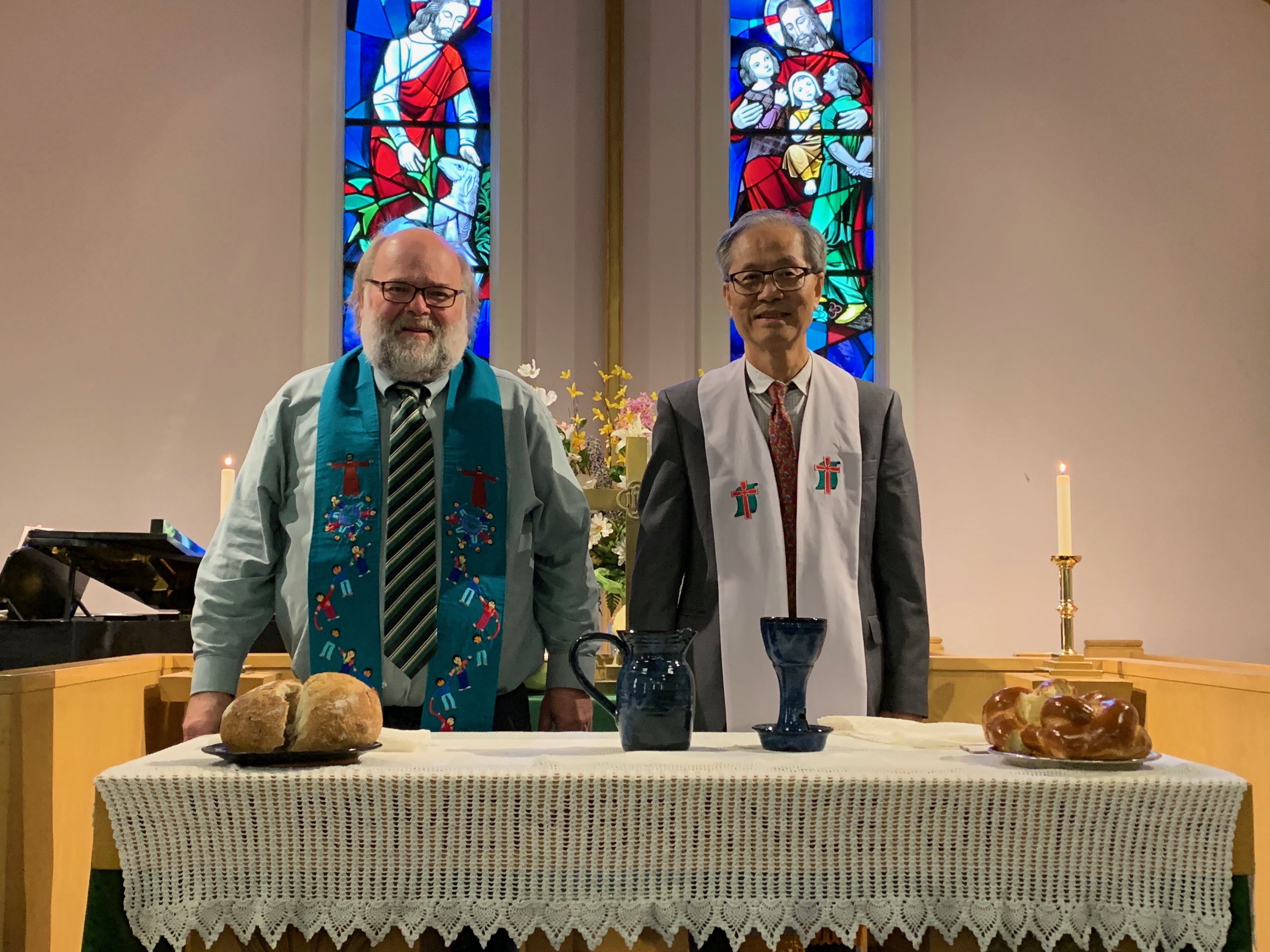
One of my favorite days of the year.  The First Presbyterian Church of Whitestone celebrated communion today. The Rev. Immanuel Bae officiated with me. Thanks to Anne Marie Russo for the photo.

IMG-0621

Leave a comment

Filed under Current Events, First Presbyterian Church of Whitestone, Friends, Worship

Keep Faith

Keep Faith
4 August 2019
First Presbyterian Church of Whitesone
The Rev. Mark Koenig

This sermon was put together on the morning of Sunday, August 4, 2019 between about 8:00 AM and 11:00 AM. The scripture planned for the day was Luke 12:13-21. It is referenced in the sermon but does not serve as the text in the traditional sense. Beginning with the quote by the Rev. Dr. J. Herbert Nelson the material is adapted from a sermon originally preached in February, 2019. Apologies if I quoted anyone without attribution. What follows is a reconstruction based on the notes taken into the pulpit.

When Wiley likes one of my sermons, he shakes my hand and says, “You stuck the landing on that one, Mark.” I have a vision of a graceful female gymnast, both feet hitting the floor. Arms extended. Her smile filling the auditorium.

I like that. But I don’t usually think of myself as particularly graceful.

Today, I have a feeling the sermon may more closely resemble my breaking the springboard for the vault, knocking over the pommel horse, staggering away, hitting my head on the rings, walking into the supports for the parallel bar and bringing it down, careening into the balance bar, falling across it, and face-planting into the mat.

I am improvising today. At the church retreat, Leslie Mott talked about the importance of improvisation both in life and in ministry. It involves taking the situation we are given, saying yes, and making things work.

One form of improvisation for clergy involves being able to adapt to circumstances in the life of the congregation, the community, the nation and the world as we preach and lead worship.

I have done that before. Many times.

I remember sitting at the kitchen table in Iowa on a Sunday morning, cutting paper apart with scissors. Removing passages. Changing the location of paragraphs. Furiously scribbling notes and adding them. Pasting things together.

Sean was about two at the time. His eyes got bigger and bigger. Finally, he asked, “What is daddy doing?”

“Just rewriting his sermon,” Tricia assured him.

I have often rewritten sermons on Sunday mornings in response to circumstances.

Never before today have I done so in the back of an Uber.

Never before today do I remember a Sunday when there were two mass shootings within 24 hours of when I preached.

Reports from last night are that at least twenty people died in a Walmart in El Paso. The shooter may have been motivated by racial hatred. An Internet post that is believed to be his talked about hating people of color and the United States being “invaded”. He made his way from the Dallas area to El Paso – a diverse town that straddles the border and so has many Mexican-American residents and is often visited by people from Mexico. At least three of the people killed have been identified as Mexican citizens who had crossed from Ciudad Juárez to shop.

This morning’s report says that at least 9 people died in Dayton. The shooting took place in a popular nightclub area late last night. Details are only now emerging.

Last weekend 4 people died in a shooting in Gilroy, California. One person was killed and 11 wounded at a celebration in Brooklyn.

Groups that monitor gun violence note that at least 7 other mass shootings occurred since we last gathered in this sanctuary.

Those are shootings where at least 4 people are shot in the same incident. It does not include shootings of individuals. It does not include individual deaths by suicide.

My heart is shattered. My mind reels. I grieve. I grieve for those who died. For those who are recovering from wounds. For families blown apart in an instant. For first responders. For witnesses. For medical personnel. I grieve to hear reports that people in El Paso did not go to medical care or to family reunion centers because they feared that ICE might be there. I pray those reports are inaccurate, but I fear they are true. And I grieve for the evil that is revealed if they are.

I rage at a world where the obscenity of mass shootings happens again. And again. And again. One of the most painful memes I saw on Facebook either this weekend read along the lines of: “I will pray for those killed in today’s shooting. The most painful word in that sentence is today’s.”

My grief almost breaks me. My rage threatens to consume me. But I will not fail. I will not falter. I will never give up. I will rise again. I rise again because of my faith in Jesus Christ. On Christ, by Christ, with Christ, in Christ I stand.

Many words have already been written about the shootings. More will come.

Among the words that speak to me are these attributed to Representative Veronica Escober, congresswoman from El Paso. She says: “We have a hate epidemic in this country.”

I agree with that, but I would add, we have a racism epidemic in this country. We have a white supremacy epidemic in this country. We have a white nationalist epidemic in this country. Again and again, those who commit mass shootings are not people of color. They are not Muslims. They are not migrants whose status is out of order. They are white men. If our country wants to ban people to make us safer, we might consider banning people who look like me.

We have a hate, racist, white supremacist epidemic in this country.

But I interrupted Congresswoman Escobar and I need to allow her to reclaim her time. She goes on to say: “We respond with abundance and love.”

We will love. That was the end of my original sermon for this morning. I talked about the rich farmer in Jesus’ parable who was motivated by greed and self-interest and fear. Those were his economic principles. Jesus, as he tells the parable, presents an alternative economic vision.

When people speak about money and things economic, the phrase “the bottom line” often appears in the presentations and conversations. The bottom line: “the primary or most important point.”[i] The bottom line in Christ’s eternal economy is that God loves us. God loves us and will never let us go.

In response to the hate and evil of mass shootings, I will stand with Jesus. I will love.

I will think and I will pray.

But if we think with the insight and wisdom of the greatest sages of the ages, but fail to act in love, we are noisy gongs.

If we pray with the fervency of Mary (a member of the congregation who has a profound gift for prayer that she has nurtured through her 97 years) and other spiritual masters, but fail to act in love we are clanging cymbals.

Love is a verb. It moves. It acts. It responds. It disrupts. It challenges. It changes.

It is time for love. Personally, and publicly. It is time for justice. Love in action in public is justice.

What might we do?

We might contact our elected representatives. We might ask them to work for responsible gun policies. They may reply that the President will not change things. Then we can remind our elected officials that they work for us. And we want them to work to end gun violence. I will do that.

We might research candidates for elected office. Who is receiving contributions from the gun lobby? Perhaps we might vote to someone who does not. Perhaps we might contribute to someone who does not. Perhaps we might volunteer for someone who does not. I will do that.

We might contribute to organizations working for responsible gun policies. There are many. I will research them and determine where I would like to make a small gift. If the Session approves, the list can be shared in The Lift.

We might witness. Perhaps when I return we can organize a vigil.

We can welcome neighbors and build community across the wondrous diversity that God creates. We can interrupt racism and disrupt white supremacy and challenge white nationalism. I will try to do better.

We can examine our culture and the role violence plays in it. The Rev. Dr. J. Herbert Nelson, Stated Clerk of our General Assembly calls us to examine our culture. He notes that we live in a culture of violence. Violence has become a form of entertainment that ranges from

“toy guns and holsters, to movies and cartoons, to video games that simulate warfare and deaths by automatic weapons, including blood splatter. Violence on television provides actual blueprints for killing another person. And daily we watch the glamorizing of murder on our mobile devices and hear lyrics to songs declaring that there is something noble about killing another human being, including shooting the police.”[ii]

I was driving in Louisville a few years back with NPR on the radio. They were interviewing Dr. Cornell West about gun violence. In my head I was his one-person amen corner. “That’s right. Preach.”

Then he said something to the effect that, “Violence has become our new pornography. It entertains us. Stimulates us. Excites us.”

My video collection flashed before my eyes. And my amen corner said, “Slow down there, Dr. West. Now you are meddling.”

Preachers usually preach to ourselves when we are honest about what we are doing. I will consider what I use to entertain myself.

Mass shootings. Death by gun violence. This is a far cry from the Biblical vision of each person made in the image of God. Of each person beloved by God. Of the call of Jesus to transform a culture of violence to a culture of love and justice.

Followers of Jesus have sought to live according to his teachings both before the crucifixion and after the resurrection.

Reflecting on the Sixth Commandment, “You shall not murder,”[iii] John Calvin notes that each human life is loved and redeemed by God, and therefore, worthy of our love. He understands that in in this commandment violence and injustice, and every kind of harm from which our neighbor’s body suffers, is prohibited.[iv] Pro-actively, the commandment calls us to act to care for one another, protect each other, and do justice.

Those are some suggestions for responding to gun violence. They may prove helpful. They may not. Other ideas will be needed. The work will prove difficult. There is no other word for it. But it is work we as followers of Jesus must do. None of us can do it all. But everyone can do something.

To say nothing can be done is irresponsible. It breaks faith with those who have lost their lives to gun violence and those who wounded by gun violence and those who have lost loved ones to gun violence. It breaks faith with our ancestors famous and humble who faced situations of obscene injustice that violated God’s precious, beloved children and said, yes, yes, there is something I can do. It breaks faith with God who does new things. May we keep faith. May we love. May we work for justice. This day. And every day.

[i] https://www.merriam-webster.com/dictionary/bottom-line.

[ii] The Rev. Dr. J. Herbert Nelson, https://www.presbypeacefellowship.org/resources/sermon-the-difference-a-gun-can-make/

[iii] Exodus 19:13

[iv] Gun Violence and Gospel Values: Mobilizing in Response to God’s Call; approved by the 219th General Assembly (2010) of the Presbyterian Church (U.S.A.); developed by the Advisory Committee on Social Witness Policy (ACSWP); published in 2011; p. 9.

Leave a comment

Filed under Current Events, First Presbyterian Church of Whitestone, Gun Violence, Worship

Sanctuary: In Three Acts

Sanctuary: In Three Acts
Luke 11:1-4
Numbers 35:9-15
28 July 2019
First Presbyterian Church of Whitestone
The Rev. Mark Koenig 

Sanctuary. A safe place. A refuge. Act I.

You can find following story online in the Tennessean and other sources. Often, the stories include video.[i]

A man drove home in Nashville. His 12-year-old son sat beside him in the van. Did they notice the car following them? They certainly did when they pulled into their driveway and the car stopped behind them.

Two men got out and identified themselves as ICE agents. They showed no identification and they never gave their names. A statement from an ICE spokesman said the officers had a removal order based on misdemeanor convictions of the man.

The man and his family understood that ICE agents cannot enter a vehicle or a home without a warrant signed by a judge. Or unless they receive permission to enter. The man refused. His wife and neighbors alerted their friends and support community.

Neighbors arrived. Family arrived. Media arrived. Immigrant rights activists arrived. City council members arrived. Nashville police arrived, called by the ICE officers. They assessed the situation, learned they had no warrants for either the man or his son and determined their only role would be to keep the peace.

The man and his son stayed in the car. Because it was hot, neighbors brought gasoline so the man could keep the car air conditioning running.

Eventually, the ICE officers determined to leave. The neighbors formed a protective shield around the car that extended to the front door of the house. The son and then the father ran quickly inside. Family, friends, neighbors, all cheered.

The practice of sanctuary – providing a safe place of refuge is ancient. In scripture, the idea appears in the book of Numbers. Here God gives the Hebrew people instructions for their life together as they made a new beginning after leaving enslavement in Egypt.

The culture at the time was based on vengeance. If I murdered someone, that person’s family could take vengeance on me and on my family. Who could then take vengeance on that person’s family and away the cycle of violence could spin.

When the laws in Numbers establish that those who commit murder, and only those who commit the murder, could be put to death, they disrupted this cycle. The principle the laws established of “an eye for an eye” sought to define justice and minimize vengeance. And then Jesus came along and disrupted this principle with teachings of nonviolent responses to violence.[ii]

The laws established in Numbers took another step toward disrupting blood violence. The verses Beth read for us today talk about “a slayer who kills a person without intent.” In modern terms, we might speak about unintentional killing as involuntary manslaughter.[iii]

Cities of refuge were created for people who committed such acts. They could flee to one of these cities and be safe until a trial could be held.

Over time this understanding of providing a place of refuge – providing sanctuary grew. During the religious wars of the Protestant Reformation, worship spaces in churches came to be seen not only as sanctuaries where God was worshiped, they came to be seen as sanctuaries where people could flee to take refuge and safety from the violence.

In churches and barns and homes, the Underground Railroad provided sanctuary to people fleeing enslavement for freedom.

Japan and China went to war in 1937. On December 13, 1937, the city of Nanjing fell to the Japanese.[iv] The events that followed are known as the Rape of Nanjing. Between 40,000 and 300,000 Chinese people were killed. The numbers are contested. The people were killed brutally. Many were tortured. Perhaps as many as 20,000 women were raped.

Amid the horror, the Nanjing Safety Zone was established to offer sanctuary and refuge. Chinese and people in Nanjing from other countries helped create the Safety Zone. But scholars agree that the man who made it work was a businessman named John Rabe. Ready for a twist? John Rabe was German. John Rabe was the head of the Nazi Party in Nanjing. While his party was killing Jews and Slavs and gypsies and LGBTQ people by the millions in Europe, the sanctuary he helped establish and managed saved the lives of between 200,000 and 250,000 people in Nanjing.[v] Rabe was not a “good person”. He was a person who served an obscenely evil cause. But for a moment, he did the right thing.

During the Holocaust, many people provided sanctuary for Jews. Muslims in Albania among them.[vi] My friend Steve Yamaguchi tells about Chiune Sugihara, a Japanese diplomat who had served in China and Finland, and ended up at the time of the Second World War in a solo diplomatic post in Lithuania. He became an Orthodox Christian along the way. At his wife Yukiko’s strong urging, he signed visas saving over 6,000 Polish Jews. Sugihara summarized his actions by saying, “I may have to disobey my government, but if I don’t, I would be disobeying God.” His act of providing the sanctuary of Japanese ended his career as a diplomat. But within the Jewish community he is viewed with deep affection.[vii]

In the 1980s, people fled violence in El Salvador and Guatemala. They arrived in the United States as undocumented refugees. The Immigration and Naturalizations Service implemented a policy of returning people to their country without allowing them to apply for asylum. “On March 24, 1982, six congregations in Arizona and California declared themselves “sanctuaries” and began building communities of support for the growing number of refugees seeking asylum.”[viii] Other congregations across the country joined them. Other congregations and people of faith and good will joined in establishing safe places of refuge.

Fast forward to 2019. People come to the United State fleeing violence and poverty in their home countries. The book of Leviticus teaches the people of God to treat the foreigner as a citizen.[ix] Jesus proclaims that when we welcome the stranger, we welcome him.[x]

Yet our government’s responses seem designed to deny safety and refuge to those in need. Families are separated. Individuals are detained in horrific conditions. The processing of asylum requests and citizenship processes slows to a crawl or a complete stall. That happens to people on the border and it happens to people in the country. As do deportations. We have begun to hear stories of citizens detained and deported; of immigrant men and women who have served in the United States military being deported.

Conversations about sanctuary have been ongoing for some time, perhaps since as long ago as 2007. They have taken on renewed urgency recently. Some congregations have opened their doors and host people in their buildings. Other congregations provide them support. Some congregations make sure their neighbors know their rights in relation to ICE. Individuals volunteer to accompany neighbors to ICE check-ins or deportation hearings. There are a variety of ways for individuals and congregations to become involved.

I invite you to pray and think about this situation. If the Holy Spirit moves you to learn more; if God calls you to consider how you or we together might respond, let me know. We can set up a conversation to explore what we might do.

Sanctuary. A safe place. A refuge. Act II.

In 1969, legal segregation remained the rule across much of the United States. Among other places, swimming pools had signs saying, “White only.” Just five years earlier a famous photo was taken of a hotel manager pouring acid into a swimming pool filled an interracial group of young people who were trying to integrate the pool.[xi]

May 9, 1969. A gentle, peacemaking Presbyterian minister enters the set of his children’s television show he has developed. I have not been able to track down the video, so I don’t know if Mr. Rogers sings, “It’s a beautiful day in the neighborhood”. I don’t know if he goes to the closet and carefully takes off his coat and put on his sweater and then zips it all the way up and then halfway back down.

From both the online episode summary and the book Peaceful Neighbor, I do know that he carries a wading pool. After carefully explaining what the pool is, he takes it outside and fills it with water.

He says that “on hot days he enjoys soaking his feet in cool water.” As he sprays his feet with a hose, Mr. Rogers spots Officer Clemmons nearby and invites him to sit down and join him. When Officer Clemmons says he does not have a towel, Mr. Rogers says they can share. Officer Clemmons pulls up a chair. He takes off his boots and socks, and the camera provides a closeup of four feet sharing the same small pool. Two white feet. Two black feet. When they are done, Officer Clemmons and Mr. Rogers share the same towel to dry off.[xii]

Remember that Mr. Rogers is also the Rev. Rogers. He knows the story of the Last Supper as told in John’s Gospel. Where Jesus washes the feet of his followers and then dries them. Jesus does so to model for his followers loving service.[xiii] The Rev. Fred Rogers got the message.

By sharing a cool pool and a dry towel on a hot day with an African American police officer, Mr. Rogers demonstrated that we are made for each other. We are not made for separation and enmity. We are made for love. For those of us who know and love Jesus, Mr. Rogers made that demonstration out of the Gospel.

And for a moment. He created sanctuary. In a segregated world, Mr. Rogers made a safe place. A refuge.

Friends, whether it is with family, with friends, with church members, with people we know only a little, with people we have just met, we can create sanctuary.

When we listen or provide help when requested.

When we smile and act kindly.

When we act for justice, show mercy, and do our best to walk with God.

When we love.

And when we pray for each other. We create sanctuary.

May we heed the urgings of the Holy Spirit to do so.

Sanctuary. A safe place. A refuge. Act III.

“Lord, teach us to pray.” It was a request from his disciples to Jesus.

“Lord, teach us to pray.” In response, Jesus provided the words the church has adapted a bit over time, and we know as the Lord’s Prayer.

“Lord, teach us to pray.”

In prayer we turn to God. And God meets us, accepts us, loves us as we are. The gift of prayer is a gift of sanctuary. It is a safe place. A refuge.

As the Rev. Shawna Bowman posted on Facebook:

God hears our prayers,
broken prayers,
silent prayers,
angry prayers,
joyful prayers,
prayers given through tears,
prayers given with no conviction, rushed prayers,
prayers shouted with rage,
prayers that come from our deepest places,
prayers that connect us, one to another,
prayers that remind us that we belong to God.

Friends, pray. Open yourself to God. Tell God what is on your heart. Pray aloud. Pray in silence. Pray by thinking. Pray by calling images to mind … friends in needs … situations for which you are concerned.

Two ideas for how to pray when we need help.

First, Anne Lamott offers a three-fold pattern for prayer: Help. Thanks. Wow.[xiv]

God, help me with …

God, thank you for …

God, I stand in awe of …

Or we could use the prayer Jesus teaches us. Pray those familiar words again and again and again.

Pray. Knowing that when we pray for others, we help create a sanctuary for them.

Pray Knowing that however we pray when we take our lives—our joys—our concerns—our whole selves to God in prayer, God will take and shield us. And we will find a solace … a refuge … a safe place … a sanctuary there.

Thanks be to God. Amen.

[i] https://www.tennessean.com/story/news/2019/07/25/viral-video-ice-agents-tried-arrest-man-nashville-immigration/1828008001/ – this article, as well as other uncited online sources, provide the basis for the first eight paragraphs of the sermon.

[ii] Matthew 5:38-42

[iii] https://www.justia.com/criminal/offenses/homicide/involuntary-manslaughter/

[iv] http://www.eyewitnesstohistory.com/nanking.htm

[v] http://day1.org/614-who_is_my_neighbor and https://en.wikipedia.org/wiki/Nanjing_Massacre and https://en.wikipedia.org/wiki/John_Rabe

[vi] https://www.yadvashem.org/yv/en/exhibitions/besa/index.asp

[vii] http://day1.org/614-who_is_my_neighbor

[viii] https://religionandpolitics.org/2017/02/21/the-sanctuary-movement-then-and-now/

[ix] Leviticus 19:34

[x] Matthew 25:35

[xi] https://www.npr.org/2014/06/13/321380585/remembering-a-civil-rights-swim-in-it-was-a-milestone

[xii] Michael G. Long, Peaceful Neighbor: Discovering the Countercultural Mister Rogers (Louisville, KY: Westminster John Knox Press, 2015),p. 88.

[xiii] John 13:3-10.

[xiv] https://www.amazon.com/dp/B008EKMBDM/ref=dp-kindle-redirect?_encoding=UTF8&btkr=1

Leave a comment

Filed under First Presbyterian Church of Whitestone, Worship

#DMZpeacechain 3

58612963_10156642575144440_3294714235040301056_o

April 28, 2019
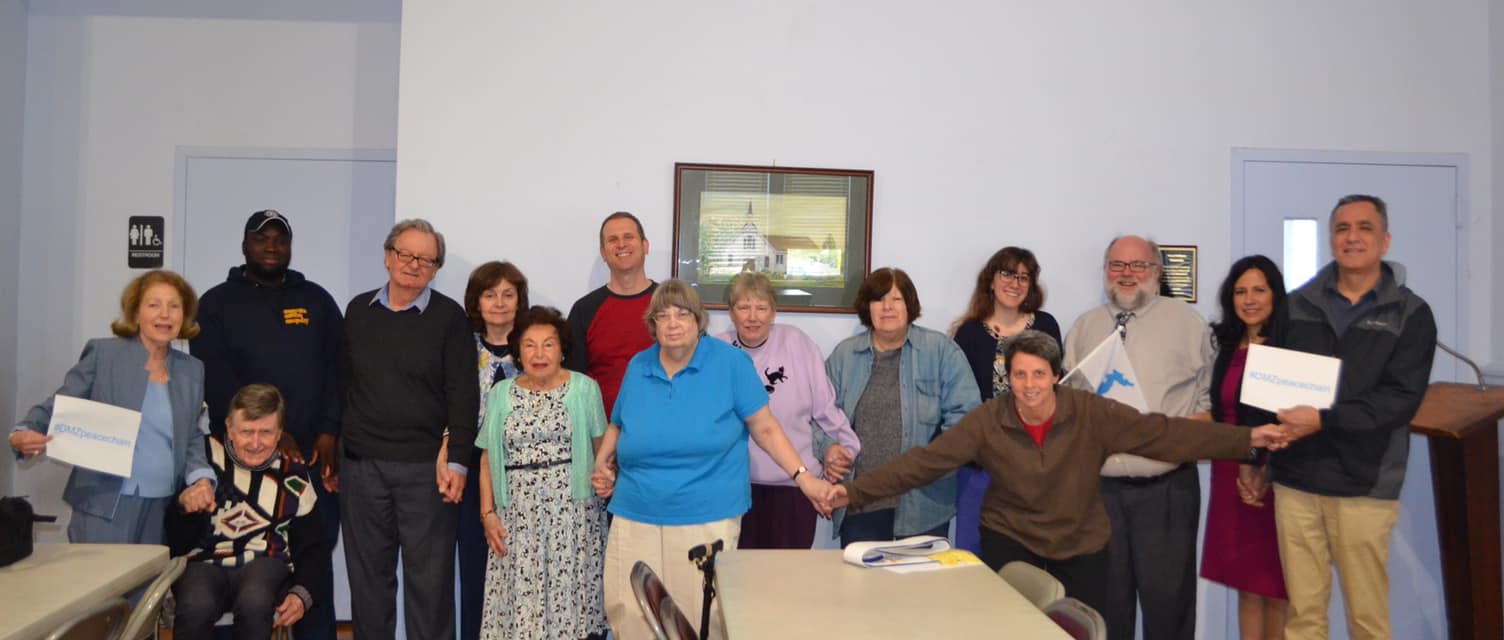
The First Presbyterian Church of Whitestone makes a #DMZpeacechain witness for peace on a reunified Korean Peninsula in New York City.
Photo by Lisa Sisenwein.

Leave a comment

Filed under Current Events, First Presbyterian Church of Whitestone, New York

Purple flowers, Whitestone 7

IMG-9019

First Presbyterian Church of Whitestone
Whitestone, New York
4 April 2019

Leave a comment

Filed under First Presbyterian Church of Whitestone, New York, Photo

Parkinson’s Unity Walk

I have registered for the 25th Parkinson’s Unity Walk on Saturday, April 27, 2019, in New York City’s Central Park and I’m reaching out to invite you to join me. I will be walking the team William the Conquerer with Bill Handler and his family. Check out last year’s team photo below.

Over one million people in the United States are living with Parkinson’s disease today – a number that continues to grow because every nine minutes, someone is newly diagnosed.

IMG_7298 (2)By joining the Unity Walk, together we can make a difference in the fight against Parkinson’s disease. One hundred percent of donations go directly to research funded by four Parkinson’s disease foundations in the United States. The Parkinson’s Unity Walk (EIN 13-3842415) is the largest single-day grassroots fundraiser for Parkinson’s disease research in the country. In addition to a 1.4-mile wheelchair-accessible walk, it is also a day of community and education.

Please support my fundraising efforts and donate to the Unity Walk for Parkinson’s disease research. To donate, please visit my fundraising webpage by searching for my name.

Whatever you can give will make a difference – every donation adds up. Together, we will find a cure, and I appreciate your support.

Sincerely,

William

P.S.  From my fundraising webpage, you can donate online and join me for the 2019 Parkinson’s Unity Walk. Thanks again for any support you can give.

You can also donate offline. Please make all checks payable and mail to:

Parkinson’s Unity Walk
PO Box 275
Kingston, NJ 08528

*If you donate offline, please include, “William Koenig, 2019 Parkinson’s Unity Walk” on the check memo line.

Leave a comment

Filed under Current Events, Exercise, First Presbyterian Church of Whitestone, Friends

Of Love and π

Luke 13:31-35
I Corinthians 13
First Presbyterian Church of Whitestone
March 17, 2019
The Rev. W. Mark Koenig

What comes to mind when you hear the word pie?

Perhaps your favorite pizza?

For me, the word takes me back to  childhood. My mother made better pies than cakes. We celebrated my birthday with chocolate cream. My brother chose Boston Cream. My sister blueberry. At least one of us made a semi-healthy choice.

Of course, mathematicians may think not of pie but of pi. Pi.  A number that designates the ratio of the circumference of a circle to its diameter.

In Greek, perimetros means circumference. Staying in Greek, Pi is the first letter in perimetros. Because of the influence of Greeks on early European mathematics, pi became the word used to describe this number.[i]

To put pi in numbers, one begins with 3.14. At some point in time, March 14 became known as Pi day. People share bad jokes. Bakeries and restaurants offer deals on pie.

Pi Day came last Thursday. I ate no pie. But I received reminders that Pi is both infinite.

Pi is infinite. It’s decimal representation never ends. It starts 3.14 and then goes on forever. Mathematician Emma Haruka Iwao recently computed over 31 trillion digits of pi. In an interview with the BBC, she said, “There is no end with pi, I would love to try with more digits.”[ii]

Reflecting on the infinite nature of Pi, reminds me of a conversation I had with a friend, Joanne Westin. Her teen-age daughter had died in a drowning accident. We talked of Jennifer and we talked of loss. And Joanne observed that, “Grief is infinite.” After a pause, she added, “And so is love.”

“Love bears all things, believes all things, hopes all things, endures all things. Love never ends.”[iii] Love is infinite, because God is love.

I know that. I believe that. I preach that. But I need to hear that this week. This heart-wrenching week.

29542890_10214989437271181_7380570066821968457_nIn Louisville, I worked with the Rev. Robina Winbush, our church’s staff person for ecumenical and interfaith relations. On Tuesday morning, returning from a visit with our church partners in the Middle East, Robina stepped from the plane and into the everlasting, ever-loving arms of God. As she deplaned at JFK, Robina collapsed. Airline personnel and EMTs could not revive her.

Tuesday evening, Mike Miller, the acting chief financial officer for the national church in Louisville, died of a massive heart attack.

53786357_10156864546396063_7080109362454200320_nWednesday evening, my phone buzzed with a text from Rex bearing the heartbreaking news that Byron Vasquez had died. A gentle, good man gone too soon, too young. Byron made a commitment and gave of himself to the United States – where too often the sin and hate of white supremacy “othered” him as it does to brown and black people.  Labelling him as “less than” and telling him to return to his country.

On Friday, New Zealand time, white supremacy struck in New Zealand. A man who posted a statement rooted in white supremacy and white nationalism, opened fire in the Masjid Al Noor and Linwood Masjid Mosque in Christchurch. As the Muslim community gathered to worship. As they prayed. At least 50 people died; many others were wounded. In the words of the New Zealand Herald:

“They are fathers, mothers, grandparents, daughters and sons.
They are refugees, immigrants and New-Zealand born.
They are Kiwis.”[iv]

Around the world, white supremacists distort the message of the Gospel in a effort to justify their heinous and heretical beliefs. The good news of Jesus Christ diametrically opposes any idea of supremacy. The idea that one group of people is supreme in any way violates everything that Jesus taught. It is a sin. Jesus calls us to love. To love God. To love neighbors. To love neighbors who love us. To love neighbors who do not love us. To love neighbors who have many similarities to us. To love neighbors from whom we differ in every imaginable way. Love, not hate, not division, not superiority, not supremacy. Love is the message of the Gospel.

Friday evening, my phone buzzed. Rex and Camilla’s friend Eugene Lloyd had died. Another good man gone.

A heart-wrenching week.

Our passage from Luke shows Jesus lamenting Jerusalem: “Jerusalem, Jerusalem, the city that kills the prophets and stones those who are sent to it!”[v]

Jesus goes on to express a desire to gather the city and its people in a protective embrace of love. “How often have I desired to gather your children together as a hen gathers her brood under her wings.”[vi] His lament continues as he acknowledges that will not happen. “You were not willing.”[vii]

Of course, we know the rest of the story. Jesus will proceed to Jerusalem. He will endure betrayal and denial. He will experience torture and execution. And three days later God will raise him from the dead. God’s infinite love will have the final word.

Valerie Kaur is a human rights activist and a member of the Sikh faith who knows something about love. She notes that the shooting in New Zealand transports her back to Oak Creek, Wisconsin. In 2012, a white supremacist opened fire at the gurdwara – the Sikh place of worship and gathering. The community was preparing their communal meal known as a langar. Kaur writes: “I see the blood of Sikh uncles & aunties in the prayer hall. What helped me breathe then… and now: love. Love as sustained practical care. Love as courage.”[viii]

At the Masjid Al Noor and Linwood Masjid Mosque, love as both courage and practical care were displayed. The first responders. People on the streets. I saw an interview with a woman who provided care to a wounded man. When told she was a hero, the woman responded. “I am not. I did what needed to be done.” That’s not a bad definition of a hero. It is certainly a definition of love.

Ava Parvin and her husband, Farid, left Bangladesh and settled in New Zealand in 1994. Farid grew ill and had to use a wheelchair. On Friday, as the terrorist aimed at Farid, Ara jumped in front of the bullets. He lived. She died. Love never ends.

Forty years ago, Haji Daoud Nabi fled war in his native Afghanistan and resettled his family in New Zealand. On Friday the 71-year old sat at the back of Al Noor Masjid. And when hate came through the door, Nabi shielded a friend with his body. Haji Nabi died. His friend lives. [ix] Love never ends.

Halfway through the shooting at the Al Noor mosque, Naeem Rashid rushed the shooter. He was killed. But in that instant, with no weapons, just his hands, he tried to stop the horror. [x] And when the shooter arrived at the Linwood Masjid, Abdul Aziz ran at him, throwing a credit card reader and then a gun that had been dropped. As the shooter drove away, Aziz continued to follow the car. Practical. Courageous.[xi] Love never ends.

My phone buzzed again on Thursday. The Session had begun the discussion that would result in the decision to receive an offering to help send Byron Vasquez’s body home. Words from a South African song from the days of apartheid went through my head:

Courage, our friend, you do not walk alone
We will walk with you, and sing your spirit home[xii]

Through our gifts, we will walk with Byron as his body returns to his home. Expressing the love that binds us together in Jesus Christ, we accompany Byron even as he is held in God’s eternal embrace of love.

I asked the Session if could I post about the offering on the church’s Facebook page and on my own Facebook page. I thought a friend or two might contribute.

Several have. Among them Janice Stamper. A Presbyterian minister, she left her church in Alaska to provide care for her aging father in Kentucky. After a lengthy illness, her father died a year ago. We prayed for her and “Ol Pap” as she called him. She sent me a message on Facebook asking how to mail a check. As I teared up, I typed back that this was amazingly kind. Jancie replied, “I sold my father’s truck. I have some money. People helped me bury my father. This is my turn to help someone else.” Love never ends.

In response to one of my first posts about the shooting in Christchurch, a friend wrote: “It’s a wicked world we live in, Mark.”

It’s a wicked world we live in. I have thought about those words ever since. I will probably continue to think about them for a long time to come.

And I don’t agree. I will stand with Louis Armstrong. We live in a wonderful world. God’s creation bears incredible beauty. People can be incredibly kind and loving. We experience tender mercies and moments of grace regularly.

People suffer. People die. People die suddenly and for reasons we may never understand. People die far too young. People die because they have difficulty accessing medical care.

Sin exists in this wonderful world. Evil exists. Wickedness, to use my friend’s word.

People do wicked things. Incredibly wicked things.

Systems and structures are shaped in ways that benefit some people and disadvantage and violate other people.

The world is broken and fearful and frightening.

In this broken, fearful, frightening world where sin, evil, and wickedness are so strong, I have chosen love. Or perhaps it would be more accurate to say God’s love has chosen me and in response I choose to love as well as I am able.

“We love because God first loved us.”[xiii] We find those words in the first letter of John. They are the essence of the Biblical narrative. Out of love, God creates. For love, God creates. God makes us to love God and one another and again and again, God invites us to love. And God acts to show us how to love. Jesus lived, died, and has been raised to show God’s love for us and to open us to love.

God embraces us in merciful love that extends to the whole human family. God challenges us to address the issue of “othering” people from whom we differ. Othering is what Byron and so many people experience when they are falsely told they have less value, they do not belong, there is something wrong with them because of where who they are. In the place of such othering, God invites us – demands from us that we see all people as our siblings.

Tommy Sands sings:

Let the circle be wide ‘round the fireside
And we’ll soon make room for you
Let your heart have no fear, there are no strangers here,
Just friends that you never knew[xiv]

Grace Ji-Sun Kim puts it in more theological language: “God sent the Son and the Spirit to descend into humanity’s darkness and despair, bringing the light of love and hope … As God has embraced us in merciful love, we now warmly embrace the wounded and the excluded in world as a testimony to the merciful love of the Triune God.”[xv]

Or as Robina Winbush wrote in a reflection published on Valentine’s Day, “Love is the essence of God in our midst … [in God’s] love we discover that there is no “other” there is only LOVE manifested and waiting to be known.”[xvi]

In this wonderful, wicked world, love has encountered me, love has grasped me, and I have said yes. As well as I am able, I will love. And in love’s name, I will work to end hate, disrupt white supremacy, and create justice, equity, and peace.

For those who make the choice to love, phones will still buzz. People, friends will die. Wickedness will take place.

Heads will spin. Hearts will ache. Pain and wounds will be endured.

We will be hard pressed. But not broken.

For love never ends.

Love never ends.

Thanks be to God,

Love never ends.

After a brief pause, I issued the following invitation:

Loved by God, we can love one another. We can love at any time. We can love at every time. We can love now. I invite you to greet one another in the love of God, the peace of Christ, and the fellowship of the Holy Spirit.


[i] https://en.wikipedia.org/wiki/Pi

[ii] https://www.bbc.com/news/technology-47524760

[iii] I Corinthians 13:6-7

[iv] https://www.nzherald.co.nz/nz/news/article.cfm?c_id=1&objectid=12213358

[v] Luke 13:34

[vi] Ibid

[vii] Ibid

[viii] https://auburnseminary.org/voices/auburn-senior-fellows-respond-to-christchurcheart-auburn-senior-fellows/

[ix] https://www.washingtonpost.com/world/2019/03/15/among-new-zealand-mosque-victims-parents-children-refugees/?utm_term=.7784361577c4

[x] https://www.stuff.co.nz/national/111335681/heroic-worshipper-tackled-gunman-at-linwood-mosque-during-christchurch-terror-attack

[xi] https://www.newsroom.co.nz/2019/03/17/492509/when-gunman-advanced-one-man-ran-at-him

[xii] My first experience of this song is the use of these lines in Eric Bogle’s song, “Singing the Spirit Home.” Here is a video of the song being sung – https://www.youtube.com/watch?v=JidpXcKZits – in an incredibly brave move, I led the congregation in singing the song today

[xiii] I John 4:19

[xiv] https://www.irish-folk-songs.com/let-the-circle-be-wide-lyrics-and-chords-by-tommy-sands.html

[xv] Grace Ji-Sun Kim, Embracing the Other (Grand Rapids, MI: William B. Eerdmans Publishing Company, 2015). P. 169

[xvi] http://blog.oikoumene.org/posts/love-the-very-essence-of-god-in-our-midst

4 Comments

Filed under Antiracism, Current Events, First Presbyterian Church of Whitestone, Friends, Gun Violence, Human Rights, New York, Presbyterian Church (U.S.A.), Worship