Category Archives: Current Events

All distance falls away

9fI5KHrvT86HktYTwp4A6Q

All distance falls away at the Lord’s table.

Today, with the First Presbyterian Church of Whitestone, I will celebrate and participate in virtual communion. We will spiritually connect as we physically distance.

To prepare, I offered the invitation to explore the meaning of communion by reflecting on past experiences of the sacrament. What did they have to teach us? What might we learn for today’s service?

Listening to myself for once, I did that. While I was washing the dishes, I recalled a communion service ten years ago.

During Holy Week of 2010, I took part in a meeting related to the Accompaniment Program of the Presbyterian Church in Colombia, the Presbyterian Peace Fellowship, and the Presbyterian Church (U.S.A.). Leaders in the Presbyterian Church of Colombia are taking great risks in their human rights work and their support of the communities of Colombians who have been displaced by the over forty years of violence in their country. They have asked Presbyterians from the United States to act as international accompaniers in order to provide a measure of safety—international eyes—for their work. The program started in 2004 and continues today. Over 100 accompaniers have served to date. Learn more about the program here:.

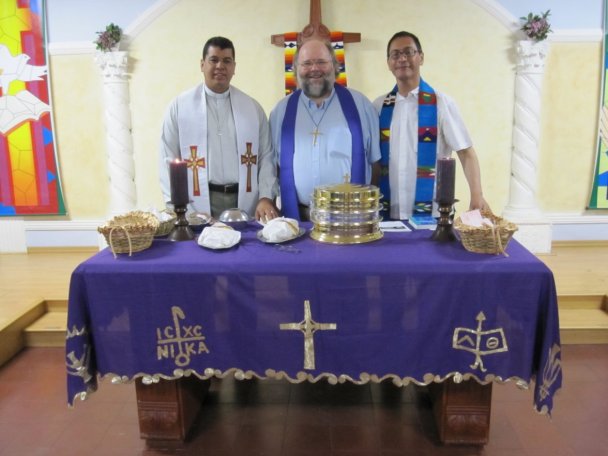
Since it was Holy Week, I had the privilege to worship with the Communidad del Camino in Barranquilla. The community honored me by inviting me to preach. Germán Zárate translated my words.

With the Rev. Adriano Portillo and the Rev. Dayro Aranzalez, I helped celebrate the sacrament of the Lord’s Supper.

The precious memory flooded over me as the water flowed over the dishes in my sink.

And I knew that whenever and wherever bread is broken and the cup is shared (in whatever form they take), the people of the Communidad del Camino, the people of the church in Colombia, the people of the church around the world, the people whose names I know, whose names I have forgotten, whose names I never knew, they all meet at the table. Miles apart, in Christ we are together.

Tonight, we gather at separate tables, scattered around Queens and Manhattan in my case. But in Christ, those tables become one—Christ’s table. Though physically distant, we gather in spiritual solidarity. And we gather with the church in all places and all times. One body. As we share in the meal Christ has prepared for us this night, I will remember that and smile.

All distance falls away at the Lord’s table.


Leave a comment

Filed under Current Events, First Presbyterian Church of Whitestone, Presbyterian Church (U.S.A.), Worship

A prayer when we are not OK

Gracious God,
help us remember that it is OK not to be OK.
We grieve.
We worry.
We fear.
Help us remember that it is OK not to be OK.
Frustration,
anxiety,
disquiet
swirl within us.
Help us remember that it is OK not to be OK.
Loneliness,
restlessness,
unease
fill our days.
Help us remember that it is OK not to be OK.
We wonder.
We doubt.
We dread.
Help us remember that it is OK not to be OK.
And help us remember you love us
you love us just as we are.
In Jesus’ name we pray. Amen.

7 April 2020
The Rev. W. Mark Koenig
with thanks to the Rev. Yena K. Hwang
who used the image “It is OK not to be OK”
at the 2018 Montreat Youth Conference

Leave a comment

Filed under Current Events, First Presbyterian Church of Whitestone, Prayer

A prayer of thanks

Dear God,

in times when I am frightened,

in days when I am discouraged,

in situations when I am unsettled,

even as I grieve for what is lost,

remind me to seek reasons to say

“thank you.”

Amen.

31 March 2020

Leave a comment

Filed under Current Events, Prayer

Candles, Fireworks, Hope

Romans 8:15-25
Candles, Fireworks, Hope
March 29, 2010
First Presbyterian Church of Whitestone
The Rev. W. Mark Koenig

“In hope we were saved. Now who hopes for what is seen? But if we hope for what we do not see, we wait for it with patience.”

I think a lot about hope these days.

Singer and activist David LaMotte wrote, “These are hard days in so many ways. Much of the time, it seems like the headlines are in competition for the worst news. … Being alive is hard work. Some days, I don’t feel hopeful.”[i]

David wrote those words two years ago. The need to think about hope goes with us always. It presses upon us with urgency in the age of Covid-19.

Be clear. Hope differs from optimism. Dramatically.

Optimism says things will get better; things will work out as we want; things will happen in a way that fits our desires and understandings.

Optimism is important. Envisioning we can do something often plays a critical role in allowing us to succeed.

Hope is not optimism. Writer and politician Vaclav Havel, who resisted the communist rule in Czechoslovakia and worked for a new future for his people said, “Hope is not prognostication. It is an orientation of the spirit.”[ii]

Hope is the conviction that however things turn out, life will make sense and all will be well even when we cannot imagine that will be. Hope lies beyond our selves, beyond our capacities. Hope lies in God.

Hope can be elusive, difficult to experience. A quick look at world events and the lives of people we love underscores that. Covid-19 highlights this reality in a dramatic fashion.

How then do we keep hope alive? How do we sustain hope that the world can be different, that we can be different? That our lives have meaning and purpose? That we can contribute to a more just, loving, peaceful society?

I don’t know that my thoughts and prayers about finding and nurturing hope have led to any absolute answers to those questions that will work for everyone. I have some ideas to share that help me understand and sustain hope. Perhaps they will prove of use to you.

Hope is relational. I cannot hope on my own. Relationships are key to hope. Hope is like lighting candles in the wind.

I had been in New York for a little over three months when the people of southern Sudan went to the polls in January 2011. The northern and southern parts of the country had engaged in violent conflict since before Sudan achieved independence. A peace had been brokered. The treaty provided that the people of the south could vote to remain part of Sudan or to become their own country.

An interfaith community gathered at the Church Center for the United Nations to pray for the people of Sudan as they voted. After prayer and scripture reading and song in the chapel, we went outside to light candles.

Cold and wind and big, wet snowflakes greeted us on the sidewalk along First Avenue. We lit our candles, but we had to work together to keep them lit. We relit each other’s candles when they went out. We used fingers and song sheets to shield the flames.

Lighting candles in the wind is relational. It takes a community. So does hope.

To hope, I need to be connected to God. I need to pray and read Scripture and worship. To hope, I need to be connected to others.

Hope is relational. It is experienced in the grace of God and in the wonder and love others who hope in me, hope for me, and hope with me.

Hope is surprising. I can open myself to hope. I can nurture hope. I cannot command or control hope.

13669846_1180325505322138_3800535346819562182_nSummer 2016. A Brooklyn Cyclones game with members of First Chinese Presbyterian Church. I have no idea of the score but in the eighth inning the end-of-game fireworks went off. We looked at each other in surprise. From the row behind me and about three seats to my left, Will Tsang said, “Work that into a sermon, Mark.” (The photo is from that night and was taken by Doreen Cheung.)

Check that challenge off the list. Hope, like eighth inning fireworks, is surprising.

If a baseball story isn’t convincing enough, here’s a Bible story.

Luke’s Gospel recounts that on the Sunday after Jesus’ death, two of his followers walked to Emmaus. The death of Jesus had crushed their hope.

As they walked, a third person joined them. They did not recognize the person, but we, who read the story now, realize it was the risen Christ. The story reminds us that Christ comes to us as we travel on the Emmaus roads of life, in hospitals resisting Covid-19, in jails and prisons, in nursing homes, at meal programs and homeless shelters, even in our homes today as we use telephones to worship. Wherever we are.

When they reached Emmaus, the followers of Jesus invited the third person to stay and the evening meal. As their guest, they asked the traveler to say grace.

The traveler. Took bread. Blessed it. Broke it. Gave it to them. They recognized him. Hope was reborn. And Jesus left them.

Hope comes in surprising, mysterious, unexpected ways. The moments do not last forever. Sometimes they do not last for long. But the moments may fill us and bless us and sustain us for living.

Hope may surprise us in a word in a sermon or in the lyrics of a song or in a passage of scripture. Hope may break through when we receive a kind word. Or when a family member or friend acts in an unexpected way; when we receive grace or mercy in the place of vengeance and punishment; when we welcome one another as God’s beloved children.

Hope may sprout when we hear of the consistent, persistent courage of first responders and medical personnel; the grace of the people who bag our groceries and who clean hospitals, medical facilities, and other essential places; the commitment of business owners who care for their employees in hard times.

Hope does not come through individuals who suggest that others should be sacrificed for the good of the economy. Hope most certainly comes—most certainly comes when individuals make sacrifices for one another.

A Minnesota state trooper stops a cardiologist for speeding. Instead of a ticket, the trooper gives the doctor some of his own N95 masks. Hope. In Italy, people step out on their balconies to make music for each other. Hope. People who live near a hospital in Vancouver open their windows to clap for the medical and support personnel at shift changes. Hope.

Because God, through Jesus, is the source of hope, we live in hope. We live in hope even when life is painful and challenging and horrifying. Hope is an act of resistance and resurrection. Hope says – let the worst happen, God is not done. God who creates and loves us; God who raises Jesus from death to life; God who pours the Holy Spirit out upon us; God will have the final word. And it will be a word of life and love and grace and hope.

“In hope we were saved. Now who hopes for what is seen? But if we hope for what we do not see, we wait for it with patience.”

Hope.

I have been thinking a lot about hope lately.

Like lighting candles in the wind, hope is relational.

Like baseball fireworks before the game ends, hope is surprising.

And rooted in God, hope is real.

Thanks be to God.


[i] https://www.davidlamotte.com/2018/hard-days/

[ii] https://www.vhlf.org/havel-quotes/disturbing-the-peace/

Leave a comment

Filed under Baseball, Current Events, First Presbyterian Church of Whitestone, Friends, Photo, Presbyterian Ministry at the United Nations, tennis, Worship

24 March 2020

Walking in the Shire.
El Padre Antonio Y’su Monaquillo Andres – Ruben Blades
Oscar Romero – Dafydd Iwan
Romero – The Project
Lay, Lady, Lay – Angelique Kidjo
Louie – Nizhoni Girls
Liwawechi – Miriam Makeba
The House That Jack Built – Aretha Franklin
Mercy/Gatekeeper – Hayley Kiyoko
Adam – Buffy Sainte-Marie
Mighty Sparrow – Sharon Shannon
Breakdown – Melissa Etheridge
Bien o Mal – Julieta Venegas
She Loves Control – Camila Cabello
Le Reve Du Queteux Tremblay – Eileen Ivers
Persona – Luna
Soul Makossa – Manu Dibango
Our Time – Merrily We Roll Along (the Playbill 30 Day Song Challenge – thanks Sean)

Leave a comment

Filed under Current Events, Exercise, Family, Music, New York, playlist

22 March 2020

Walking. Morningside Gardens. The Shire.
Water Is Life – Wanita Bird
The Sea – Morcheeba
Wade in the Water – Sweet Honey in the Rock
Rain Song – Sharon Burch
Shimmer, Prayer for Cleaning the Water – Joy Harjo
Where Peaceful Waters Flow – Gladys Knight & The Pips
River – Natalie Merchant
Cherokee River – Walela
I’m Going Down to the River of Jordan – Fannie Lou Hamer
Mighty River – Mary J. Blige
Orinoco Flow – Enya
Bridge over Troubled Water – Aretha Franklin
River Song – Stiff Gins
Proud of Your Boy – Aladdin (the Playbill 30-Day Song Challenge song – thanks Sean)

Leave a comment

Filed under Current Events, Exercise, Music, New York, playlist

We Are the Church

I Corinthians 12:12-27
First Presbyterian Church of Whitestone
22 March 2018
The Rev. W. Mark Koenig

We’ve never done it that way before. We’ve never done it that way before.

A minister comes to a new call direct from seminary with a fresh vision and untried ideas. A minister comes to a new call after years of experience in other have tested and reshaped vision and possibilities.

A Session meeting happens. With enthusiasm and handouts and video clips, the minister proposes a new program or a new way of doing ministry.

The people listen respectfully. The minister finishes. And silence ensues.

After what seems like an eternity, but is only 12.8 seconds, someone says, “Yeah … that’s interesting. We’ve never done it that way before.” And there the idea ends.

Today we worship in a way that at least I have never done before. As are congregations across the country and around the world we are finding new ways to live as church in the age of Covid-19. Ways we have never done before.

On this first day we worship apart, it seems essential to me to affirm that we are the church. On this day and on all the days ahead with whatever they may bring, we are the church.

As Paul reminded the followers of Jesus in Corinth, the church is first and foremost the Body of Christ. The people who have come to faith in Jesus and are bound together in his love and by God’s grace, in the power of the Holy Spirit.

“For just as the body is one and has many members, and all the members of the body, though many, are one body, so it is with Christ. Now you are the body of Christ and individually members of it.”

When we are together, we are the Body of Christ. When we are apart, we are the Body of Christ. Everyone on this phone call. Everyone we can call to mind—in other parts of the country or around the world. People we have never met and will never know. All are part of the Body of Christ. All are the church.

We are the church. Things have changed in this age of Covid-19. It is odd to preach looking at a phone instead of people. Other changes may occur in the days ahead. We don’t know.

But we know we are the church.

We are the church. We love God. We gather to worship by conference call. We will continue to explore ways to worship. We pray. I am sending a daily email with some form of prayer or spiritual nurture. Let me know if you are not receiving that. Pray in other ways. Read Scripture. Meditate. Sing. Sing as if no one is listening, goes an old saying. We can do that now. Find whatever ways keep you connected to God.

We are the church. We love neighbors. For those who can stay home, we love our neighbors by sitting on our couch. For those who have to go out, we show our love in the steps we take to show love and protect ourselves and others. For all of us, love is shown when we wash our hands and cover our mouths.

As we physically distance ourselves from one another, it is crucial that we socially connect. My friends Stephen and Laura learned of a family struggling to make ends meet. They shared the concern anonymously on Facebook and raised over $700 in small gifts. Susan is sewing face masks for a friend who is a nurse. We are going to ramp up our Flock program this week with Deacons and Elders checking on congregation members.

We can connect with family and friends. Call. Text. Send a card. I have four friends who are now working at home and caring for children. They feel a tad overwhelmed. I send them a simple text each week—no great solutions, just a  reminder that I am thinking of them. Facebook has issues but it is a way to remain in touch with each other and a broader community. Rex is willing to help you if you want to learn more about using Facebook. If we are financially able, we might consider buying a gift certificate at one of our favorite restaurants.

We can advocate for governments to respond to hateful, racist acts against Asian Americans. We can call the federal government to ensure that relief measures benefit people in need as well as corporations. We can prepare for the conversations that will be needed as our country recovers and restructures when the age of Covid-19 ends.

Keep looking for random acts of kindness and organized acts of justice that keep us socially connected while we physically distance ourselves.

We are the church. We love ourselves. We take care of ourselves. We ask for and accept help when we need it. If you need help, contact me or another member and we will do what we can. During the PAUSE as our governor calls us, learm something new. Practice a hobby. Laugh. Cry when tears are needed. Grieve when grief comes. Exercise. That gets tough. It’s 30 steps for a lap across and back my apartment. That’s 333 steps to get to 10,000. When I told my friend and trainer Nicole, she said: this is a perfect time to finally do those stretches I taught you. Eat well. Take a nap. Forgive someone. Forgive yourself. Give thanks to God daily.

We are the church. Much has changed. More will change. But we are the church.

There is a scene in The Lord of the Rings where Frodo, the hobbit, reflects on the challenges facing the community as he talks to Gandalf the wizard.

“I wish this need not have happened in my time,” said Frodo.

“So do I,” said Gandalf, “and so do all who live to see such times. But that is not for us to decide. All we have to decide is what to do with the time that is given us.”

I certainly wish Covid-19 had not happened. I wish it had not happened in my time. But it has. It is. This is the time we have been given.

We decide what we do with this time. But we do not decide alone. Wherever we are and however we gather as the First Presbyterian Church of Whitestone, we are the Body of Christ, bound together with followers of Jesus around the world. Jesus is with us. We are the church. Thanks be to God. Amen.


Leave a comment

Filed under Current Events, First Presbyterian Church of Whitestone, New York

The Plague and covid-19

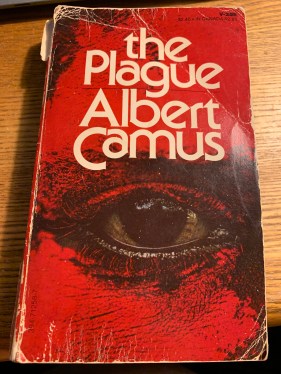
If I were to ask people to guess my favorite novel – the novel that has most influenced me, I think only a few people would get the right answer. The Lord of the Rings and Possessing the Secret of Joy come in high on the list, but they stand just short of The Plague.

IMG-1510The Plague was written by Albert Camus, who as my friend Alonzo Johnson points out was Algerian – his parents were French – but he was born in Algeria. The novel tells the story of a plague sweeping through the city of Oran. It explores the impact on people and how people respond.

Today my friend, Catherine Gordon, posted a link to a reflection on The Plague, Camus on the Coronavirus“.

The author writes: “But there can never be safety — and that is why, for Camus, we need to love our fellow damned humans and work without hope or despair for the amelioration of suffering. Life is a hospice, never a hospital.”

Even as an “at risk, vulnerable” person on PAUSE (yes – that is New York’s name for it) may I love; may I work to ameliorate suffering.

This day. And all days.

I have tracked down my copy, at least the third I have owned, and will read it again starting this evening. Related posts may follow.

Leave a comment

Filed under Books, Current Events, Friends, New York

Of needs and sharing

We thank you God for your love,
your love that accompanies us even in hard times.
We thank you for those moments of grace
when we experienced the sharing of your good gifts,
and for those moments of grace
when we shared what you had given to us.
In the living of these days,
grant us the wisdom to seek help
when we stand in any form of need;
inspire us to act in love when
you have given us something to share when
our family, our friends, our neighbors stand in need.
We pray in Jesus’ name. Amen.

Leave a comment

Filed under Current Events, First Presbyterian Church of Whitestone, Prayer

March 20 trip to the Bahama Deli

Walking well more than six feet away from any other human,
which was easy since no other human appeared in view,
I stopped at the light on the corner of Amsterdam and La Salle.
I lifted my eyes to the train
from whence came the roar of an uptown #1.
I looked into the part of the cars
I could see from that angle
and counted three people.
The train clattered past.
I paused in wonder
at how life has changed
before I crossed the empty street on red
and continued on my way.

Manhattan, New York
20 March 2020

Leave a comment

Filed under Current Events, New York, Poem