Category Archives: Worship

Never Left Alone

John 14:15-21
17 May 2020
The First Presbyterian Church of Whitestone
The Rev. Mark Koenig 

I have heard many sermons about love over the years. I have preached many sermons about love over the years. You have heard some of them. Today you will here one more.

Working on this sermon, I received some insight into why that happens. Statistics. Courtesy of Jaime Clark-Soles. Writing in the Feasting on the Gospels commentary, he notes that John’s Gospel uses verb forms of the word love fifty times, Matthew thirteen times, Mark six, and Luke fifteen. Nouns for love appear thirteen times in John, Matthew two times, and Luke sixteen.[i]

That totals 115 times. And that’s only in the Gospels. The Bible has 62 more books.[ii] To quote Fats Domino that’s a “Whole Lot of Lovin’”[iii]

In today’s passage from John’s Gospel, Jesus returns to love. John wrote these words some time after Jesus had returned to heaven. Perhaps as many as fifty years had passed. It is unlikely that anyone for whom John wrote had ever met Jesus. Most of the first followers of Jesus had died. The Rev. Dr. Thomas Blair notes that John’s “words of living hope” were addressed to “a community for whom Jesus was a holy memory.”[iv]

This morning we return to the upper room with Jesus and the disciples. He washed their feet. They shared a meal. And Jesus gave them a new commandment to love one another.[v]

After Judas left to betray Jesus. After Peter promised to lay down his life for Jesus. After Jesus replied Jesus that Peter would deny him. Three times. Before the morning came. After all that, Jesus returned to love.

“If you love me you will keep my commandments.”

Straightforward. Clear. Concrete. Leaves little doubt about what people  should do. But difficult. Complicated. Challenging. Even for us as individuals.

We often love. We celebrate a special man’s special day. We feed those who hunger. We say the kind word. We offer a shoulder to cry on. We write a letter to an elected official for justice.

But I join the Rev. Jill Duffield in confessing that when I look at the world, I do not always see a whole lot of lovin’ going on. The cross on which Jesus died provides the prime example that sometimes, love is met with violence. White supremacy and patriarchy are woven into the fabric of our society and deny equity to many people. COVID-19’s toll grows. The pandemic impacts nearly every aspect of life in almost every place. Rev. Duffield observes that we have reached the point that using, or not using face masks proves divisive.[vi]

Like those first disciples, we sometimes fail to act in love. Even the most loving relationships know challenges—particularly when we quarantine together as the days blur together. It is not easy. The age of COVID-19 has led to an increase in domestic violence around the world.[vii]

But the challenges do not need to rise to that level. A friend told me yesterday, “We all get grumpy from time to time. We have been short on patience with one another.” There are five members of his family. “It’s tough staying home and not being able to go anywhere.”

That happens to those of us who live alone too. I got somewhat testy on a Zoom meeting on Thursday. I raised my voice. Said some unkind things. Turned off Zoom and left the meeting. Fortunately, the problem was that the sound on my computer was not working. No one heard me. I stood up. Made another cup of coffee. Figured out a workaround and joined the meeting again.

“If you love me you will keep my commandments.”

I know I can’t live up to that all the time. I suspect I am not alone in feeling that way. I suspect his first disciples did. Love does not always lead to love. Again and again, they failed to understand what Jesus said. Again and again, they made mistakes. We do the same.

In our passage for today, Jesus addresses the challenge of living up to the commandment to love. He tells us that God will provide resources so his people can live faithfully.

“I will ask the Father, and he will give you another Advocate, to be with you forever. The Spirit of truth abides with you and will be in you.

“I will not leave you orphaned; I am coming to you. In a little while the world will no longer see me, but you will see me; because I live, you also will live.”

Jesus says that while he would no longer be seen teaching and healing, but his ministry and witness would continue. In his followers. In us. As difficult as it may be, when we love – Jesus will be revealed to the world.

And Jesus says we do not attempt to love in response to Jesus unaided. We are not abandoned. We are not orphaned. We are never left alone. God sends the Advocate, the Comforter, the Holy Spirit to bind us together in Christ. It is together that we can best love. It is together that we most nearly follow Jesus.

The Rev. Dr. Thomas Blair notes that a principle of mountain climbing helps illustrate this point. I have hiked up and down a couple of mountains following well-marked trails. In high school, I climbed Baldy Mountain in New Mexico with the Boy Scouts–over 12,000 feet up and down. I had more hair then. My whole family trudged down Mount Washington in New Hampshire one summer our sons were younger.

Both those experiences and any other close encounters I have had with mountains involved putting one foot in front of the other and staying on the trail. No equipment needed.

The Rev. Dr. Blair points out that on larger mountains and expeditions, climbers tie themselves to one another. They do so to keep from getting lost or from walking over a cliff. Climbers further say that when they are tied together – and when the going gets tough – and one of the climbers is tempted to say, “I have had enough,” they know they are physically connected. The rope commits them to one another. No individual can turn around and go home. On they go, step by step by step, carefully, surely, climbing up or climbing down together. [iv]

As we try to follow Jesus, we may have challenges loving. We may want to give up. Throw up our hands, say some words we don’t want any others to hear, and quit. Jesus knew this well.

“I will not leave you orphaned,” said Jesus. “I am coming to you.” We are made one by the Holy Spirit. One in the Spirit, we can trust in one who is greater than we can understand, to keep us moving on the journey of faith, to encourage us when believing seems absurd, to strengthen us when loving seems difficult.

We are God’s beloved children, in whom God delights. Jesus says if we love him, we will keep his commandments. We are never left alone; the Holy Spirit binds us to Jesus and to one another. One in the Spirit, one in the Lord, we can walk with each other. Sometimes hand in hand and sometimes six feet apart. We can work with each other. Sometimes side by side and sometimes at an appropriate physical distance. However we walk; wherever we work, the world will know we are Christians by our love.[ix] This day and every day. Amen.

[i] Jarvis, Cynthia A.; Johnson, E. Elizabeth. Feasting on the Gospels–John, Volume 2: A Feasting on the Word Commentary (Kindle Locations 5172-5176). Westminster John Knox Press. Kindle Edition.

[ii] https://www.presbyterianmission.org/what-we-believe/bible/

[iii] https://en.wikipedia.org/wiki/Whole_Lotta_Lovin%27_(Fats_Domino_song)

[iv] https://secondpresby.org/sermons/never-orphaned-never-alone/

[v] John 13:35

[vi] https://pres-outlook.org/2020/05/6th-sunday-of-easter-may-17-2020/

[vii] https://chescocf.org/wp-content/uploads/2020/04/Domestic-Abuse-Rises-Worldwide-New-York-Times.pdf

[viii] https://pres-outlook.org/2020/05/6th-sunday-of-easter-may-17-2020/

[ix] Peter Scholtes, “We Are One in the Spirit”, No. 300 in the Glory to God hymnal
Leave a comment

Filed under First Presbyterian Church of Whitestone, Worship

Freed to Love

John 20:19-31
The First Presbyterian Church of Whitestone

After the empty tomb; after the encounter with Mary Magdalene in the garden; the followers of Jesus gathered behind locked doors. They were afraid. Afraid without Jesus. Afraid of arrest. Afraid of death. Maybe even afraid of life:  afraid of what Jesus might ask of them if Jesus really were resurrected.

It seems appropriate to note that the disciples physically distanced themselves from the people gathered in Jerusalem. They met the qualification of not meeting in groups bigger than 10. Judas had left after the betrayal. And Thomas. Well Thomas was not there. Perhaps they could not score an InstaCamel or DonkeyPod delivery and he was out foraging. Perhaps he was grieving in his own way. We are not told. All we know is Thomas was not there.

Behind the locked door and beyond the fear, Jesus appears to them.  He gives them his peace. He breathes the Holy Spirit on them. He sends them into the world with work to do. It’s like group CPR.

The resurrection is for the purpose of re-creation after death, and re-creation before death. The resurrection is about the life to come. It is about this life. The resurrection of Jesus leads to the resurrection of his followers – the creation of the Church – so that through the power and ministry of our life together, the people of Jesus might become God’s continuing presence in the world.

“Receive the Holy Spirit,” Jesus says, and the stage is set . . . the disciples are ready to go . . . it is a new beginning in the great adventure of life in faith . . . except someone is missing. Thomas is not there. Jesus must come back and pick him up.  For no one can be forgotten. No one can be left out. The new life is for the people of Jesus . . . all the people.

Jesus returns when Thomas is present. Jesus displays his wounds. And Thomas believes. “My Lord and my God!” The words of Thomas serve as the basic affirmation of faith for followers of Jesus. And they serve as the basis for every formal affirmation that has followed.

This year, this passage resonates with me in ways it has never done before. Our lives parallel that of the disciples. Life after the execution of Jesus was not OK for first disciples. Life today is not OK for me. I venture it is not OK for you.

We grieve. Death. Dashed dreams. Lost hopes. Unmet expectations fill our individual hearts and our collective consciousness.[i] The other day, a friend responded to my “How are you” text with: “I had a long, ugly cry today.” I replied that one of my favorite songs features Rosey Grier, a gentle giant, former Pro Bowl defensive lineman singing, “It’s Alight to Cry.”[ii] We grieve.

We shelter in place. We pause. Out of a need to protect others and ourselves, we establish and maintain physical distances. We isolate and separate.

We fear. Writing in The Presbyterian Outlook, the Rev. Jill Duffield notes, “Our fear is utterly understandable. The death toll of this virus mounts. The extent of the economic fallout is yet to be determined, but we know it is, and will continue to be, huge. We’ve seen the suffering, the wounds inflicted, the crucifixion completed. No wonder we shelter in place in anxiety, with no sense of when the world will take a turn for the better.”[iii]

The similarities are striking. Psychologically, emotionally, even physically, we share  great deal with the first disciples. That’s where the Good News of this story finds us.

Christ the Lord is risen today. The gifts he brought his first followers behind locked doors, he brings to us.

The Rev. Duffield names those gifts. The Holy Spirit to inspire us. Hope in the face of fear. Peace amid chaos. Belief in life no matter how deadly the circumstances.[iv] A ministry and a mission.

And that brings us to Kelly Clarkson. I had to look her up. She won the first season of American Idol in 2002. I did not know that because I have never watched an episode of the show in all the years it has been on the air. Her victory led to a recording contract and launched her career as a singer-songwriter, actress, author, and television personality.[v] You may know more. I have told you everything I know.

Except. My friend So Jung Kim posted the news that Kelly Clarkson released a new song this week. “I Dare You.” She released six versions of the song in six different languages. Arabic, French, Hebrew, Spanish, German, and English.[vi]

Clarkson says the song is “about love and all its forms, in the face of adversity. Choosing to love instead of fear.”[vii] She believes that message will connect globally at this moment in time.[viii]

In English, the chorus says:

I dare you to love
Oh, I dare you to love
Even if you’re hurt and you can only see the worst
Even if you think it’s not enough
Oh, I dare you to love.[ix]

I believe that when the Risen Christ entered that locked room to meet the ten and then the eleven, he provided his followers what they – what we – need to take that dare.

In their fear, in the chaos, in their anxiety, the Risen Christ gave his followers the gifts they needed to love one another, to love neighbors, to love themselves, as God in Christ loved them. He freed them to love. He equipped them to love.

And he does the same for us.

Christ the Lord is risen today. The Risen Christ gives us the Holy Spirit, provides hope for our fears, peace in chaos, faith in life in deadly circumstances.[x] The Risen Christ does not magically make all our challenges and afflictions go away. Rather the Risen Christ equips us for the living of our days. And frees us to love.

Even when we are not OK. Especially when we are not OK. Jesus reminds us of God’s unending love for us – come what may, God loves us. And by the grace of God, we too can love. This day and every day, we are freed to love. Thanks be to God.

[i] https://pres-outlook.org/2020/04/2nd-sunday-of-easter-april-19-2020/

[ii] https://www.youtube.com/watch?v=Y52bs0aX6v8

[iii] Ibid.

[iv] Ibid.

[v] https://en.wikipedia.org/wiki/Kelly_Clarkson

[vi] https://www.countryliving.com/life/entertainment/a32187398/kelly-clarkson-new-song-i-dare-you-6-languages/

[vii] Ibid.

[viii] Ibid.

[ix] https://genius.com/Kelly-clarkson-i-dare-you-lyrics

[x] https://pres-outlook.org/2020/04/2nd-sunday-of-easter-april-19-2020/

Leave a comment

Filed under Current Events, First Presbyterian Church of Whitestone, Worship

Empty

John 20:1-10
Easter Sunday
April 12, 2020
First Presbyterian Church of Whitestone

Christ is risen.

We gather at the end of a Holy Week different from any other on an Easter Sunday different from any other.

Every year has unique features. Christians have observed Holy Week and Easter in periods of persecution, during armed conflict and war, and while plague ravaged the land.

Still Easter 2020; Easter in the age of COVID-19 differs widely and wildly from any Easter we and most followers of Jesus have celebrated.

No egg hunts. No visits with family. No trips to restaurants. No crowded gatherings around a table straining under the weight of a feast. No new clothes or bonnets for many of us.

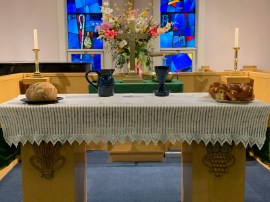
IMG-0618We gather in separate places today. Our church building stands empty for the moment. It does so not out of fear. As such buildings do across our country and around the world, that temporarily empty building on the corner of 149th and 15th offers a profound witness to our faith. It proclaims that we are a people of life even as we walk through the valley of the shadow of death. It represents an incredible act of revolutionary love, amazing grace, and spiritual solidarity. Thanks be to God.
Dr. William Brown of Columbia Theological Seminary points out that this year’s Easter celebration with a temporarily empty building may be among the most biblical Easters we have experienced.[i] The Easter proclamation of resurrection begins with the discovery of the empty tomb.

After the crucifixion, early on the first day of the week, in the darkness, John’s Gospel tells us that Mary Madgalene went to the tomb. Heart broken, soul sick, spirit sore, she made a lonely, courageous journey.

She went to see where they had placed her teacher, her friend. She went to pay her respects even after her death. She went because nothing else made sense.

At the tomb, she found the stone rolled aside. What more indignity can there be, she must have wondered? She went to get others. “They have taken the Lord out of the tomb, and we do not know where they have laid him.” Peter and the disciple “whom Jesus loved,” return to the tomb with her. Entering they find emptiness. No body of Jesus; only the cloths from his burial.

Each Gospel tells a slightly different version of the encounter with the empty tomb. They all share two common features. Women first. Women went to the tomb first. Women become the first to tell the good news. While the number varies from gospel to gospel, it is always small. Large numbers of followers did not cram together as close as they could on that day of resurrection. It began with a tomb emptied of death and women.

We know not how the resurrection of Jesus happened. No one witnessed God raising Jesus.

The resurrection of the followers of Jesus proved something more of a process. It did not happen in an instant. As the Rev. Denise Anderson notes, the “women who were first at the tomb to find it empty were rocked to their core. But even when they shared the news, the ones with whom they shared it weren’t instantly changed for hearing it. They hardly even believed it.”[ii]

The Rev. Anderson goes on: for the first followers of Jesus on that day of resurrection, “there was still grief. There was still despair. There was still anxiety. There was still waiting. Wondering. Worrying.”[iii] But. God had raised Jesus. God’s work had been accomplished. Christ was risen. Christ is risen.

Perhaps more starkly than have other Easters, this day reminds us that we live in the tension of believing in resurrection even as we feel keenly the impact of suffering and death. Much of what gave us balance and equilibrium in life has been smashed off kilter. We grieve. Uncertainty grips us. We find ourselves in a similar position to the women and the first followers of Jesus.

And  yet, we have the witness not only of Mary and the other women who went to the tomb. We have the witness of women through the ages … and some men, too. People who lived as Jesus calls us to live; people who loved who as Jesus called us to love. People who though stricken with grief and filled with fear, lived and loved. And in the living and in the loving, they encountered the risen Christ. As we live and as we love following Jesus, we too have encountered the risen Christ. We encounter the risen Christ now. We will encounter the risen Christ in the future.

Grief and doubt and fear do not deny the resurrection. They cannot.

Grief and doubt and fear do not indicate the absence of hope and faith and love; they are fellow travelers. They go together, as the Rev. Ben Perry notes.[iv]

Christ is risen, and we mourn for those who have died and we ache for those who are ill and we endure heartbreak for those who are abused, neglected, and forgotten.

Christ is risen, and COVID-19 grips our city and God’s world.

Christ is risen, and we can love one another.

Christ is risen, and there is work to do to ensure that all people in our society have access to safe homes, meaningful and safe work, health care, good food, and the necessities of living.

Christ is risen, and the Matthew 25 vision invites us to make sure that the least of the human family, the people pushed to the margins, receive our attention and our care.

Christ is risen, and the resurrection reminds us that the worst things are never the last things.[v]

Though we tremble at the tomb, though alleluias quaver on our lips, Christ is risen. This Easter day and every day may we know the words of Archbishop Desmond Tutu:

Goodness is stronger than evil;

Love is stronger than hate;

Light is stronger than darkness;

Life is stronger than death;

Victory is ours through Him who loves us.[vi]

Christ is risen.

People of the empty tomb, people of the temporarily empty building,

Christ is risen!

Alleluia.

[i] https://www.ctsnet.edu/the-life-giving-emptiness-of-this-easter/

[ii] This comes from a Facebook by the Rev. Tawnya Denise Anderson, coordinator for Racial and Intercultural Justice, Presbyterian Church (U.S.A.), on April 12, 2020.

[iii] Ibid.

[iv] This and the next several paragraphs are inspired by words written by the Rev. Ben Perry and posted on Facebook.

[v] Thanks to the Rev. Dr. Michael Granzen for this image.

[vi] Desmond Tutu, “Victory Is Ours” in An African Prayer Book (London: Hodder and Stoughton Ltd, 1995), p. 80.

Leave a comment

Filed under Current Events, Easter, First Presbyterian Church of Whitestone, Worship

All distance falls away

9fI5KHrvT86HktYTwp4A6Q

All distance falls away at the Lord’s table.

Today, with the First Presbyterian Church of Whitestone, I will celebrate and participate in virtual communion. We will spiritually connect as we physically distance.

To prepare, I offered the invitation to explore the meaning of communion by reflecting on past experiences of the sacrament. What did they have to teach us? What might we learn for today’s service?

Listening to myself for once, I did that. While I was washing the dishes, I recalled a communion service ten years ago.

During Holy Week of 2010, I took part in a meeting related to the Accompaniment Program of the Presbyterian Church in Colombia, the Presbyterian Peace Fellowship, and the Presbyterian Church (U.S.A.). Leaders in the Presbyterian Church of Colombia are taking great risks in their human rights work and their support of the communities of Colombians who have been displaced by the over forty years of violence in their country. They have asked Presbyterians from the United States to act as international accompaniers in order to provide a measure of safety—international eyes—for their work. The program started in 2004 and continues today. Over 100 accompaniers have served to date. Learn more about the program here:.

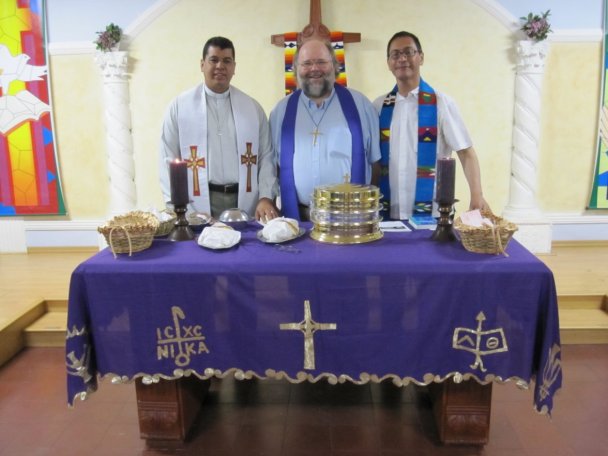
Since it was Holy Week, I had the privilege to worship with the Communidad del Camino in Barranquilla. The community honored me by inviting me to preach. Germán Zárate translated my words.

With the Rev. Adriano Portillo and the Rev. Dayro Aranzalez, I helped celebrate the sacrament of the Lord’s Supper.

The precious memory flooded over me as the water flowed over the dishes in my sink.

And I knew that whenever and wherever bread is broken and the cup is shared (in whatever form they take), the people of the Communidad del Camino, the people of the church in Colombia, the people of the church around the world, the people whose names I know, whose names I have forgotten, whose names I never knew, they all meet at the table. Miles apart, in Christ we are together.

Tonight, we gather at separate tables, scattered around Queens and Manhattan in my case. But in Christ, those tables become one—Christ’s table. Though physically distant, we gather in spiritual solidarity. And we gather with the church in all places and all times. One body. As we share in the meal Christ has prepared for us this night, I will remember that and smile.

All distance falls away at the Lord’s table.


Leave a comment

Filed under Current Events, First Presbyterian Church of Whitestone, Presbyterian Church (U.S.A.), Worship

Candles, Fireworks, Hope

Romans 8:15-25
Candles, Fireworks, Hope
March 29, 2010
First Presbyterian Church of Whitestone
The Rev. W. Mark Koenig

“In hope we were saved. Now who hopes for what is seen? But if we hope for what we do not see, we wait for it with patience.”

I think a lot about hope these days.

Singer and activist David LaMotte wrote, “These are hard days in so many ways. Much of the time, it seems like the headlines are in competition for the worst news. … Being alive is hard work. Some days, I don’t feel hopeful.”[i]

David wrote those words two years ago. The need to think about hope goes with us always. It presses upon us with urgency in the age of Covid-19.

Be clear. Hope differs from optimism. Dramatically.

Optimism says things will get better; things will work out as we want; things will happen in a way that fits our desires and understandings.

Optimism is important. Envisioning we can do something often plays a critical role in allowing us to succeed.

Hope is not optimism. Writer and politician Vaclav Havel, who resisted the communist rule in Czechoslovakia and worked for a new future for his people said, “Hope is not prognostication. It is an orientation of the spirit.”[ii]

Hope is the conviction that however things turn out, life will make sense and all will be well even when we cannot imagine that will be. Hope lies beyond our selves, beyond our capacities. Hope lies in God.

Hope can be elusive, difficult to experience. A quick look at world events and the lives of people we love underscores that. Covid-19 highlights this reality in a dramatic fashion.

How then do we keep hope alive? How do we sustain hope that the world can be different, that we can be different? That our lives have meaning and purpose? That we can contribute to a more just, loving, peaceful society?

I don’t know that my thoughts and prayers about finding and nurturing hope have led to any absolute answers to those questions that will work for everyone. I have some ideas to share that help me understand and sustain hope. Perhaps they will prove of use to you.

Hope is relational. I cannot hope on my own. Relationships are key to hope. Hope is like lighting candles in the wind.

I had been in New York for a little over three months when the people of southern Sudan went to the polls in January 2011. The northern and southern parts of the country had engaged in violent conflict since before Sudan achieved independence. A peace had been brokered. The treaty provided that the people of the south could vote to remain part of Sudan or to become their own country.

An interfaith community gathered at the Church Center for the United Nations to pray for the people of Sudan as they voted. After prayer and scripture reading and song in the chapel, we went outside to light candles.

Cold and wind and big, wet snowflakes greeted us on the sidewalk along First Avenue. We lit our candles, but we had to work together to keep them lit. We relit each other’s candles when they went out. We used fingers and song sheets to shield the flames.

Lighting candles in the wind is relational. It takes a community. So does hope.

To hope, I need to be connected to God. I need to pray and read Scripture and worship. To hope, I need to be connected to others.

Hope is relational. It is experienced in the grace of God and in the wonder and love others who hope in me, hope for me, and hope with me.

Hope is surprising. I can open myself to hope. I can nurture hope. I cannot command or control hope.

13669846_1180325505322138_3800535346819562182_nSummer 2016. A Brooklyn Cyclones game with members of First Chinese Presbyterian Church. I have no idea of the score but in the eighth inning the end-of-game fireworks went off. We looked at each other in surprise. From the row behind me and about three seats to my left, Will Tsang said, “Work that into a sermon, Mark.” (The photo is from that night and was taken by Doreen Cheung.)
Check that challenge off the list. Hope, like eighth inning fireworks, is surprising.

If a baseball story isn’t convincing enough, here’s a Bible story.

Luke’s Gospel recounts that on the Sunday after Jesus’ death, two of his followers walked to Emmaus. The death of Jesus had crushed their hope.

As they walked, a third person joined them. They did not recognize the person, but we, who read the story now, realize it was the risen Christ. The story reminds us that Christ comes to us as we travel on the Emmaus roads of life, in hospitals resisting Covid-19, in jails and prisons, in nursing homes, at meal programs and homeless shelters, even in our homes today as we use telephones to worship. Wherever we are.

When they reached Emmaus, the followers of Jesus invited the third person to stay and the evening meal. As their guest, they asked the traveler to say grace.

The traveler. Took bread. Blessed it. Broke it. Gave it to them. They recognized him. Hope was reborn. And Jesus left them.

Hope comes in surprising, mysterious, unexpected ways. The moments do not last forever. Sometimes they do not last for long. But the moments may fill us and bless us and sustain us for living.

Hope may surprise us in a word in a sermon or in the lyrics of a song or in a passage of scripture. Hope may break through when we receive a kind word. Or when a family member or friend acts in an unexpected way; when we receive grace or mercy in the place of vengeance and punishment; when we welcome one another as God’s beloved children.

Hope may sprout when we hear of the consistent, persistent courage of first responders and medical personnel; the grace of the people who bag our groceries and who clean hospitals, medical facilities, and other essential places; the commitment of business owners who care for their employees in hard times.

Hope does not come through individuals who suggest that others should be sacrificed for the good of the economy. Hope most certainly comes—most certainly comes when individuals make sacrifices for one another.

A Minnesota state trooper stops a cardiologist for speeding. Instead of a ticket, the trooper gives the doctor some of his own N95 masks. Hope. In Italy, people step out on their balconies to make music for each other. Hope. People who live near a hospital in Vancouver open their windows to clap for the medical and support personnel at shift changes. Hope.

Because God, through Jesus, is the source of hope, we live in hope. We live in hope even when life is painful and challenging and horrifying. Hope is an act of resistance and resurrection. Hope says – let the worst happen, God is not done. God who creates and loves us; God who raises Jesus from death to life; God who pours the Holy Spirit out upon us; God will have the final word. And it will be a word of life and love and grace and hope.

“In hope we were saved. Now who hopes for what is seen? But if we hope for what we do not see, we wait for it with patience.”

Hope.

I have been thinking a lot about hope lately.

Like lighting candles in the wind, hope is relational.

Like baseball fireworks before the game ends, hope is surprising.

And rooted in God, hope is real.

Thanks be to God.


[i] https://www.davidlamotte.com/2018/hard-days/

[ii] https://www.vhlf.org/havel-quotes/disturbing-the-peace/

Leave a comment

Filed under Baseball, Current Events, First Presbyterian Church of Whitestone, Friends, Photo, Presbyterian Ministry at the United Nations, tennis, Worship

What’s Our Thing?

.

What’s Our Thing?
John 4:4-30
First Presbyterian Church of Whitestone
15 March 2020
The Rev. W. Mark Koenig

I don’t know about you, but I have learned, or relearned, a great deal so far during this age of Covid-19 in the United States.

          I have learned, or relearned, about superheroes. They don’t all wear tights and capes.

A portrait of the author as superhero. No tights were involved

Superheroes wear medical gear. Nurses, doctors, technicians, researchers, medical care providers of all sorts.

          Superheroes wear work clothes. Janitors. Custodians. Cleaning services. Carry bottles of disinfectant and sanitizer. Clean our public places. Clean our streets. Check out our groceries. Deliver meals. Deliver packages.

          Superheroes wear uniforms. EMTs. Police. Firefighters. First responders of all shapes and size. Those who serve in our military.

          The people – all the people – who often labor in obscurity in ways I cannot remember or imagine or name this morning to make life better, fuller, more whole for us – they are the superheroes. They are your neighbors, whether you know their names or nor. They are your family. They are seated around you. They are you.

          I have learned, or relearned, about systems.

          We need a health care system that allows all people access.

          We need a public health system that can respond quickly, nimbly, creatively in moments of crisis and protects us all.

          We need an employment system that provides medical leave for all people and assists hard working people who fall on hard times.

          We need a housing system that provides a safe place for all people. That system must protect people who may receive abuse instead of love in their homes.

          We need a criminal justice system that protects the public at large but also respects the dignity and protects the lives of offenders.

          We need an economic system so structured that elected officials have no concern that closing schools will result in children going hungry. An economic system that responds to the needs of people more quickly than it responds to the corporations.

          I have learned, or relearned, about accepting responsibility.

          At 7:09 pm on April 12, 1945, the owner of a failed haberdashery from Independence, Missouri, who had only a high school education, was sworn in as President of the United States. On his desk, he placed a sign that read, “The buck stops here.” And while Harry S. Truman served as president the buck did stop there.

          I have learned, or relearned, that while none of us can do everything, all of us can do something.

          Zion Williamson is 19 years old. He plays basketball for the New Orleans Pelicans in the NBA. He makes more in one month from salary and endorsements than most people will earn in a lifetime. The NBA suspended the season on Wednesday. On Friday, Zion Williamson announced he would pay the salary of every Smoothie King Center employee – that’s where the Pelicans play – he would pay their salary for the next 30 days. Other players and teams have made similar gestures–both basketball teams and hockey teams. My son Eric’s favorite player – Kevin Love appears to have been the first – “Love” – how about that for fulfilling your name. Still one thing sets Zion Williamson apart. He is 19 years old.

          My guess is that none of us here make $10 million dollars a year. None of us has a list of endorsements longer than today’s bulletin. None of us own a sports team.

          But all of us can do something.

          My friend from high school, Nancy, suggests we make care packages for the 90-year-olds who live in our neighborhoods. Toilet paper. Lysol. Hand sanitizer. Leave it anonymously. If we are caught, Nancy suggests that the appropriate response is “Please let me know if you need anything else.”

          Yzette, who I work with at the presbytery, has posted an offer on Facebook. Anyone who needs anything for their children can contact her and she will do whatever she can to help.

          Phil and Samson eat in Chinatown on a regular basis to support the restaurants and their employees. (Note: this was written before it was announced that restaurants would close except for deliveries and take-outs as of Tuesday, March 17).

          The First Presbyterian Church of Hastings, Nebraska has initiated a “meal ministry.” People are invited to double the recipe when they make a meal Half they eat. Half goes into the freezer. Appropriately packaged. When they hear of someone who has fallen ill, or someone who is homebound due to a quarantine or fear of going out, they deliver it to them. They are encouraged to include a note and a prayer with each meal they deliver.

          In the moments before this service began, the Deacons of the First Presbyterian Church of Whitestone voted to make a gift to support the work of City Harvest to rescue food to share with people who know hunger in New York.

          None of us can do everything. Each of us can do something.

          We see that in our Gospel reading from John.

          A woman. A Samaritan woman encounters Jesus at a well.

          At a time when men did not interact with women. Especially with no one else present. At a time when tensions tangled relationships between Jews and Samaritans. Jesus talks with her. Jesus talks with her.

          They talk about her life. Jesus knows everything. And there is a lot to know.

          They talk about living water. About life. Abundant, eternal, whole life.

          The woman is transfixed. The woman is transformed.

          And she knows the blessings that Jesus bestows are not just for her. They must be shared. She returns to her city to tell her friends, to tell anyone who would listen, to come and see Jesus.

          None of us can do everything. Each of us can do something. And that was the Samaritan woman’s thing. She had an experience of such power and wonder and grace that she simply had to share. To tell people about Jesus. To encourage people to meet Jesus.

          Some in her city came to believe because of her testimony about Jesus. More came to believe when they made the trek to the well and met him for themselves.

          None of us can do everything, but each of us can do something.

          As we live in this age of Covid-19, the challenge, the opportunity, the invitation we face, as individuals and as the First Presbyterian Church of Whitestone is to ponder the question, “What’s our thing?” And when our discernment leads us to clarity, then we are called to act – and to do the something God calls us to do. By the grace of God, in the power of the Holy Spirit, and the company of Jesus and all the saints, may we so live.

Leave a comment

Filed under Current Events, First Presbyterian Church of Whitestone, Worship

Matthew 2:1-12

Persians (Iranians)
follow star
worship Jesus

Leave a comment

Filed under Current Events, Six Word Story, Worship

All Saints’ Day

Bread is broken,
wine is poured,
space transcended,
time torn;
and all in Christ
are one.

On All Saints’ Day – November 1, 1995, I had the privilege to worship at St. Paul’s Anglican Church in Cape Town, South Africa. I had talked and preached about All Saints’ Day often. I have deep appreciation for the Communion of Saints. It is an important and profound dimension of my faith. Still, this was the first All Saints’ Day service I ever attended. It included the sacrament of the Lord’s Supper and led me to write these words.

For all the saints, thanks be!

Cape Town, South Africa
2 November 1995

Leave a comment

Filed under Poem, Worship

World Communion Sunday 2019

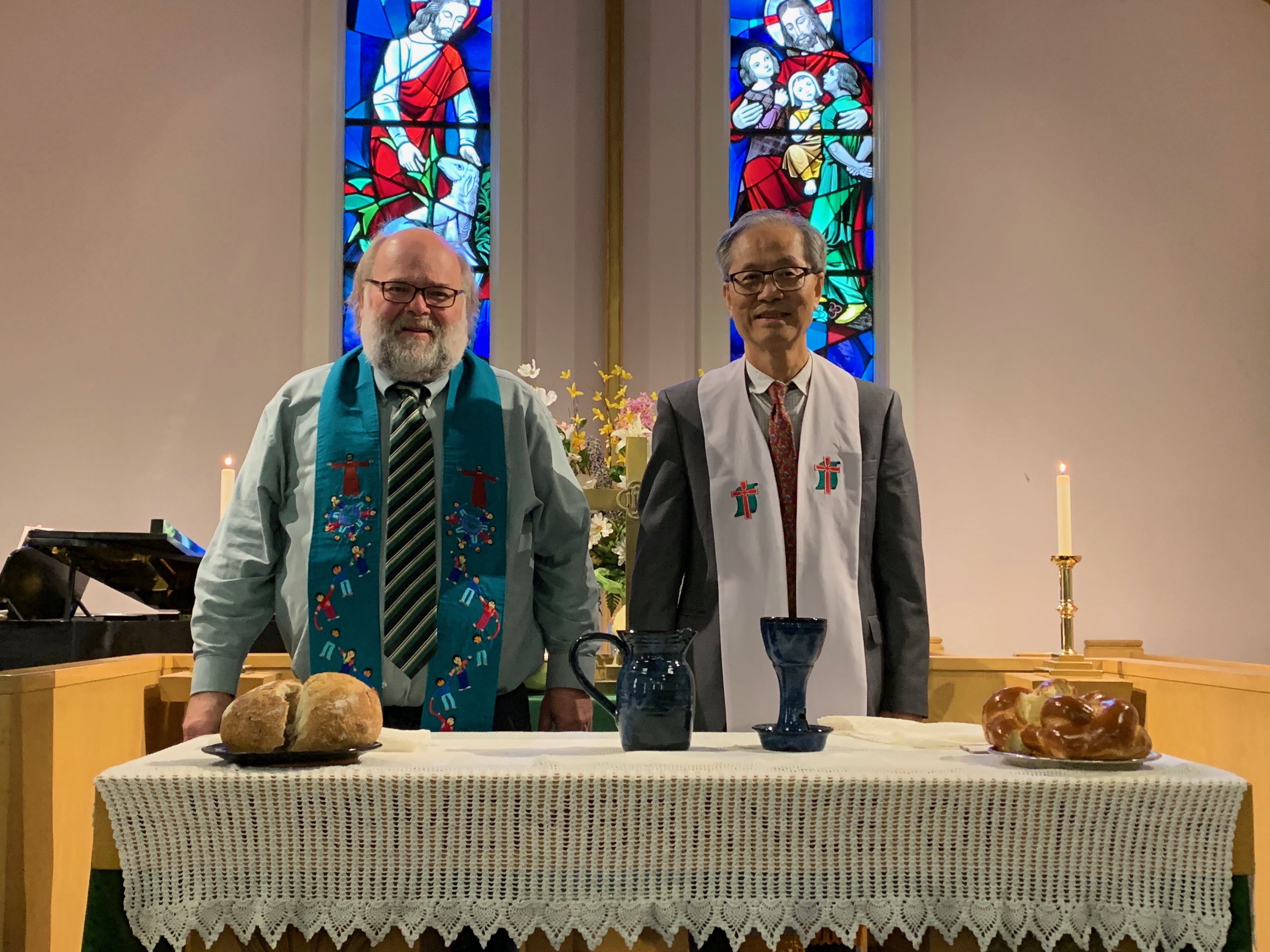
One of my favorite days of the year.  The First Presbyterian Church of Whitestone celebrated communion today. The Rev. Immanuel Bae officiated with me. Thanks to Anne Marie Russo for the photo.

IMG-0621

Leave a comment

Filed under Current Events, First Presbyterian Church of Whitestone, Friends, Worship

Keep Faith

Keep Faith
4 August 2019
First Presbyterian Church of Whitesone
The Rev. Mark Koenig

This sermon was put together on the morning of Sunday, August 4, 2019 between about 8:00 AM and 11:00 AM. The scripture planned for the day was Luke 12:13-21. It is referenced in the sermon but does not serve as the text in the traditional sense. Beginning with the quote by the Rev. Dr. J. Herbert Nelson the material is adapted from a sermon originally preached in February, 2019. Apologies if I quoted anyone without attribution. What follows is a reconstruction based on the notes taken into the pulpit.

When Wiley likes one of my sermons, he shakes my hand and says, “You stuck the landing on that one, Mark.” I have a vision of a graceful female gymnast, both feet hitting the floor. Arms extended. Her smile filling the auditorium.

I like that. But I don’t usually think of myself as particularly graceful.

Today, I have a feeling the sermon may more closely resemble my breaking the springboard for the vault, knocking over the pommel horse, staggering away, hitting my head on the rings, walking into the supports for the parallel bar and bringing it down, careening into the balance bar, falling across it, and face-planting into the mat.

I am improvising today. At the church retreat, Leslie Mott talked about the importance of improvisation both in life and in ministry. It involves taking the situation we are given, saying yes, and making things work.

One form of improvisation for clergy involves being able to adapt to circumstances in the life of the congregation, the community, the nation and the world as we preach and lead worship.

I have done that before. Many times.

I remember sitting at the kitchen table in Iowa on a Sunday morning, cutting paper apart with scissors. Removing passages. Changing the location of paragraphs. Furiously scribbling notes and adding them. Pasting things together.

Sean was about two at the time. His eyes got bigger and bigger. Finally, he asked, “What is daddy doing?”

“Just rewriting his sermon,” Tricia assured him.

I have often rewritten sermons on Sunday mornings in response to circumstances.

Never before today have I done so in the back of an Uber.

Never before today do I remember a Sunday when there were two mass shootings within 24 hours of when I preached.

Reports from last night are that at least twenty people died in a Walmart in El Paso. The shooter may have been motivated by racial hatred. An Internet post that is believed to be his talked about hating people of color and the United States being “invaded”. He made his way from the Dallas area to El Paso – a diverse town that straddles the border and so has many Mexican-American residents and is often visited by people from Mexico. At least three of the people killed have been identified as Mexican citizens who had crossed from Ciudad Juárez to shop.

This morning’s report says that at least 9 people died in Dayton. The shooting took place in a popular nightclub area late last night. Details are only now emerging.

Last weekend 4 people died in a shooting in Gilroy, California. One person was killed and 11 wounded at a celebration in Brooklyn.

Groups that monitor gun violence note that at least 7 other mass shootings occurred since we last gathered in this sanctuary.

Those are shootings where at least 4 people are shot in the same incident. It does not include shootings of individuals. It does not include individual deaths by suicide.

My heart is shattered. My mind reels. I grieve. I grieve for those who died. For those who are recovering from wounds. For families blown apart in an instant. For first responders. For witnesses. For medical personnel. I grieve to hear reports that people in El Paso did not go to medical care or to family reunion centers because they feared that ICE might be there. I pray those reports are inaccurate, but I fear they are true. And I grieve for the evil that is revealed if they are.

I rage at a world where the obscenity of mass shootings happens again. And again. And again. One of the most painful memes I saw on Facebook either this weekend read along the lines of: “I will pray for those killed in today’s shooting. The most painful word in that sentence is today’s.”

My grief almost breaks me. My rage threatens to consume me. But I will not fail. I will not falter. I will never give up. I will rise again. I rise again because of my faith in Jesus Christ. On Christ, by Christ, with Christ, in Christ I stand.

Many words have already been written about the shootings. More will come.

Among the words that speak to me are these attributed to Representative Veronica Escober, congresswoman from El Paso. She says: “We have a hate epidemic in this country.”

I agree with that, but I would add, we have a racism epidemic in this country. We have a white supremacy epidemic in this country. We have a white nationalist epidemic in this country. Again and again, those who commit mass shootings are not people of color. They are not Muslims. They are not migrants whose status is out of order. They are white men. If our country wants to ban people to make us safer, we might consider banning people who look like me.

We have a hate, racist, white supremacist epidemic in this country.

But I interrupted Congresswoman Escobar and I need to allow her to reclaim her time. She goes on to say: “We respond with abundance and love.”

We will love. That was the end of my original sermon for this morning. I talked about the rich farmer in Jesus’ parable who was motivated by greed and self-interest and fear. Those were his economic principles. Jesus, as he tells the parable, presents an alternative economic vision.

When people speak about money and things economic, the phrase “the bottom line” often appears in the presentations and conversations. The bottom line: “the primary or most important point.”[i] The bottom line in Christ’s eternal economy is that God loves us. God loves us and will never let us go.

In response to the hate and evil of mass shootings, I will stand with Jesus. I will love.

I will think and I will pray.

But if we think with the insight and wisdom of the greatest sages of the ages, but fail to act in love, we are noisy gongs.

If we pray with the fervency of Mary (a member of the congregation who has a profound gift for prayer that she has nurtured through her 97 years) and other spiritual masters, but fail to act in love we are clanging cymbals.

Love is a verb. It moves. It acts. It responds. It disrupts. It challenges. It changes.

It is time for love. Personally, and publicly. It is time for justice. Love in action in public is justice.

What might we do?

We might contact our elected representatives. We might ask them to work for responsible gun policies. They may reply that the President will not change things. Then we can remind our elected officials that they work for us. And we want them to work to end gun violence. I will do that.

We might research candidates for elected office. Who is receiving contributions from the gun lobby? Perhaps we might vote to someone who does not. Perhaps we might contribute to someone who does not. Perhaps we might volunteer for someone who does not. I will do that.

We might contribute to organizations working for responsible gun policies. There are many. I will research them and determine where I would like to make a small gift. If the Session approves, the list can be shared in The Lift.

We might witness. Perhaps when I return we can organize a vigil.

We can welcome neighbors and build community across the wondrous diversity that God creates. We can interrupt racism and disrupt white supremacy and challenge white nationalism. I will try to do better.

We can examine our culture and the role violence plays in it. The Rev. Dr. J. Herbert Nelson, Stated Clerk of our General Assembly calls us to examine our culture. He notes that we live in a culture of violence. Violence has become a form of entertainment that ranges from

“toy guns and holsters, to movies and cartoons, to video games that simulate warfare and deaths by automatic weapons, including blood splatter. Violence on television provides actual blueprints for killing another person. And daily we watch the glamorizing of murder on our mobile devices and hear lyrics to songs declaring that there is something noble about killing another human being, including shooting the police.”[ii]

I was driving in Louisville a few years back with NPR on the radio. They were interviewing Dr. Cornell West about gun violence. In my head I was his one-person amen corner. “That’s right. Preach.”

Then he said something to the effect that, “Violence has become our new pornography. It entertains us. Stimulates us. Excites us.”

My video collection flashed before my eyes. And my amen corner said, “Slow down there, Dr. West. Now you are meddling.”

Preachers usually preach to ourselves when we are honest about what we are doing. I will consider what I use to entertain myself.

Mass shootings. Death by gun violence. This is a far cry from the Biblical vision of each person made in the image of God. Of each person beloved by God. Of the call of Jesus to transform a culture of violence to a culture of love and justice.

Followers of Jesus have sought to live according to his teachings both before the crucifixion and after the resurrection.

Reflecting on the Sixth Commandment, “You shall not murder,”[iii] John Calvin notes that each human life is loved and redeemed by God, and therefore, worthy of our love. He understands that in in this commandment violence and injustice, and every kind of harm from which our neighbor’s body suffers, is prohibited.[iv] Pro-actively, the commandment calls us to act to care for one another, protect each other, and do justice.

Those are some suggestions for responding to gun violence. They may prove helpful. They may not. Other ideas will be needed. The work will prove difficult. There is no other word for it. But it is work we as followers of Jesus must do. None of us can do it all. But everyone can do something.

To say nothing can be done is irresponsible. It breaks faith with those who have lost their lives to gun violence and those who wounded by gun violence and those who have lost loved ones to gun violence. It breaks faith with our ancestors famous and humble who faced situations of obscene injustice that violated God’s precious, beloved children and said, yes, yes, there is something I can do. It breaks faith with God who does new things. May we keep faith. May we love. May we work for justice. This day. And every day.

[i] https://www.merriam-webster.com/dictionary/bottom-line.

[ii] The Rev. Dr. J. Herbert Nelson, https://www.presbypeacefellowship.org/resources/sermon-the-difference-a-gun-can-make/

[iii] Exodus 19:13

[iv] Gun Violence and Gospel Values: Mobilizing in Response to God’s Call; approved by the 219th General Assembly (2010) of the Presbyterian Church (U.S.A.); developed by the Advisory Committee on Social Witness Policy (ACSWP); published in 2011; p. 9.

Leave a comment

Filed under Current Events, First Presbyterian Church of Whitestone, Gun Violence, Worship