Before her death in January of this year, my friend the Rev. Dr. So Jung Kim, who served the PC(USA) as the associate for theology in the Office of Theology and Worship, said to me in very low moment, “No one will remember me.”
I told her she was wrong.
On Sunday, St. Andrew Presbyterian Church, where my son Eric serves as transitional pastor, will include So Jung among the saints they name. I am grateful.
If your congregation is naming saints, I am sure you have many individuals to remember. I give thanks for each one of them.
And if you are so inclined, please include the Rev. Dr. So Jung Kim and help demonstrate that we do remember her.
For the Rev. Dr. So Jung Kim and all the saints – thanks be to God!
Join faith communities in an interfaith prayer vigil on the eve of the first hearing of the lawsuit against the Department of Homeland Security’s rescission of the sensitive locations memo. The vigil will take place on Thursday, April 3rd, at 6:30pm ET at National City Christian Church in Washington, DC and will be livestreamed at 7:00pm ET. Together, we will gather lifting prayers for justice, compassion, and the protection of immigrant communities. All are welcome to stand with us in this moment of faith and resolve.
Thanks to God for this day. A day made by God and given to us.
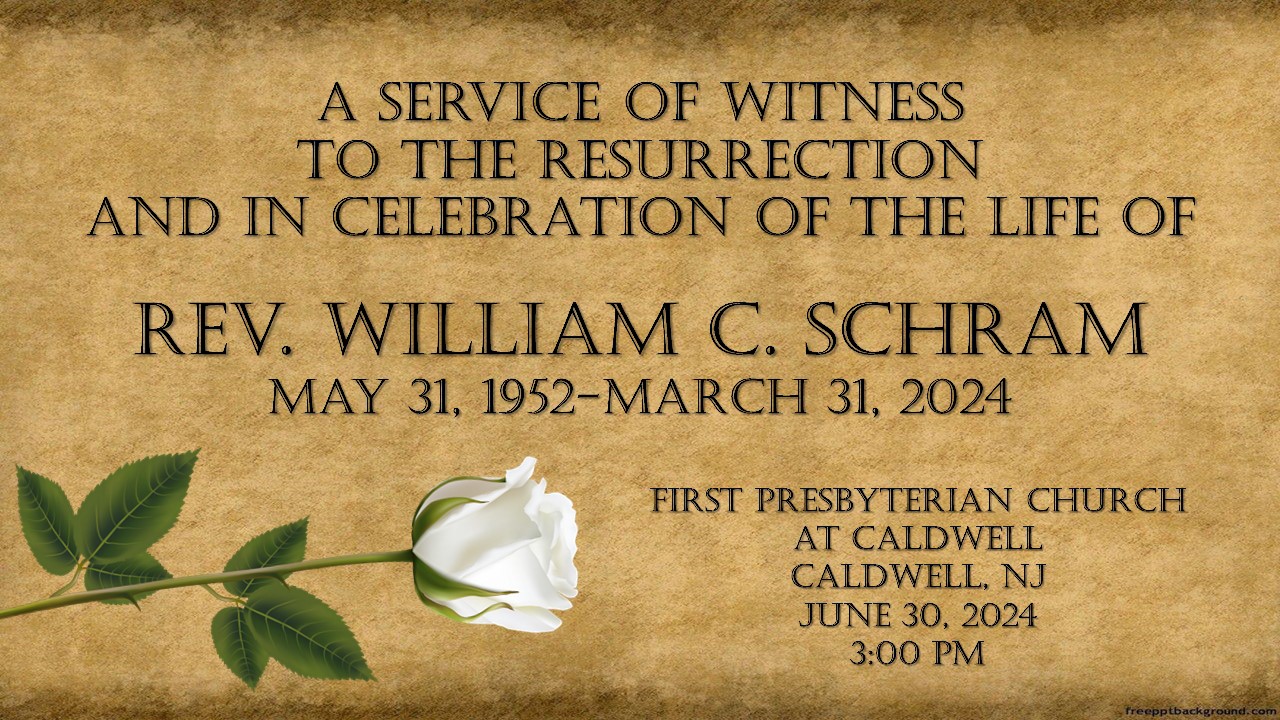
Thanks to Jenny, Melissa, Jessica, Katie and all the members of the Rev. William C. Schram’s family for the honor of preaching on this occasion. Thanks also to the family for the privilege of wearing Bill’s robe.
Thanks to Rev. Chris and the session of the First Presbyterian Church at Caldwell for the invitation to participate in the service.
Thanks to all who have gathered in person or online to celebrate the life of this good man and faithful servant, to stand in solidarity with his family, and to proclaim the resurrection in which Bill believed and stood.
And yet, despite the gratitude which washes over me, I do not want to be here.
I do not want to be in this space. In this pulpit. On this day. At this time. For this reason.
I want Bill to grow old and enjoy life with Jenny and their family.
I want my friend to bask in retirement, alternating between moments of stupefying boredom and sublime, manic overload.
I want to attend Presbyterian gatherings and walk down the hall and unexpectedly, like some form of Presbyterian Spanish Inquisition, recognize that familiar laugh I first head almost fifty years ago.
I want to inwardly groan when I see hump day humor memes and bad dad jokes posted on Facebook. And sometimes I would outwardly groan.
I want to receive messages with the word of the day. Long, unpronounceable words whose definitions bring a tear to my eye and a smile to my lips as they remind me of life shared.
I want to rejoice with Bill when the Lions or the Jets or even the Bears finally win the Super Bowl – after the Steelers put together a streak of ten consecutive championships.
I want to share photos and stories of grandchildren.
That’s what I want. I do not want to be here.
And yet, the way life has played out, I would not be in any other space at this time and for this reason.
Everything has a season. Every matter has a time. That’s what the writer of Ecclesiastes tells us. The writer goes on to list many aspects of life.[i] Implying that each time or season happens discretely – one moment following the other. We imagine time as a straight line. Moving from one moment to the next. That understanding contains truth. But not all the truth.
As we live, times and seasons often, maybe always, come together simultaneously. As they do today. We have multiple matters on our mind. We gather suspended between the brevity and the beauty of life. We know the certainty of death and the undying reality of love. All things must, and do, pass. Love never ends.
The time and the times of our lives – the purposes and matters of living – the seasons – intersect in intriguing ways. Perhaps that happens every day. It certainly does today.
This is a day of many seasons. A moment of multiple, intertwining times.
This is a time to give thanks to God for the life and love of Bill Schram. For a season, God shared Bill with us. Through Bill’s love, God touched and blessed us. Even those who never met Bill in person have met him through Jen, their children, grandchildren, and family. However we met Bill, we are better—our lives are richer—for having known him. Thanks be to God for the gift of Bill and for the love we shared; the love that through the mystery of the Communion of Saints, we continue to share.
This is a time to honor ministry. Bill served the Presbyterian Church (U.S.A.) in multiple congregations in multiple states for almost 44 years. Through sermons preached, prayers said, justice work done, congregational transitions facilitated, pastoral visits made, hands held, great humor and even bad jokes, Bill faithfully followed Jesus Christ.
When we were in seminary. Bill had this habit of breaking out in song from time to time. The same song. A song of sublime musicality and profound, poetic lyrical power. A sunbeam, a sunbeam, Jesus wants me for a sunbeam.
Occasionally he would add a liturgical dance as he sang.
That may make you smile. It may make you laugh. But if you ever worked with Bill or if you ever attended a church that Bill served, you know the song described the man. Bill was a sonbeam. A S O N beam, sharing love, seeking justice, living good news and all the time pointing to Jesus.
This is a time to remember. We remember shared life. Tender mercies. Blessings. Over the course of a life well lived and love freely shared, there are a lot of memories. All of us have them. Some specific to our experiences with Bill and some shared with others. Our memories rush over us at times. And at times they sneak up on us. We may tear up without warning. Or we may smile at what seems like odd moments. In both cases, this happens because a memory of Bill enters our heart.
This is a time to grieve. Death has come for Bill. Too soon. Too young. Death has come. As we do with any loss, we grieve.
Grief is the raggedy emotion rooted in our our values. We grieve because we love. We grieve to honor who and what is dear to us.
Grief brings common elements. We may weep as Jesus wept at the death of his friend Lazarus. We may ask questions. We may deny what happened. We may become angry in many ways, even angry at God. We may feel paralyzed and unable to function. We may want to withdraw completely. We may eat too much. We may not eat enough.
You may have been on this roller coaster journey of grief since you learned of Bill’s death. I know I have. I have wept. I have asked questions. And I have been, and I am, more than a little pissed at God. At times death may be welcome. Always death is part of life. But that does not mean I have to like it in every instance. In Bill’s case, I do not like it.
This is a time to grieve together. Grief is natural and human. It is individual. But we can support one another. We walk the shadowed valley of grief for ourselves But, we do not have to walk it alone. We can share memories, tell stories, sit together in silence. Provide a cup of coffee, offer a listening ear, extend a helping hand. Together, we can make our way through grief.
This is a time to hope. We grieve. But even in our deepest grief, hope remains. Paul told the Thessalonians not to “grieve as others do who have no hope. For since we believe that Jesus died and rose again, even so, through Jesus, God will bring with him those who have died.”[ii]
The Second Letter to the Corinthians tells us that “we know that if the earthly tent we live in is destroyed, we have a building from God, a house not made with hands, eternal in the heavens.” Do I understand that verse completely? Do I know what that house will look like? What style it will be? The floor plan?
Of course not.
But in this I trust, by this I seek to live. God is love. Jesus proclaimed that God is love. In the power of the Holy Spirit, Jesus lived God’s love.
God is love. God loves us. Now. Always. Unconditionally. God’s love never ends. And God’s love is stronger than death. When the powers of domination and oppression sought to put an end to Jesus and his message of love, they failed. Oh, they tortured and humiliated and killed him. They put him in a tomb. They sealed the tomb. But three days later God raised Jesus to new life. I don’t understand what happened. Nor do I understand how whatever happened, happened. I can’t explain it and will not try.
But I affirm that resurrection happened. I affirm resurrection because of the experience of the followers of Jesus through the ages. Because of my experience of the church today. Because more than 2,000 years later, every day and in countless ways, followers of Jesus like Bill share unconditional love, modeled on the love of God revealed in Jesus.
This is a time to say to death, with breaking, aching hearts and shaking, trembling voices, “Christ is risen! Christ is risen, indeed!” Alleluia.
In life and in death, we belong to God.
In life and in death, we belong to God.
The Rev. William C. Schram, my friend Bill, is held securely in the loving care of God.
Each of us and all of us are held securely in the loving care of God.
Now and always.
There simply is no better place for any of us to be.
And this brings us full circle. We started with thanks. We close with thanks.
For the life and love and faith and work of God’s beloved child Bill Schram. For the love we shared. For the love we share. For the love of God which is the source of Bill’s love and our love and which holds us fast. Thanks be to God.
Perhaps I should have felt disappointed. Our tea with Archbishop Desmond Mpilo Tutu was canceled. I had looked forward to this visit. We were to meet him and to share tea with him at his home on Bishop’s Court. However, his schedule became very hectic during the days when we were in Cape Town. Or perhaps it would be more accurate to say that the Archbishop had to change his hectic schedule. I complain about how full my calendar gets – imagine what his looks like! At any rate, the tea with our group from Cleveland was dropped from Archbishop Tutu’s schedule because he had to go to Johannesburg during that time.
This photo, by Benny Gool, is in the public domain, according to the Archbishop’s personal assistant.
On Thursday, November 2, we rose early. We arrived at St. George’s Cathedral in Cape Town for the 8:00 am All Soul’s Day mass. Archbishop Tutu was the celebrant. Brightness and life beamed from him as he prayed his way through the mass. When the time came to pass the peace, he came among us and wished the peace of Christ upon us. The service continued. The moment of the Eucharist arrived. We made our way forward. From the hands of Archbishop Desmond Tutu, we received the host. From his eyes, loved shone on each person. From his face, welcome emanated, surrounding us each and all and embracing the world.
As the service ended, Archbishop Tutu asked that we be introduced to the congregation of about thirty or so. He greeted us warmly. We presented him with a “Rainbow Children” stole. In joy he put it on. We could sense his excitement although he did manage to refrain from dancing! It took an effort. Then he asked if we were really from the United States – because no one was ready to take pictures. The cameras came out and, with gracious exuberance, Archbishop Tutu posed with the group and with each of us individually. Then he was gone.
Perhaps I should feel disappointed. But I do not. If you had a choice between sharing with Archbishop Desmond Tutu either a spot of tea or the cup of Christ – how would you choose?
For the life and faith and love of witness of Archbishop Desmond Mpilo Tutu, thanks be to God.
Cape Town, South Africa 2 November 1995 revised North East, Maryland 26 December 2021
A sermon on Luke 1:39-55 Dickey Memorial Presbyterian Church 19 December 2021
From 2010 through 2016, I served as the director of the Presbyterian Ministry at the United Nations.
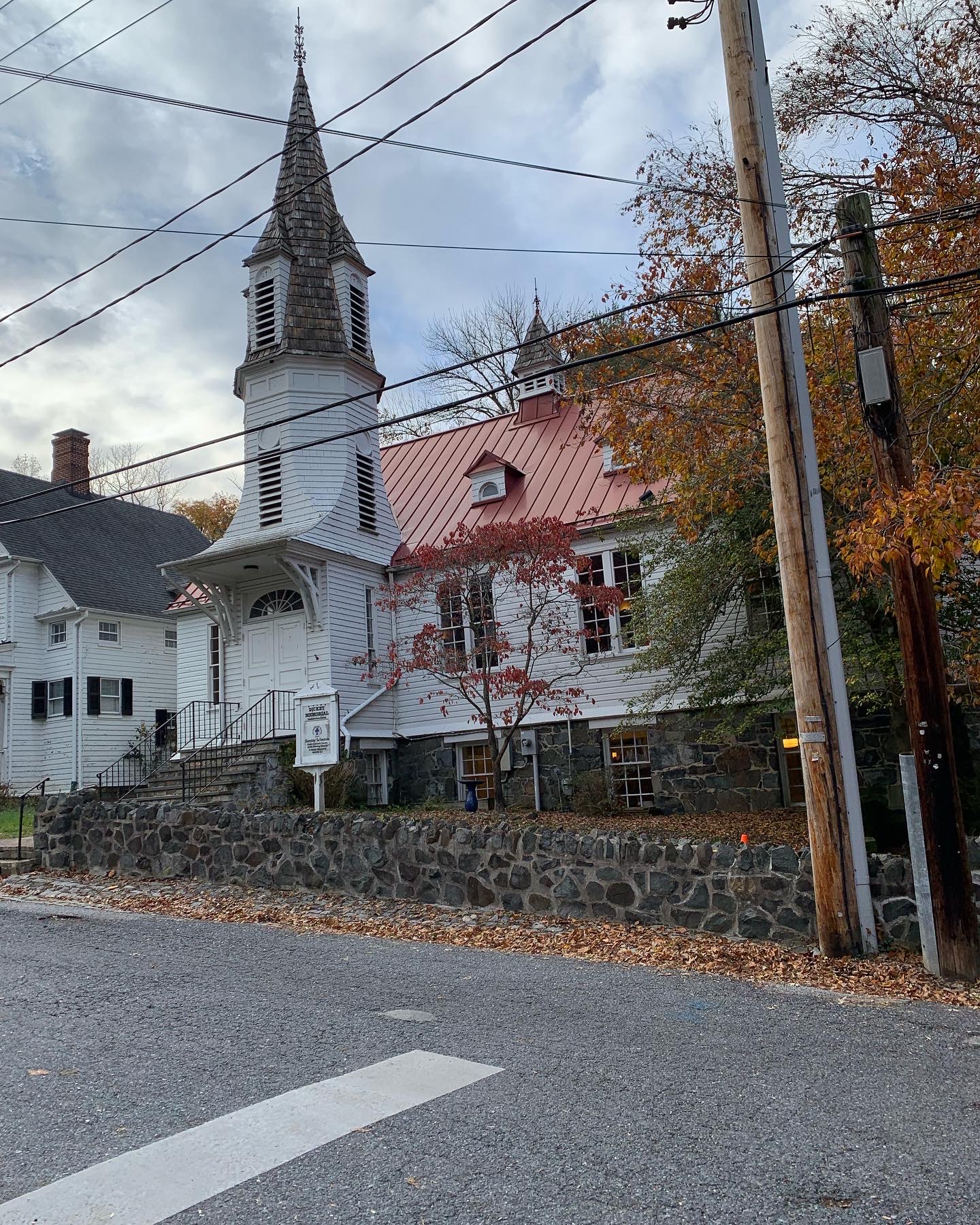
Dickey Memorial Presbyterian Church
Memories of precious people, painful international events, and amazing happenings swirl in my heart and mind.
Among my favorite memory is the moment I have come to call the good night ritual. .
Each night, I shut off my computer, turned out the light, and left the office. I walked down the hall to the elevator and pushed the call button. When the cab arrived, I pushed “1” to go downstairs. Hector would be there to see me out. Always. And always we spoke. Sometimes we talked about weather or family. Often, we talked sports. Conversations got interesting the week my Steelers beat Hector’s Jets. After some conversation, I made for the door, As I stepped across the hallway, I heard Hector’s final words: always the same words, always in the same, kind voice: “Good night, Marko. Get home safe.”
In Advent and Christmas, we think of home in many ways.
“Please Come Home for Christmas,” sings Aaron Neville.
“I’ll Be Home for Christmas,” sings Oscar Peterson.[i]
Spoiler alert. If you have forgotten the ending of A Christmas Carol; if you have never seen It’s a Wonderful Life, I invite you to plug your ears for a moment. I will let you know when the spoilers are done.
After the visits of three ghosts in A Christmas Carol, Ebenezer Scrooge sends a feast to Bob Cratchit’s home and then travels to celebrate at his nephew’s home.
After the visit of one rather ordinary angel second class, in the climactic moment of George Bailey’s renewal, he makes his way home.
I see places I have lived at different times when I hear the word “home”.
Unique sights, smells, and sounds.
Home also recalls people. Beloved people. Family. Friends. Chosen family. Different in different homes. But always people.
Home is a place. 123 Sesame St. 80 Main St., Apt. 23D
Home is people.
Elder Vilmarie Cintrón-Olivieri observes that as a poor, unwed teenager, Mary was surrounded by dangers and uncertainty – both physical and societal. When she learned of her pregnancy, Mary sought a haven, a sanctuary, home.[ii]
Home for Mary was a place. The house of her relative Elizabeth. Home was people. Zechariah was there. Silent, but there. More importantly, Elizabeth and the baby in her womb, were present.
They welcome and affirm Mary. And in a moment that Stephen Sondheim could have written, Mary breaks into a song. “My soul magnifies the Lord, and my spirit rejoices in God my Savior.” The Magnificat. A song that has been set in many ways over the centuries, including the Canticle of the Turning which we will sing shortly.
The Magnificat holds together the grittiness of life on the margins, the resilient hope of those who trust in God, and the power to image a new way of living.
My friend the Rev. Margaret Aymer suggests that we need to revise our view of Mary. Rather than gentle Mary, meek and mild, Margaret says Mary is better seen as Jesus’ radical Jewish Mama. A woman full of strength and courage and hope. An alternative vision fires her imagination. God’s vision of justice, equity, and peace. This vision, sung in Mary’s song, no doubt found its way into the lullabies she sang to Jesus and the stories she told him. It shaped him. It guided his living. His words and deeds exemplify his mama’s song.[iii]
Consider, church: the Triune God – Creator, Christ, and Holy Spirit or whatever formula you use – exists in relationship.
Made in God’s image, we are made for relationships. The late bell hooks reminds us of this when she says that healing is an act of communion. Rarely, if ever, she says, are any of us healed in isolation. Healing comes through relationships. Life comes through relationships.[iv]
We are made for each other. We are made for relationships of integrity, compassion, justice, equity, solidarity, accountability, responsibility, and love. We are made to be home to one another.
The village of Le Chambon in France provided sanctuary and home to Jews during the Second World War. Fleeing the monstrous, sinful evil of the Nazis, Jews would arrive in this Huguenot village. They made their way to the building we Presbyterians would call the manse. They knocked and were usually greeted by Magda Trocme with the words, “Welcome. Come in.” The process of creating home began. Years later, asked why their village and people became a sanctuary of home, Magda replied, “They knocked. What else could we do?”[v]
This theology – that God has made us and called us to be home for one another – was shared by those who ran the Underground Railroad. It is shared by those who welcome refugees, who support citizens returning from incarceration, and who offer sanctuary to individuals and families at risk of deportation to the violence-filled places they have fled.
Whether they are running for their lives or they are buffeted and battered by life, we will encounter people in need of refuge, haven, and sanctuary. Through Jesus Christ, God who is love, God who is our sanctuary and home, empowers us to say, “Welcome. Come in.”
Part of what allows us to create home is God’s gift of imagination. Our shared humanity allows us to imagine the pain and the fear of people in need.
More importantly, our faith allows us to imagine our relatedness to the entire human family. Each child is our child. Every person created and loved by God is a person to whom we are bound by the unbreakable cords of God’s love.
Imagination is an act of faithful subversion in a world that tells us nothing will change. Things will always be the same. There is nothing we can do about it.
Not so, says imagination. Not so. There can be, there is, another way. Imagination is the root of joy. Imagination is the source of hope. When we dare to imagine that Jesus just might be on to something when he tells us to love one another; we take the first steps toward loving one another.
At home with Elizabeth, Mary’s imagination inspired her to break into song about what God has done, what God will do, and what God is doing. Mary’s song, Rachel Held Evans reminds us, declares that God has chosen sides.[vi]
God has chosen not narcissistic rulers or leaders, but an un-wed, un-believed teenage girl for the holy task of birthing, nursing, and nurturing God.
God has chosen not the powerful, but the humble.
Not the rich, but the poor.
Not the occupying force, but people pushed to the margins.
God has made a home. That home, Jesus reveals, is among the people the world casts aside. Women. Children. The poor. Lepers. Samaritans. Tax collectors. Sinners. God’s home includes people of every sexual orientation and every gender identity, people living on the streets, people whose immigration papers do not match the government standards, people battling addiction, people dealing with mental illness, and anyone pushed aside by the culture of domination.
Any time we human creatures seek to keep some of God’s children out and we draw a line to exclude and we say, “you do not belong,” God wipes the line aside. “Hold my beer,” the Holy Spirit says, and she begins the patient, careful work of removing the line and welcoming all God’s children home.
Church, we know that does not happen quickly enough. We know people, too many precious people, are wounded in the time it takes God to erase the lines. That grieves us and God. But we also know that patiently, persistently God is at work. And God invites us to join that work.
In her defiant, prophetic, imaginative song, Mary—a dark-skinned woman who would become a refugee, a member of a religious minority in an occupied land—names this reality: God makes a home for and with those who have been driven to the margins by the powerful. And we are invited to meet God there on the margins and be welcomed home.
During Advent, we journey home.
During Advent, we work to create home.
During Advent and always, may we journey and work with the stubborn, unsentimental hope of Jesus’ radical Jewish Mama – a woman so convinced the baby inside her would change everything, she proclaimed that:
The powerful have already been humbled;
The vulnerable have already been lifted up;
The world is turning;
And it is turning toward home.
Thanks be to God. Amen.
[i] Many artists have recorded both songs. The versions by Aaron Neville and Oscar Peterson were the first to appear in my iTunes Library.
[ii] This comes from Vilmarie’s commentary on Luke 1:39-55 in the Sanctified Art Close to Home Sermon Planning Guide for this Sunday.
[iii] I found this image from the Rev. Dr. Margaret Aymer a couple years ago. I can no longer find the source.
A sermon preached at the First Presbyterian Church of Whitestone on 28 February 2021 on the occasion of the end of service as interim pastor.
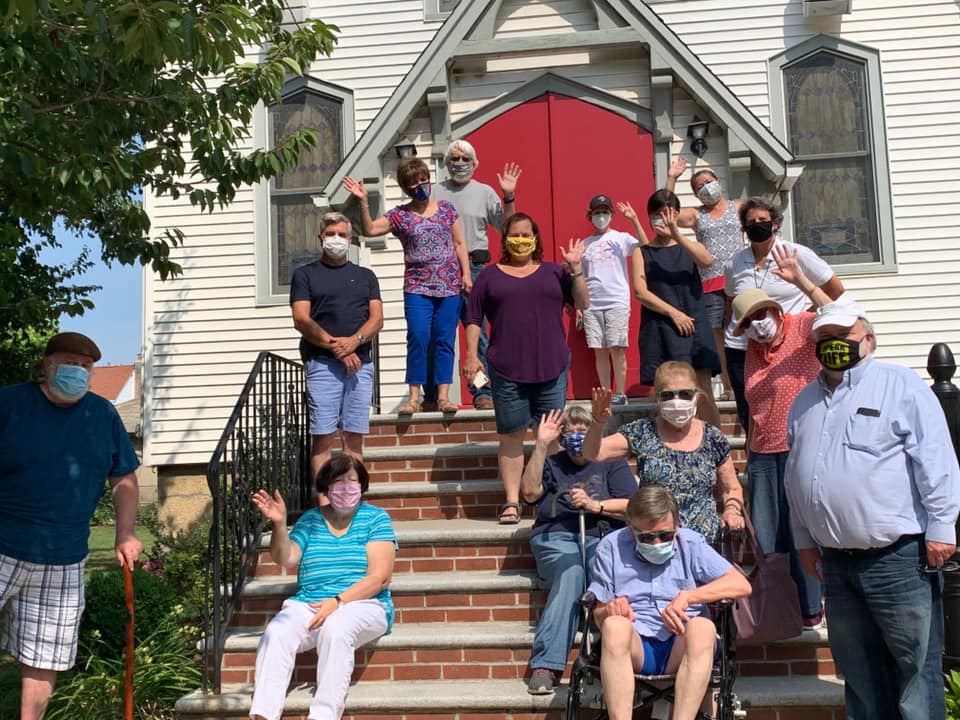
See you on Zoom event July 2020
What is your favorite Christmas Carol? Not the kind of question you would expect on the Second Sunday of Lent, is it.
While I have rarely met a Christmas carol I do not like, I have a favorite: “Once in Royal David’s City.”
As an eight-year-old boy soprano I sang a solo verse of that carol at the Presbyterian Church on Neville Island, Pennsylvania.
My voice has changed since then. It happens. Now I am more of a baritone. Which as my brother points out means “Mark sings and the rest of us have to bear the tone.”
Rest easy, I will not sing. But a song has been an earworm these last few days.
In Act II of the musical Hamilton, George Washington informs Alexander Hamilton that he will not run for a third term as president. Washington asks Hamilton to help write his farewell address. Their conversation plays out in the song: “One Last Time.”
One last time The people will hear from me One last time And if we get this right We’re gonna teach ‘em how to say Goodbye You and I[i]
It is a song about beginnings and endings. An ending for George Washington as and a beginning for the country. As Washington sings “the nation learns to move on. It outlives me when I’m gone.”[ii]
Beginnings and endings; endings and beginnings have occupied a great deal of my thoughts and feelings this week. I have been reminded of how closely beginnings and endings, endings and beginnings blur together.
Sometimes endings are built into the fabric of beginnings. They are inseparable. For example, an interim pastor serves to help a congregation prepare for the next installed pastor. And then leaves. That is the point of an interim relationship. It is intended to end. When I began serving as the interim pastor of the First Presbyterian Church of Whitestone on March 1, 2018 the clock started running. It would only be a matter of time until our service together ended.
Now that day has arrived.
To return to Broadway, the curtain will fall on my ministry tonight at midnight. Seconds after midnight, the curtain will rise Pastor Janice’s ministry. There is some sorrow at this moment. At least for me. But there is greater joy about what the future will bring. Thanks be to God. Today we say goodbye.
We have shared time together. We have dealt with difficulties. We have experienced joy. We have wonderful memories. We have done significant ministry. I am and will forever be grateful. But we say goodbye.
You will always be in my head and in my heart. We are bound in the Communion of Saints. To paraphrase Paul, “I will thank God every time I remember you. I will pray for each of you and for all of you. I will give thanks for how we have shared in ministry and living the gospel from the first day of March 1, 2018 until now.”[iii] But we say goodbye.
I hope you will pray for me a time or two or ten. Each day. Maybe more often. But we say goodbye.
That is what interim pastors and the congregations they serve do. Saying goodbye creates a healthy boundary to allow the new pastor to flourish. Saying goodbye does not diminish what we have done for each other or what we mean to each other. It does not alter my affection for you. It clears the deck and opens the way to the future. I am no longer the pastor. Pastor Janice is. I will no longer be here. She will. Together with Pastor Janice you will move on in your life and ministry as a congregation. And I will move on as well.
President Washington, at least according to Lin-Manuel Miranda, moved on to sit under his own vine and fig tree and take a moment alone in the shade.[iv]
I have no vine. Nor a fig tree. If I did, they would probably make me sneeze.
My plan is to take some time and figure out what my plan is. I am grateful to Tricia for giving me the space to do that. Retirement may be out there. Or I may look for some form of ministry. Time, and the movement of theHoly Spirit will tell. What comes after goodbye for me remains unclear.
As we say goodbye, I offer some insights I have gleaned through the years about ministry. In the words of those classic theologians the Beatles, I do so with a little help from my friends. Ginger, Babs, Mac, Bunty, Fowler, Nick, and Fetcher.
Well, they could be my friends. If we had met. And if they were real.
They appear in Chicken Run – a claymation movie involving chickens, rats, dogs, and some humans.
Chicken Run is set in 1950s Great Britain on Tweedy’s chicken farm. The chickens live ringed by barbed wire fences. The chickens make money for the Tweedys by laying eggs. Hens that fail to lay eggs soon make their final appearance. On the Tweedy’s dinner table.
The chickens, led by a hen named Ginger, become fed up with this life. Ginger knows that the chickens deserve better – a life free from the demand to produce eggs, free from the threat of death, and free from the farm. She shares her vision with the other chickens and convinces them to begin living out the vision in the only way possible – escape.
They devise a plan for escape and put it into operation. And they fail. Many attempts are made. Each attempt fails. And every time the chickens try again.
Two events break this cycle. A rooster from the United States named Rocky arrives. He brashly promises to teach the chickens to fly across the fence that traps them. At the same time, Mrs. Tweedy decides that eggs are not profitable enough. The farm will produce chicken pies. Escape becomes essential. As one chicken profoundly says, “I don’t want to end up as a pie. I don’t even like gravy.”
I will tell no more of the story so as not to spoil the ending for those who have not seen it. But what does it say about ministry?
The Tweedys said the chickens’ role was to live on their farm in the conditions they established and produce wealth for the Tweedys. Led by the prophet Ginger, the chickens had an alternative vision. They envisioned a world with no barbed wire, no dogs, no huts, and no quotas. Instead, there would be freedom and abundance and sunshine and sharing.
Jesus proclaimed and lived an alternative vision. In the face of the domination of empire and the division of the human family along lines of class and gender and sexual identity and age and nationality, Jesus taught a vision of radical inclusion, expansive love, and unfailing justice. He envisioned a world turned upside down.
Part of that vision involves recognizing who we are and whose we are. The chickens refused to accept the way in which they were assigned worth by the dominant culture. To the Tweedys, the chickens had worth only as means of production. Once they ceased to be productive they had no value and they were disposed of. The chickens knew that they were more than that. They knew they had value simply because they existed.`
Ministry involves accepting our own value and reminding others of their value. We are repeatedly told that our value comes from externals – skin color, wealth, status, gender or sexual identity, age, ability. The list goes on. Elaborate systems and structures are built upon human differences by the powerful to maintain and enhance their power and privilege.
Ministry is knowing and claiming and living the awareness that I am God’s beloved child. And so are you. And so is everyone we meet. We should be treated as such. We should treat each other as such. We should challenge anyone who says otherwise. In the words of the Rev. Dr. Grace Ji-Sun Kim, we move from treating people as others to embracing one another in God’s love.[v] And then we work to dismantle systems that perpetuate privilege and inflict oppression.
The community created in Chicken Run crossed usual lines. Nick and Fetcher are rats. That’s not a comment on their character. That’s an identification of their species. They aren’t the brightest rats. They spend a good amount of time waiting for the eggs that Rocky, the rooster, has promised to lay for them. Still the rats become part of the community working together toward the goal of freedom and a better life for all.
Ministry involves reaching out to and serving with people from whom we differ. God creates and enjoys an amazing diversity. Our challenge and opportunity is to build a welcoming, including community. God calls us to create a place at the table for everyone born, as Shirley Murray writes. God calls us to break down and reshape, remake, and replace as needed. And to make sure that not only does everyone have a place, everyone can share their voice, and every voice is heard.
The chickens created a community that worked together. When one hen had problems laying eggs, others would share theirs. Rocky points out that one or two chickens could easily escape. Ginger replies, “But that’s not the point. Either we all escape or none of us escape.” Ministry involves commitment and caring for one another.
Each chicken, and rat, had gifts they used to help one another. Everyone did something when needed. Ministry is a corporate practice – a communal art. It is not for the professionals alone. It is for everyone. It involves discerning the gifts we each have and then using those gifts for the good of the community and the world.
Chicken Run includes a rooster named Fowler who served in the Royal Air Force during the Second World War. “644th Squadron, Poultry Division – we were the mascots.” He fondly tells stories about, “Back in my day…” The time comes when his gifts are needed. When asked to help, Fowler begs off. Ginger says, “Fowler you are always talking about back in your day. Well you are here now. And it is now that we need you. This is your day.”
Beginnings and endings blur. Time has a way of jumbling together. We stand on the shoulders of those who have gone before. We plan and dream into the future. But in the end, today is the only day we have. Today we follow. Today we serve.
Today we make a transition. To return to Broadway one last time, one scene ends tonight. Tomorrow we begin a new scene in God’s Master Story – a story that began in the act of creation and that will extend until the end of days and the fulfillment of all things. A story of Divine creativity and grace and love in which we are privileged to play roles for a time. It is the story that has brought us to this moment and place. It is the story that draws us into the future.
We do not know for sure what the future will bring. But of this we may be certain. Whatever roles we play, we will be part of God’s Master Story of God’s grace and our response in ministry. I will, someday, figure out what comes next for me. You and Pastor Janice will engage in amazing ministry. And God will be with us all. This day. Every day. Thanks be to God.
Through the years, Pentecost worship services sought to capture the excitement of the day.
Red paraments. Red stoles. Red clothes.
One year each person at worship received a roll of crepe paper—red, yellow or orange. At the appropriate moment, they tossed their roll into the air creating a cascade of fire colors.
Another year we stationed large fans in the sanctuary corners. Turned on when the scripture reading mentioned wind. Some ideas work better than others.
Worshipers were given homemade pompoms with the instructions to wave them whenever the preacher said, “Holy Spirit.” Pinwheels played the same role one year.
A djembe drummer began a slow, soft cadence at the beginning of the scripture reading. The drumming increased in volume and became wildly uninhibited as the story continued reaching a climax when the crowd said in the followers of Jesus were drunk.
Every Pentecost service differed slightly from every other. Every Pentecost service contained similar themes.
Today’s Pentecost service is the most different Pentecost service I have experienced. But those themes remain.
Breath.
Fire.
Witness.
The Greek word “pneuma” that is used in the Pentecost story is related to the Hebrew word “ruah”. In each language, the word is closely linked to wind, spirit, and breath.[i]
Let’s think in terms of breath today.
Breath keeps us alive. Indeed, it gives us life. According to the account of creation found in Genesis 2, God formed the human creature from the dust of the ground. And then God breathed life into the creature.[ii]
Breath gives life. Sustains life. Provides life. It is a reflex process, one of our most natural abilities.[iii] Until it is not. The age of COVID-19 has taught us that.
As the Rev. Angela Denker of Minneapolis notes, “People who die of Covid often die because they can’t breathe, the virus engulfing their lungs and suffocating them. Sometimes a machine breathes for them, for long enough that their lungs can heal and gather strength again.”[iv]
When we go out, we wear masks. They provide a measure of protection to the people we meet in the event we have coronavirus either with or without symptoms. They also offer a smaller measure of protection to us, the person wearing the mask.[v] As we breathe in and even more so as we breathe out, the mask reduces the number of air droplets that may contain germs.
Last Monday we received another startling, sobering reminder of the importance of breath.
“I can’t breathe.”
The Washington Post reports that “On May 25, Minneapolis resident George Floyd was pinned facedown on the ground, in handcuffs, by a white police officer who pressed his knee against Floyd’s neck for more than eight minutes. Floyd, a 46-year-old black man, was suspected of passing a counterfeit $20 bill. He was unresponsive when paramedics arrived, and he was pronounced dead later.”[vi]
Under that knee, bearing the full weight of white supremacy culture, racism, and prejudice George Floyd died. Among his final words, “I can’t breathe.” The same words uttered by Eric Garner, who died in a chokehold on Staten Island almost six years ago in an encounter that was also captured on video.[vii]
The racism that claimed the lives of George Floyd and Eric Garner; the racism that that threatened the life of Christian Cooper in the Bramble and claimed the lives of Breonna Taylor in Louisville and Ahmaud Arbery in Brunswick, Georgia and Tony McDade in Tallahassee and so many other black and brown people in so many places; that racism has been present in this country since its beginning. Racism has always contaminated the air we breathe. Writing from Minneapolis a few days ago, Angela Denker notes that we cannot ignore the “death in the air any longer. It burns bright orange.”[viii]
Fire.
In Minneapolis and St. Paul, people took to the streets to protest the killing of George Floyd. In Louisville, people took to the streets to protest the killing of Breonna Taylor. In New York and cities across the country, people took to the streets to stand in solidarity, to protest other killings, and to protest the existing impacts of racism on black people and people of color. Those impacts are seen in who is imprisoned; who has more wealth; who has better jobs. Efforts to make it more difficult to vote appear to focus on black people and other people of color.[ix] Racism appears in the age of COVID-19. Blacks and Latinx/Hispanics die in disproportionate numbers of the disease. People who continue to work during the pandemic, often in less safe conditions, are black and brown. “African Americans have been living in a burning building for many years, choking on the smoke as the flames burn closer and closer,” states Kareem Abdul-Jabar.[x]
This underlying reality, when combined with over acts of violence, leads people to protest. Most protest is peaceful. Some is not. Some is met with overt violence by police. Sometimes agent provocateurs incite and commit violence to discredit the legitimate protest or for other reasons.[xi] Sometimes all that happens at the same time. And sometimes it leads to fire. In Minneapolis. Louisville. New York. Philadelphia.
Angry fire, purifying fire, destructive fire. Different, on first glance, from the holy fire that brought understanding and unification on Pentecost. Yet the hope remains that God, who raised Jesus from the dead, can take flames of death and transform fire into new life and hope for the future. Phoenix-like, from the flames and ash, by God’s grace, new life may emerge.[xii] God does new things. We have witnessed resurrection before. We will witness God’s marvelous acts again.
Witness.
Jesus commissions his followers to be witnesses.[xiii] To bear witness to what God has done, is doing, and will do in Jesus Christ.
Witness, Dr. Eric Barreto of Princeton Seminary, reminds us is not just about our words or even our tweets.[xiv]Dr. Barreto notes that the kind of witness Jesus calls for involves seeing and listening. Witness trusts the testimony of people who have been oppressed, even when there is no video to view. Witness believes people who have been harmed.[xv]
Witness holds the hand and looks into the eyes of someone who is dying, not as a spectator, but as people whose lives are intertwined. Witness also leads us to stand with people who are oppressed.
Witness marches on the streets. Votes with love. And advocates with those who are elected.
As followers of Jesus, we bear witness to an innocent man crucified by the empire. It seems important this week to remember that crucifixion killed by putting the weight of the body on the person’s chest so that the person … Jesus … could not breathe.[xvi]
After the wind. After the fire. The followers of Jesus witnessed. They told the crowd in Jerusalem what they had seen and heard and learned with Jesus. Luke included that long list of peoples and places in this passage for a reason. And it was not to make life difficult for Eric or whoever reads the lesson aloud. It to say that the Holy Spirit is for all the world. For everyone. As Dr. Shively Smith of the Boston University School of Theology, puts it: on Pentecost all “nations heard the gospel preached in all the many languages that … reflect the glory of the God who created and sustains them all.[xvii]
Pentecost reminds us that the God who created the world inhabits the breath and speech of all our siblings throughout the entire earth. God creates a wondrous diversity in the human family. God revels in that diversity. God is present in that diversity. And God is present when diverse people who love and care for each other.
Today we celebrate the gift of the Holy Spirit … God’s breath and fire … that reminds us that it is only together with all people that we truly express the image of God. We receive inspiration to witness to that image in our words and in our actions.
If Pentecost reminds us of God’s love for diversity and the value of all people then on Pentecost and every day after, followers of Jesus must denounce racism and white supremacy culture and the actions that it empowers. We must listen and learn. And then witness in word and deed to a different world, a world where all are welcome, loved, and cherished. And when we have done that, we must do so again. And again. And again.
The effort to disrupt racism and white supremacy culture and dismantle systems of oppression is not something we do once and check off a box. It is a calling for a lifetime. It is our calling. For that calling, God gives us the Holy Spirit with its many gifts. Touched by the Holy Spirit, we can be persistent, resilient, and adaptive.
This day, and every day.
In the face of systemic evil, the Holy Spirit empowers us to follow Jesus and work to build a different world. I know I will make mistakes in that work. I will fall short. But I know that each time I fall I can pick myself up again, certain that God will have the final word and it will be a word of grace.
“And Jesus said to him, ‘Foxes have holes, and birds of the air have nests; but the Son of Man has nowhere to lay his head.’” (Matthew 8:20, NRSV)
“It offends me [that politicians demand that our temples be open] because such assertions pretend to limit the worship of God’s people to a building, […] because Jesus was a teacher of mountains, deserts, rivers, boats and seas.”
– Marissa Galván-Valle
A bit of the litany in English:
We worship from our homes,
Mountain Teacher, because our gratitude goes beyond
the sanctuary pews and the temple walls
We reflect in isolation,
Desert Mystic, because our soul is strengthened
by the silence of active listening and the quietness of your presence.
Acts 1:1-11 May 24, 2020 First Presbyterian Church of Whitestone The Rev. W. Mark Koenig
(Image by the Rev. Bruce Reyes-Chow)
Whatever else they were, the early followers of Jesus were a persistent, resilient, adaptive group of people.
Yes, they failed to understand what Jesus taught them. They made mistakes. They fell short. Often. At the end, Judas betrayed Jesus. The other men fled when he was arrested.
Then there was Peter. No follower demonstrates their shortcomings as clearly as Peter.
When Jesus taught his disciples that he would suffer and die, Peter “took Jesus aside” and objected to the teaching. This may have been a set-up. Because the gospel says that when Jesus replied, he looked first at his disciples and then rebuked Peter. “Get behind me, Satan.”[i] I don’t know about you, but I would have something of a problem following someone who called me Satan. Peter hung with Jesus.
John’s Gospel tells us that there was something of an awkward moment when Jesus went to wash the disciples’ feet at the meal we call the Last Supper. Peter said no. Jesus explained why. Peter said wash my hands and head too. Jesus explained why not. Twice in one conversation, Peter got it wrong.[ii]
He did so again when Jesus talked about his coming death. “I’ll lay down my life for you,” Peter said. Jesus answered, “before the cock crows, you will have denied me three times.”[iii] After Jesus’ arrest, Peter did exactly as Jesus predicted.
At the arrest of Jesus, A disciples took out a sword and started hacking away. All three gospels include this story. John names the disciple. Peter. A noble gesture to protect Jesus. But misguided. “Put away the sword,” the nonviolent Jesus said.[iv]
But, for all the times that Peter fell short, and for all the times that the others fell short, I still say those first disciples were persistent, resilient, and adaptive.
Consider all they went through as they followed Jesus.
They left their families behind. Not always easy to do.
They left their homes and employment. I do not know how much a fisherperson earned in the time of Jesus, but it had to be more than one could earn following an itinerant preacher and teacher with no place to lay his head.[v]
Jesus expanded their understanding of who God loved. To the Jewish people, Jesus added: Samaritans, Gentiles, Romans, Syrophoenicians, women, children, people with illnesses that normally put them outside the community, and everyone. Each act of kindness and healing and welcome on the part of Jesus meant his followers had to draw love’s circle wider and wider until it disappeared, and they realized that each person is a beloved child of God.
The length of Jesus’ ministry is not precisely known. Many scholars suggest between 3 and 3.5 years.[vi] Others think it was shorter. However long, his disciples spent most of that time with Jesus.
Then came the arrest and crucifixion. And Jesus was gone. His disciples left alone. They struggled with what to do.
Three days later, the resurrected Jesus appeared to them again. After some confusion, they rejoiced.
Then came the Ascension. The return of Jesus to heaven. The events described in today’s passage. As did many of the people of the day, his disciples still had political expectations of him. They still thought he would establish an earthly kingdom, so they asked if he would do that now. Jesus responded that that was not for them to know. God controls the time.[vii]
Jesus then promised the Holy Spirit.[viii] I invite you to join us next Sunday at the same Zoom time and the same Zoom channel to learn, or hear again, what became of that promise.
For now, consider all the disciples experienced.
They left much behind to follow Jesus.
Life on the road.
Prejudice breaking, mind expanding teachings.
Jesus with them.
Jesus arrested and put to death in a state-sanctioned execution. Not with them.
Jesus resurrected. With them.
Jesus ascended. Not with them.
They lived a whirlwind life following Jesus. And for the record it that whirlwind would continue as they continued to follow.
Through it all, they were persistent, resilient, and adaptive. Persistent. They stayed the course. Resilient. They recovered from difficult events kept on going. Adaptive. They changed again and again and again.
Persistent. Resilient. Adaptive. These are not named in the Bible as either the fruits or the gifts of the Holy Spirit. I believe they are both. Because without them, the movement that started with those first followers of Jesus could never have grown to be the church that it is today.
This weekend, one of the conversations in our nation has been about opening churches and other house of worship. But to talk about opening churches is to address the wrong question.
Buildings played, play, and will play an important role in the life of the church through the ages. But the Church is the people—people who have committed to follow Jesus and covenanted to do so together.
I was confirmed as a member and ordained as a minister of the Word and Sacrament inside the physical facility known as East Main Presbyterian Church in Grove City, Pennsylvania. But that building has undergone many renovations and additions, as I noticed when I returned three years ago for my mother’s memorial service.
As it is and as I remember it, it holds a warm spot in my heart. But far warmer are the spots filled with people – Rev. Gordon Boak, Rev. Jack Dunlap, Nancy Paxton, Polly Beech, Becky May, the list goes on and on. Because the Church … the Church is the people. People who have committed to follow Jesus Christ and who have covenanted to follow together.
A church is not closed because the doors to its building are temporarily shut.
A church is not closed because the people have made the difficult choice to provide sacred distance and care for its members and community—particularly the most vulnerable people in its community—by not meeting in person for a season.
A church only closes when its people fail to love. Only closes when its people stop proclaiming the word. Only closes when its people no longer reach out to one another and the community and the world.
Churches have not closed. The First Presbyterian Church of Whitestone has not closed. We do not need to open or even reopen the church because we never closed the church. We and many others closed church buildings. And when the time is right and the risk can be minimized, we and congregations and mosques and synagogues and other houses of worship will return to our buildings.
Until then, we will be persistent. Resilient. Adaptive. The first followers of Jesus did this. And the Church of Jesus Christ has done this since the day of Pentecost. Teaser alert: tune in next week, same Zoom time, same Zoom channel to learn more about that day.
The Roman Christians of the third century who from time to time worshiped underground in the catacombs would be stunned to take part in a Zoom worship service.[ix] But after a while, and after they learned English, they would figure out that gathered around devices the likes of which they never imagined, we are worshiping Jesus.
Despite all the movies I have watched, I really have no idea what it would have been like to worship in a massive cathedral during the middle ages. I have no desire to invent a time machine and go back and find out. I do not want to study Latin for one thing. But if I did, I would learn what to do and see the connections.
Persistent. Resilient. Adaptive. That is the story of the Church. That is the story of the First Presbyterian Church of Whitestone.
Presbyterians have gathered for almost 149 years on the corner of 15th and 149th. The building has changed over the years. I first saw our building about 10 years ago. Fellman Hall and the lift were not there. Programs changed over the years. But the essence of the Church has remained the same. The First Presbyterian Church of Whitestone has always consisted and consists today of followers of Jesus Christ who have proclaimed the Good News of God’s grace and witnessed to the love of God in Jesus Christ.
After almost 149 years, we worship on Zoom Church.
We share the Lord’s Supper.
We sing. That is a challenge for us and for everyone using Zoom, but we have figured out a way to make it work.
We pray for each other and for needs in God’s world.
When one hurts, we all hurt. When one rejoices, we all give thanks to God.
We celebrate birthdays.
We study.
We have learned a new way to reach out to neighbors who hunger.
We have trained officers. We will ordain and install them next Sunday.
The First Presbyterian Church of Whitestone is open, serving God, and following Jesus.
We are Christ’s Church:
Persistent.
Resilient.
Adaptive.
And one last time, I invite you to join us next week at the same Zoom time, the same Zoom channel to hear about the Holy Spirit who gives us those gifts. Amen.



 Pentecost.
 Acts 1:1-11
 Along the Graybeard Trail