Category Archives: Presbyterian Ministry at the United Nations

The Until We Meet Again Tour – 29 July 2016, part 2

The Until We Meet Again Tour involved an evening walk from the Presbyterian Ministry at the United Nations to New York City Center. There my son Sean joined me to see God Bless You, Mr. Rosewater, a musical based on the Kurt Vonnegut novel of the same name. James Earl Jones played the role of Kilgore Trout.

During the intermission, I noted to Sean that once again I had chosen a play that might be described as non-traditional. He replied that at least this one had a somewhat linear plot. He further noted that this was the first collaboration by Howard Ashman and Alan Menken with the result that the music and lyrics were well done.

IMG_3229

See you along the Trail.

Leave a comment

Filed under Family, Music, New York, Presbyterian Ministry at the United Nations

All people have voices

On 11 March 2016, I spoke about the work of advocacy at the orientation for the Presbyterians attending the 60th Session of the United Nations Commission on the Status of Women. I was asked to post a portion of my remarks and did so on the Presbyterian Ministry at the United Nations blog. I reprint the words here with the permission of the blog editor (who happens to be me).

All people have voices.
The task of advocacy has nothing to do with giving voice to the voiceless, because
all people have voices.
Some people have voices we choose not to hear.
Some people have voices we ignore.
Some people have voices we force to the margins.
Some people have voices we oppress, repress, suppress.
Some people have voices we have silenced, sometimes for a long time, but
all people have voices.

The work of advocacy leads us
to uncover the voices of our sisters and brothers whose voices we ignore, drive to the margins, suppress, or silence
to hear the voices of our sisters and brothers
to listen, truly listen, passionately listen to the voices of our sisters and brothers
to heed the voices of our sisters and brothers
and then to work with our sisters and brothers whose voices we ignore, drive to the margins, suppress, or silence
to amplify the voices of our sisters and brothers
to bring the voices of our sisters and brothers to the halls of privilege and the tables of power
to invite and call and challenge all people, particularly privileged, powerful people, to hear the voices of our sisters and brothers
to demand that all people, particularly privileged, powerful people, listen, truly listen, passionately listen to our sisters and brothers whose voices we ignore, drive to the margins, suppress, or silence because
all people have voices.

See you along the Trail.

1 Comment

Filed under Human Rights, Presbyterian Church (U.S.A.), Presbyterian Ministry at the United Nations

Move the stone

The Presbyterian Ministry at the United Nations hosted a seminar for a group from the University of Baltimore Law School. One of the speakers was Shulamith Koenig no relation although interestingly her husband’s family and my father’s family both appear to have lived in what is now Austria and at the time was part of the Austro-Hungarian Empire, founding president of the People’s Movement for Human Rights Learning. In her presentation, Shulamith said:

IMG_1791I walk down the street and
fall over a stone.
Everyone picks me up.
No one moves the stone.
By all means pick me up.
But someone
please move the stone.

See you along the Trail.

Leave a comment

Filed under Friends, Photo, Presbyterian Ministry at the United Nations, United Nations

Child of God, citizen of the world, ambassador for Christ

Smylie - 2016-01-16 Bulletin_Page_1A memorial service was held today at the First Presbyterian Church in Englewood, New Jersey, for the Rev. Robert F. Smylie, director emeritus of the Presbyterian Ministry at the United Nations. Bob, who served God and the Presbyterian Church (U.S.A.) at the United Nations for almost 30 years, died on December 19, 2015. 

I had the privilege to know Bob as a colleague and a friend. I had the honor to speak today at the service. Here is what I said:

In his second letter to the church in Corinth, Paul tells the followers of Jesus that we are ambassadors for Christ. All of us. Wherever we may be, we are ambassadors for Christ, sharing the message of reconciliation: God loves us and desires us to love God and love one another. In Christ’s name, we proclaim that message in our words and our living.

For those who have had the privilege to serve God and the church at the United Nations the servant role of ambassador is clear. The Presbyterian Ministry at the United Nations represents the Presbyterian Church (U.S.A) – represents the Church of Jesus Christ – within the UN community. There we serve as ambassadors for Christ.

In his ministry within the UN community and in his living, Bob Smylie served Jesus Christ and the Presbyterian Church as an ambassador in many ways. Ambassadors play a key role as bridge builders: building and nurturing and paying attention to the relationship between the state and the government they serve and the state and government where they are posted.

Bob went about building bridges with energy, intelligence, imagination, and love.

Bob built bridges between faith in Jesus Christ and the global neighborhood. He affirmed the separation of church and state but he knew that our faith in a sovereign God of all of life compels us to engage in public issues—to apply our faith as God enables us to the concerns of the day in our communities and in our country and in that community of nations that is the United Nations. Bob reminded the church and the UN community that the UN was created to pursue peace and security; the church proclaims and pursues God’s concern for peace and justice.

Bob built bridges between theological reflection, ethical analysis, and public policies. He had a gift, a well-honed gift, that allowed him to “synthesize what was going on in the world and look at it through a reformed theological lens” in the words of Sara Lisherness, director of the Compassion, Peace and Justice ministries in the Presbyterian Mission Agency. Dean Lewis, who first hired Bob to work for the Presbyterian Church, highlighted Bob’s capacity to articulate a “clear vision of what was needed to move toward solutions from a sound theological foundation.”

Perhaps this came through most clearly in Bob’s work that helped shape the social witness policies of the Presbyterian Church (U.S.A.). There he was something of a Triboro bridge builder. He brought togehther current issues, rigorous academic insights, and faithful discipleship to create policies that allowed the church to engage in ministry in the name of Jesus Christ.

For the first part of his career, Bob worked from 475 Riverside Drive and commuted to midtown Manhattan to engage the UN community. When the new Presbyterian Church (U.S.A.) moved its national offices to Louisville, Bob was left behind in New York to create what is now the Presbyterian Ministry at the United Nations. He helped build the bridge between different styles of ministry.

Bob built bridges within the church – strengthening relationships between national level programs, mid-councils, academic institutions, committees, congregations, and individuals. He built bridges with UN programs and agencies and NGOs such as the US Fund for UNICEF. Through his career he built bridges with the U.S. government and Mission to the United Nations. He built bridges with the ecumenical and interfaith community in New York. Within that community he is remembered for his faith and integrity and for his excellence.

Bob built bridges between people of different ages. He was an amazing mentor to those who served as staff or interns. People who learned from Bob about ministry and living as followers of Jesus now serve as ambassadors for Christ within the church and outside the church. Through his engagement with and support of younger people, Bob helped build Christ’s diplomatic corps.

Today give thanks for the life and faith and witness and love of Bob Smylie: child of God, citizen of the world, ambassador for Christ. During the years of violence and oppression in Central America, the church developed a custom to remember those with whom they had shared life. Every time they gathered at table to break bread and share a cup to receive the body of Christ they would call out the names of those saints from their church who had been tortured or murdered by the military death squads.  And then as each name was called out, the whole congregation would respond, “Presenté” meaning they are present with us. They are physically gone, but in the wondrous mystery that is the Communion of Saints they share the journey with us. Forever.

The Presbyterian Peacemaking Program, where Bob served for some twenty of the years he worked for the church, picked up the custom and began using it during staff meetings and at conferences and other gatherings. Today as family of Bob, colleagues of Bob, and friends of Bob, I invite you to join me.

The Rev. Robert F. Smylie.

Presenté!

Thanks be to God.

See you along the Trail.

Leave a comment

Filed under Friends, Presbyterian Church (U.S.A.), Presbyterian Ministry at the United Nations

Choose welcome

Here’s a piece written by Ryan Smith, my colleague at the Presbyterian Ministry at the United Nations about responding to the call of the Rev. Gradye Parsons to “chose welcome” in relation to refugees. 

Our Stated Clerk, the Reverend Gradye Parsons invited Presbyterians to take a selfie with a banner saying “We Choose Welcome,” responding to fear of Syrian refugees. This week, my colleagues at the Presbyterian Center in Louisville joined together in the chapel to choose welcome themselves.

As I sat in my office in New York, across the street from the United Nations, I thought about welcome. I thought, as Rev. Parsons reminded us of the innkeeper not welcoming Mary and Joseph. I thought about our recognition of World AIDS Day and was reminded that it wasn’t until 2009 that HIV/AIDS status was no longer something that could block entry or green card status here in the United States.

I watch the flags float in front of the United Nations and am reminded that the UN, an intergovernmental body’s own Charter begins with “We the peoples…”

I am reminded that we are all “we the peoples.” No matter where you are born, where you live, what faith you practice, who you love, what race you are, or so much more. We the peoples are determined (as the United Nations Charter reminds us) “to reaffirm faith in fundamental human rights, in the dignity and worth of the human person, in the equal rights of men and women and of nations large and small…” “to practice tolerance and live together in peace with one another as good neighbours…”

So we choose welcome!

The Presbyterian Ministry at the United Nations joins others in the faith community in advocating justice and peace within the United Nations system, including with governments from across the globe. The United Nations Charter sets the goal to “save succeeding generations from the scourge of war, which twice in our lifetimes has brought untold sorrow to mankind…”

While we have not seen a third World War, the succeeding generations of the authors of the United Nations Charter have seen war, conflict, strife. We know that right now, the UN estimates that more than 60 million people are displaced by violence and conflict. Presbyterians join ecumenical, interfaith and secular partners in advocating here at the United Nations, the one global roundtable.

A refugee himself, John Calvin in his Institutes of the Christian Religion said, “We are not to reflect on the wickedness of men but to look to the image of God in them, an image which, covering and obliterating their faults, an image which, by its beauty and dignity, should allure us to love and embrace them.” We should love and embrace all, no matter who they are or where they are from.

In this Advent season of anticipation and hope, I am thankful to be part of a community who today, across the street from the United Nations, joined Presbyterians in affirming “We Choose Welcome!”

Leave a comment

Filed under Current Events, Presbyterian Church (U.S.A.), Presbyterian Ministry at the United Nations, United Nations

Walking for the Presbyterian Ministry at the United Nations

march_flyer_5_sm[1]_page_1_medium250The Presbyterian Women’s Gathering begins this week! On Saturday, June 20, there will be a march for Justice and Peace that will benefit the Presbyterian Ministry at the United Nations and CARE. I will be walking!

Download, fill in, and return the pledge form or direct message me to sponsor me (or anyone else).

See you along the Trail.

Leave a comment

Filed under Presbyterian Church (U.S.A.), Presbyterian Ministry at the United Nations

Career move?

As the Presbyterian participants in the 59th Session of the United Nations Commission on the Status of Women gathered for an orientation, I discovered that I had to hand write two name tags.

11024722_875801315791982_6215896611103693162_n

Do I have a career in font design?

See you along the Trail.

Leave a comment

Filed under Current Events, Friends, Photo, Presbyterian Ministry at the United Nations, United Nations

Let the circle begin

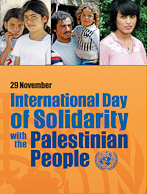
Intl Day Solidarity Palestinian PeopleToday is the International Day of Solidarity with the Palestinian People.

The UN Calendar of Observances app says this about the day:

More than eight million Palestinian people live in territory occupied by Israel, in Israel, in neighbouring Arab States, and in regional refugee camps. International Day of Solidarity provides an opportunity to remind the international community that the question of Palestine remains unresolved and that the Palestinian people have not yet attained their inalienable rights as defined by the UN General Assembly, including the right to self-determination and national independence.

On the official page for the day, the UN provides this description:

In 1977, the General Assembly called for the annual observance of 29 November as the International Day of Solidarity with the Palestinian People (resolution 32/40 B ). On that day, in 1947, the Assembly adopted the resolution on the partition of Palestine(resolution 181 (II))

In resolution 60/37  of 1 December 2005, the Assembly requested the Committee on the Exercise of the Inalienable Rights of the Palestinian People and the Division for Palestinian Rights, as part of the observance of the International Day of Solidarity with the Palestinian People on 29 November, to continue to organize an annual exhibit on Palestinian rights or a cultural event in cooperation with the Permanent Observer Mission of Palestine to the UN.

The observance of the International Day of Solidarity with the Palestinian People also encouraged Member States to continue to give the widest support and publicity to the observance of the Day of Solidarity.

In 2014, the Day, which is normally observed on 29 November, will be commemorated at UN Headquarters in New York on Monday, 24 November.

I had the privilege to speak on behalf of the Israel-Palestine NGO Working Group at the UN for the observance of the International Day of Solidarity with the Palestinian People. We called for the UN and international community to increase their engagement and efforts to support Palestinians and Israelis in the search for just, sustainable peace.

UN Secretary-General Ban Ki-moon also spoke. He concluded:

On this International Day of Solidarity, I call on the parties to step back from the brink.  The mindless cycle of destruction must end.  The virtuous circle of peace must begin.

May the circle begin!

See you along the Trail.

Leave a comment

Filed under Human Rights, Presbyterian Church (U.S.A.), Presbyterian Ministry at the United Nations

Orange Your Neighbourhood – End Violence against Women and Girls Now

banner_en_medium400

adapted from an email sent by UN Women’s Civil Society Section and originally published on Swords into Plowshares

November 25 is the International Day to End Violence against Women and the start of the 16 Days of Activism against Gender-Based Violence Campaign! As you may know, this year’s UN celebrations will take place under the theme “Orange Your Neighbourhood – End Violence against Women and Girls Now“. The initiative led by the Secretary-General’s UNiTE campaign focuses on local actions towards ending violence against women and girls, while using orange as the uniting colour of all advocacy efforts.

As part of  the online campaign for the 16 Days, UN Women’s Civil Society invites everyone to join in the effort and orange their social media accounts. It’s quite simple – you can show your support and orange your Twitter and Facebook profile pictures by adding an orange Twibbon filter.

Could consider adding the Twibbon filter to your organization’s and/or personal profile picture any time between 25 November and 10 December to raise awareness on ending violence against women and girls. We can join the conversation on social media through the hashtags #orangeurhood and #16days, and are welcome to use any of the suggested messages and images available in UN Women’s social media package.

Learn more about the PC(USA)’s initiative to end violence against women and girls.

Presbyterians against Domestic Violence provides a number of liturgical and resources to address domestic violence.

Presbyterian Women offers suggestions for actions to end violence against women and girls year round.

See you along the Trail

Leave a comment

Filed under Current Events, Human Rights, Presbyterian Church (U.S.A.), Presbyterian Ministry at the United Nations, United Nations

Wars Leave Devastating Impact on Environment

Here is an EthicsDaily.com article “Wars Leave Devastating Impact on Environment” co-written with Grace Ji-Sun Kim.

Check EthicsDaily.com for more articles, videos and news.

November 6 is the International Day for Preventing the Exploitation of the Environment in War and Armed Conflict.

Ancient words from Deuteronomy remind us of the relationship between conflict and the environment created by God.”If you besiege a town for a long time, making war against it in order to take it, you must not destroy its trees by wielding an ax against them. Although you may take food from them, you must not cut them down. Are trees in the field human beings that they should come under siege from you?” (Deuteronomy 20:19)Conflict claims human lives, maims human bodies and scars human souls – combatant and non-combatant alike. Conflict also exacts a cost on God’s creation.The United Nations General Assembly echoed these words when it declared Nov. 6 the International Day for Preventing the Exploitation of the Environment in War and Armed Conflict.

The United Nations Environment Program (UNEP) report, “From Conflict to Peacebuilding: The Role of Natural Resources and the Environment,” observes, “Environmental factors are rarely, if ever, the sole cause of violent conflict. Ethnicity, adverse economic conditions, low levels of international trade and conflict in neighboring countries are all significantly correlated as well.”

“The exploitation of natural resources and related environmental stresses can be implicated in all phases of the conflict cycle, from contributing to the outbreak and perpetuation of violence to undermining prospects for peace,” the report added.

War impacts the environment, particularly when parties in a conflict have deliberately targeted natural resources. For example:

  • During World War I, the British sabotaged Romania’s oilfields to deny them to the Central Powers.
  • From 1962 to 1971, the United States sprayed some 20 million gallons of herbicides, Agent Orange foremost among them, on rural areas of South Vietnam in an effort to deny cover and food to the Viet Cong and North Vietnamese forces.
  • As they retreated from Kuwait in 1991, Iraqi forces blew up oil wells and set fire to oilfields.

Conflict disrupts land use, water supply, air quality and ecosystems. Conflict creates refugees whose struggle for survival may lead to depletion of resources or other stresses on ecosystems. Environmental impacts may remain long after conflict ends.

People in Japan, the United States and various Pacific islands continue to suffer the effects of the development, testing and use of nuclear weapons.

The International Campaign to Ban Landmines reminds us that “some 60 countries around the world are contaminated by landmines and thousands of people continue living with this daily threat of losing their life or limb.”

In the past, conflicts occurred between nation states. Today, conflict more often takes place within a nation state, although it may involve people from beyond national borders.

The UNEP report said, “Civil wars such as those in Liberia, Angola and the Democratic Republic of Congo have centered on ‘high value’ resources like timber, diamonds, gold, minerals and oil.”

The environment suffers as military exercises use fuel. The production of weapons consumes natural and financial resources that could have been used to promote human welfare and environmental protection.

International law offers one way to protect the environment in times of conflict.

However, the UNEP report concluded that “the existing international legal framework contains many provisions that either directly or indirectly protect the environment and govern the use of natural resources during armed conflict. In practice, however, these provisions have not always been effectively implemented or enforced.”

Strengthening and expanding international law in relation to environmental protection in conflict is crucial.

Klaus Toepfer, executive director of UNEP from 1998 to 2006, called for “safeguards to protect the environment” in which “using the environment as a weapon” would be “denounced as an international crime against human-kind, against nature.”

Environmental remediation provides directions for responses after conflict.

Remediation may involve rapid responses, as occurred in extinguishing the fires and cleaning the spills in Kuwait.

It may involve long-term environmental sustainability plans such as reforestation and paying careful attention to environmental concerns in post-conflict situations.

International law may reduce the environmental impacts of conflict and preparations for conflict. Environmental remediation may help in a conflict’s aftermath.

Conflict prevention remains the most effective way to protect the environment. This includes demilitarization.

Diplomatic negotiation, people power, addressing poverty, strengthening human rights and the rule of law, building democratic institutions, controlling small arms, teaching nonviolence and other strategies may help prevent intrastate conflict.

Recognizing that the human family shares one planet and has no other place to live should inspire environmentalists to become peacemakers and peacemakers to become environmentalists.

Christians are called to environmental peacemaking work. God has made all that exists; God has made us.

All people are God’s children; all people are our brothers and sisters. The earth, and all that is therein, belong to God.

God entrusts this earth to us for a time, to exercise care on behalf of the created order, our sisters and brothers, generations as yet unborn, and God.

Addressing the environmental impact of conflict is a way we live our faith.

Grace Ji-Sun Kim is a visiting researcher at Georgetown University and the author of six books and numerous articles. Jamie Yen Tan provided research assistance on this project.

Leave a comment

Filed under Current Events, Presbyterian Ministry at the United Nations, United Nations