Category Archives: Presbyterian Church (U.S.A.)

Lent 2017, day 10

lenten-reflections-on-the-confession-of-belhar“God hopes we don’t approach the gift of our unity out of begrudging obligation, but that by God’s grace, we will embody our unity from a spiritual posture of joy and awe, amazed at how wonderfully God has made us one.”
Shannon Johnson Kershner
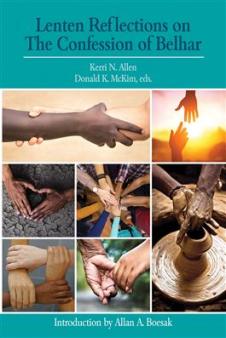
Lenten Reflections on the Confession of Belhar

May awe
and amazement
give rise to
joy

This Lenten season I am using a new resource to explore the Belhar Confession: Lenten Reflections on the Confession of Belhar, edited by Kerri N. Allen and Donald K. McKim. The Presbyterian Church (U.S.A.), in which I serve as a teaching elder (pastor), added the Confession of Belhar to our Book of Confessions in 2016. This confession came from the Dutch Reformed Mission Church during its historic struggle against apartheid in South Africa.

See you along the Trail.

Leave a comment

Filed under Antiracism, Books, Lent, Presbyterian Church (U.S.A.)

Lent 2017, day 8

lenten-reflections-on-the-confession-of-belhar“We deliberately and intentionally practice giving ourselves to one another because we realize we belong to each other. We need each other. We are inextricably tied together. We pursue this unity like a brutal physical regimen. It is not something we come by perfectly, all at once. It is terribly messy, awkward, and fully human. In many ways, it brings out our deepest insecurities and vulnerabilities if we are doing it faithfully and hopefully.”
Mihee Kim-Kort
Lenten Reflections on the Confession of Belhar

May I live into unity with all my
mess,
awkwardness,
vulnerability,
insecurity,
and everything I need to be
fully human
and thus
receive faith and hope
for the living of these days.

This Lenten season I am using a new resource to explore the Belhar Confession: Lenten Reflections on the Confession of Belhar, edited by Kerri N. Allen and Donald K. McKim. The Presbyterian Church (U.S.A.), in which I serve as a teaching elder (pastor), added the Confession of Belhar to our Book of Confessions in 2016. This confession came from the Dutch Reformed Mission Church during its historic struggle against apartheid in South Africa.

See you along the Trail.

Leave a comment

Filed under Antiracism, Books, Lent, Presbyterian Church (U.S.A.), Uncategorized

Lent 2017, day 7

“… before we arrive at Holy Week, we spend time in the wilderness with Jesus. We reflect on the violence that surrounds too many places in our nation and the world. We sit with the Belhar Confession, and we can contemplate Belhar’s origins from South Africa during the violent rule of apartheid. In the midst of the violence struggle for dignity and justice, the church took a stand to say that love conquers all.”
Joseph Kinnard
Lenten Reflections on the Confession of Belhar

Where human dignity is violated,
where violence reigns,
where systems perpetuate injustice,
may we proclaim love;
difficult as it is,
may we, may I,
proclaim love.
may I, may we,
live love.

This Lenten season I am using a new resource to explore the Belhar Confession: Lenten Reflections on the Confession of Belhar, edited by Kerri N. Allen and Donald K. McKim. The Presbyterian Church (U.S.A.), in which I serve as a teaching elder (pastor), added the Confession of Belhar to our Book of Confessions in 2016. This confession came from the Dutch Reformed Mission Church during its historic struggle against apartheid in South Africa.

See you along the Trail.

Leave a comment

Filed under Antiracism, Books, Lent, Presbyterian Church (U.S.A.)

Lent 2017, day 6

“The casual and self-justified divisions existing across so many lines of difference within the body of Christ around the world wreak havoc and destruction to God’s witness through the church. Belhar underscores our need to confess both the reality of this brokenness and the call to live differently–to embody the demonstration of unity for which Jesus lived, prayed, suffered, died, and rose to make possible. Such restored, re-created communion is God’s model and mission in the world.”
Mark Labberton
Lenten Reflections on the Confession of Belhar

I’m not sure the divisions are always that casual. They may be carefully calculated. Divisions may go unnoticed by the people who benefit from them, and who have created them. Casual, calculated, self-justified, unnoticed, the divisions are real. They wreak havoc and destruction in the church and in its witness. May I have the grace to notice when I create divisions as well as long-standing divisions that benefit me. May I have the courage to work to disrupt and overcome divisions.

This Lenten season I am using a new resource to explore the Belhar Confession: Lenten Reflections on the Confession of Belhar, edited by Kerri N. Allen and Donald K. McKim. The Presbyterian Church (U.S.A.), in which I serve as a teaching elder (pastor), added the Confession of Belhar to our Book of Confessions in 2016. This confession came from the Dutch Reformed Mission Church during its historic struggle against apartheid in South Africa.

See you along the Trail.

Leave a comment

Filed under Antiracism, Books, Presbyterian Church (U.S.A.)

Lent 2017, day 5


lenten-reflections-on-the-confession-of-belhar“We are blessed saints by God. Bound in God’s grace, we live within God’s mercy. In God’s mercy, we need to build up instead of tear down. We show God’s mercy to each other through forgiveness. Lent reminds us of the important role forgiveness plays in unity. To forgive others is crucial in situations of conflict, as is accepting forgiveness offered to us. Mercy and forgiveness are essential.”
Grace Ji-Sun Kim
Lenten Reflections on the Confession of Belhar

May I have the courage to forgive others; the grace to accept forgiveness; and the mercy to forgive myself.

This Lenten season I am using a new resource to explore the Belhar Confession: Lenten Reflections on the Confession of Belhar, edited by Kerri N. Allen and Donald K. McKim. The Presbyterian Church (U.S.A.), in which I serve as a teaching elder (pastor), added the Confession of Belhar to our Book of Confessions in 2016. This confession came from the Dutch Reformed Mission Church during its historic struggle against apartheid in South Africa.

See you along the Trail.

Leave a comment

Filed under Antiracism, Books, Lent, Presbyterian Church (U.S.A.), Uncategorized

Lent 2017, day 3

lenten-reflections-on-the-confession-of-belhar“After his resurrection, Jesus commissioned the creation of a family originating not from a common human ancestor, but a divine calling. This family transcends national borders, cultures, and languages. Jesus called for disciples to be made of all nations–indeed, as Belhar says, the ‘entire human family.’ That does not mean that we reject or erase our differences, for a family made from all nations will necessarily have variety. We can, however, reject the lie that such variety cancels out unity. The vision, after all, has always been that this family would be different.”
T. Denise Anderson,
Lenten Reflections on the Confession of Belhar

With thanks for the wonderful variety God creates within the family, with repentance for the ways family members have been excluded and marginalized and homogenized and for the ways I have participated in such exclusion, marginalization, and homogenization, and with commitment to disrupt exclusion, marginalization, and homogenization and to work for justice and equity, I journey toward Lent.

This Lenten season I am using a new resource to explore the Belhar Confession: Lenten Reflections on the Confession of Belhar, edited by Kerri N. Allen and Donald K. McKim. The Presbyterian Church (U.S.A.), in which I serve as a teaching elder (pastor), added the Confession of Belhar to our Book of Confessions in 2016. This confession came from the Dutch Reformed Mission Church during its historic struggle against apartheid in South Africa.

See you along the Trail.

Leave a comment

Filed under Books, Lent, Presbyterian Church (U.S.A.)

Lent 2017, day 2

lenten-reflections-on-the-confession-of-belhar“Belhar constrains us to say out loud to God and the faithful how we have been complicit through our unwillingness to speak and act, even as we witness injustice in the public square.”
Mark Lomax, Lenten Reflections on the Confession of Belhar

This Lenten season I am using a new resource to explore the Belhar Confession: Lenten Reflections on the Confession of Belhar, edited by Kerri N. Allen and Donald K. McKim. Explorations will continue after Lent with Thirty Days with the Belhar Confession, produced by the Presbyterian Peacemaking Program.

The Presbyterian Church (U.S.A.), in which I serve as a teaching elder (pastor), added the Confession of Belhar to our Book of Confessions in 2016. This confession came from the Dutch Reformed Mission Church during its historic struggle against apartheid in South Africa.

Hopefully reflecting on the words of the confession, scripture,and the writings of friends and people I do not know, will provide insights and strength for me in the struggle for justice and equity in the face of racism, sexism, Islamophobia, and related forms of oppression. Hopefully they will inspire me to speak and act on the public square, in the church, and throughout life.

See you along the Trail.


Leave a comment

Filed under Books, Lent, Presbyterian Church (U.S.A.)

Good reasons to come to Standing Rock – to do needed physical labor

On November 15, 2016, I had the privilege to go with Native American Presbyterian leaders to the Water Protector camps at Standing Rock in North Dakota. Among the reasons for people to come to Standing Rock is to do needed physical labor.

Darkness descended on the camp as we arrived.
We stood, watching the flames of the fire dance.
woodA man fed more wood, the smoke tickling our noses. 
“We need help in the kitchen.”
The voice came from behind.
I turned and walked across the compound. ”
What can I do?”
“Here’s a knife. Get some gloves in the back.
Help debone this suckling pig.”
That had never appeared on my resume.
But it was the work needed at the moment.
For the next thirty minutes, with Estrella and Quay,
I cut and tore meat from bone.
Meat from bone.
Meat from bone as a dog stared hungrily at my work.
“Healthy food,” Quay cheerfully told all who came and asked what was for supper.
“Ready in 45 minutes,” Brandon told everyone. No matter when they asked.
From around the fire came the sound of drums and song as we cut meat from bone.
Meat from bone.
Meat from bone. Until it was done.
I left the kitchen.
The dog stared.
The drums played.
The fire danced.
The people continued.

15 November 2016
Ft. Yates, North Dakota

Note – the photo, by my friend Buddy Monahan, shows me helping move firewood, another task I did for a time, a task that did not inspire bad poetry in the same way deboning did. 

Leave a comment

Filed under Current Events, Presbyterian Church (U.S.A.)

When incivility becomes the norm

by J. Herbert Nelson, II | Stated Clerk of the PC(USA) General Assembly

This statement is a response to the violence on America’s streets after the election of Mr. Donald Trump as President–Elect of the United States of America. It was originally posted by the Presbyterian News Service

Stated Clerk of the General Assembly, Reverend Dr. J. Herbert Nelson

LOUISVILLE – I read several post-election statements and heard news accounts of violence, riots, and protests while in Central America visiting Presbyterian Church (U.S.A.) mission partners. The news images were shocking to both our partners and me. We struggled to understand the results of the election, particularly given Mr. Trump’s stance on immigration, which was the theme of my visit. However, I was not as startled as my Central American friends. Serving as director of the Presbyterian Church (U.S.A) Office of Public Witness in Washington, D.C., for six years prior to becoming Stated Clerk prepared me to understand the outcomes we face in electoral politics. Although I have shared parts of this writing before with congregations and audiences, there seemed to always be a sense of skepticism among the hearers. I proclaim the message once again, because the apparent shock for many has left people raising the question, “What happened?”

I wish to affirm in this moment that many in our congregations and communities hold legitimate fear about their safety and the protection of their human rights. We hold close our Muslim, Hispanic, African American, immigrant, and LGBTQ neighbors, and those from other marginalized groups. We hold close the women who give us life and the poor for whom daily bread is not promised. The rash of hateful harassment [1] reported in the wake of the election insists upon the urgency of the call to be one who “… executes justice for the orphan and the widow, and who loves the strangers, providing them food and clothing. You shall also love the stranger, for you were strangers in the land of Egypt” (Deut. 10:18–20, NRSV).

This writing is not a denial of the results of the election. President-Elect Trump is our newly elected leader. However, it is my hope that the post-election anger, pain, and frustration demonstrated on the streets will lay the foundation for a transformed political system in the years to come. Through coalition building and community organizing, we have an opportunity to create a vision of shared prosperity, safety, dignity, and justice that is truly inclusive and compelling to a broad base.

I insist, though, that no matter how robust the infusion of energy into the struggle for justice, it will never be worth the pain, suffering, and yes, death, which will be wrought by the promised policies of the incoming administration. My integrity as a spiritual leader commands me to face the reality that some of our communities are under grave threat. In my recent travels to El Salvador, I spoke with many who expressed fear for their family members’ safety in the U.S.; that the violence they fled El Salvador to escape would be brought upon them tenfold if they were deported back to their country of origin. People with preexisting conditions are troubled over what a sudden loss of healthcare would do to their wellbeing. Same-gender parents are rushing to finish their adoptions and secure their rights as a family. Survivors of sexual assault are contending with a culture that would elect to our highest office a known abuser. In this dark night, the doors of the Church are open as refuge, resource, and organizing home.

As Christians, we cannot accept a nation that normalizes violence, exclusion, and racism in our political rhetoric and public policy. We know God has called us to co-create a world where a dignified life is available to all, and anything less offers no suitable worship. In the coming months and years, “… From everyone to whom much has been given, much will be required; and from the one to whom much has been entrusted, even more will be demanded” (Lk. 12:48 NRSV). We will be asked to open our church basements to late-night meetings, our sanctuaries to provide Sanctuary to those facing deportation, and to intervene in public harassment.

Just as the doors of the Church are open, so too are the doors to the movement for justice. We invite you to join us in our steadfast commitment to stand with the marginalized and our humble desire to contribute to strategy and vision that will help create the kingdom of God.

Read more.

1 Comment

Filed under Current Events, Human Rights, Presbyterian Church (U.S.A.)

Presbyterian advocacy group issues challenge to ‘raise our collective voice’

From the Advocacy Committee on Racial Ethnic Concerns of the Presbyterian Church (U.S.A.)

Advocacy Committee for Racial Ethnic Concerns calls church to action

Press Release | ACREC

The Advocacy Committee for Racial Ethnic Concerns (ACREC) calls the Presbyterian Church (U.S.A.) to embody what it has confessed, “that the church as the possession of God must stand where the Lord stands, namely against injustice and with the wronged; that in following Christ the church must witness against all the powerful and privileged who selfishly seek their own interests and thus control and harm others. Therefore, we reject any ideology which would legitimate forms of injustice and any doctrine which is unwilling to resist such an ideology in the name of the gospel.”
– Belhar Confession

People of color in the U.S. are being killed by police in disproportionate numbers because of the color of their skin, their race, and ethnicity. We condemn and lament the continued and routine killing of unarmed people of color particularly African American men and call for full investigations in the police killings of Keith Lamont Scott in Charlotte, North Carolina, Terence Crutcher in Tulsa, Oklahoma, and Tyre King in Columbus, Ohio.

People of color in the U.S. live under surveillance, the threat of deportation, and constant systemic violence. We are alarmed by the Obama administration’s continuing pattern of deportation and family separation. We are alarmed by the ways in which police and ordinary citizens are deputized, formally and informally, to perpetuate this culture of surveillance and violence. We are alarmed by the persistence of anti-Muslim and Islamophobic rhetoric and policy proposals abounding in the current presidential campaign.

People of color in the U.S. are being attacked and criminalized for their courageous stands against police violence, greed, environmental injustice, and treaty violations. We condemn the use of militarized private contractors to remove the Native Americans encamped at the confluence of the Missouri and Cannonball rivers seeking to stop the development of the Dakota Access Pipeline that threatens water, earth, and indigenous sacred spaces.

People of color in the U.S. are reminded daily in explicit and implicit ways of the hold white supremacy has over the soul of this nation. White supremacy; as a church we must say it. It is white supremacy that lies at the root of the systemic violence that kills, suffocates the life, limits the mobility, and creates the logic for the policing and detention of people of color in the United States.

Given this reality, ACREC calls the members of the Presbyterian Church (U.S.A.) to leave the comfort of their buildings to put their bodies on the line as co-conspirators in a movement for transformation, to stand for reparative justice instead of cheap reconciliation, to join communities of resistance, declaring that all people are created by God which means uttering without equivocation that Black Lives Matter!

We call the members of the Presbyterian Church (U.S.A.) to support the efforts of those gathered at Standing Rock to protect the water, the land, and the generations of people whose lives are threatened by the Dakota Access Pipeline expansion.

We call the teaching elders of the Presbyterian Church (U.S.A.) to not just lament and pray for change but to challenge the members of their congregation to acknowledge and confess our participation in systems of oppression and to lead them to work for justice in and outside of the church.

We call the ruling elders of the Presbyterian Church (U.S.A.) to exercise their spiritual and ecclesiastical leadership by creating and formulating ways for their congregation to engage in actions – economic and programmatic – that interrupt white supremacy.

ACREC strongly encourages the Presbyterian Church (U.S.A.) and all of its members to join the mobilization of 5,000 prayers and/or actions around the world calling for water rights, clean air, and the restoration of the earth and its peoples by participating in the International Days of Prayer and Action with Standing Rock (October 8-11, 2016).

ACREC also strongly encourages the congregations and mid-councils of the Presbyterian Church (U.S.A.) to support the newly established Freedom Rising Fund created as a result of an action taken by the 222nd General Assembly (2016). This fund will support specific actions, “not just in word, but also in deed, to address and improve the worsening plight of the African American male.” Congregations and mid-councils are asked to direct a portion of the Peace and Global Witness Offering to this fund.

Finally, we urge our church and all of its members, especially those who are white, to join us in breaking silence. Commit with us to raise our collective voice not just to proclaim the good news of God’s grace but to call out injustice, to call out the forces that threaten to tear us apart with xenophobic, racist, and Islamophobic rhetoric. May we have the courage.

Buddy Monahan (Chair, ACREC)
Thomas Priest Jr.(Vice Chair, ACREC)

Leave a comment

Filed under Antiracism, Current Events, Presbyterian Church (U.S.A.)