
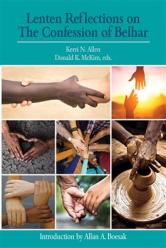
 “God hopes we don’t approach the gift of our unity out of begrudging obligation, but that by God’s grace, we will embody our unity from a spiritual posture of joy and awe, amazed at how wonderfully God has made us one.”
Shannon Johnson Kershner
Lenten Reflections on the Confession of Belhar
May awe
and amazement
give rise to
joy
This Lenten season I am using a new resource to explore the Belhar Confession: Lenten Reflections on the Confession of Belhar, edited by Kerri N. Allen and Donald K. McKim. The Presbyterian Church (U.S.A.), in which I serve as a teaching elder (pastor), added the Confession of Belhar to our Book of Confessions in 2016. This confession came from the Dutch Reformed Mission Church during its historic struggle against apartheid in South Africa.
See you along the Trail.
 “We deliberately and intentionally practice giving ourselves to one another because we realize we belong to each other. We need each other. We are inextricably tied together. We pursue this unity like a brutal physical regimen. It is not something we come by perfectly, all at once. It is terribly messy, awkward, and fully human. In many ways, it brings out our deepest insecurities and vulnerabilities if we are doing it faithfully and hopefully.”

 “We are blessed saints by God. Bound in God’s grace, we live within God’s mercy. In God’s mercy, we need to build up instead of tear down. We show God’s mercy to each other through forgiveness. Lent reminds us of the important role forgiveness plays in unity. To forgive others is crucial in situations of conflict, as is accepting forgiveness offered to us. Mercy and forgiveness are essential.”
 “I love that we Presbyterians have embraced the Belhar Confession. With it we confess the global evil which is also our particularly American evil. We claim our hope that in the church, Jesus Christ’s reconciling work has reconciled us with God and and with one another.”
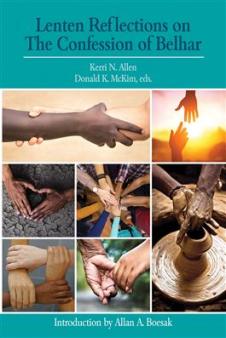 “After his resurrection, Jesus commissioned the creation of a family originating not from a common human ancestor, but a divine calling. This family transcends national borders, cultures, and languages. Jesus called for disciples to be made of all nations–indeed, as Belhar says, the ‘entire human family.’ That does not mean that we reject or erase our differences, for a family made from all nations will necessarily have variety. We can, however, reject the lie that such variety cancels out unity. The vision, after all, has always been that this family would be different.”
 Along the Graybeard Trail