
 “By faith we connect the action of restoration to God’s work through Jesus. By experience, we note that one cannot restore a right relationship that never existed (that is many experiences of women, people of color, LGBT folks, youth, differently abled, immigrant, poor, differently political, and others). Now that we are beginning to recognize through the Belhar Confession that all is not, and has not been ‘right,’ how will I/you/we commit to thinking differently.
“The Greek verb katallasso (‘reconconcile’) could also be translate as ‘to change’ (for example, a course of action.”
Eric A. Thomas
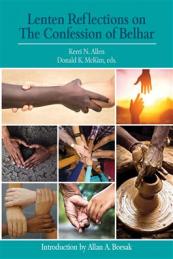
Lenten Reflections on the Confession of Belhar
What will we change? What will I change? To use Eric’s words (with a parenthetical addition): “How will we (I) create new ways of restoration, partnership, advocacy, and welcome?”
This Lenten season I am using a new resource to explore the Belhar Confession: Lenten Reflections on the Confession of Belhar, edited by Kerri N. Allen and Donald K. McKim. The Presbyterian Church (U.S.A.), in which I serve as a teaching elder (pastor), added the Confession of Belhar to our Book of Confessions in 2016. This confession came from the Dutch Reformed Mission Church during its historic struggle against apartheid in South Africa.
See you along the Trail.
 “The Gospel says we are to care enough about the welfare of others to teach and tell them all that Christ has taught and continues to tell us. The Belhar insists that we be the church by ‘living in a new obedience which can open new possibilities of life for society and the world.’ Together the gospel and Belhar pull off the comfortable covers of quietism and push us to engage one another in the interest of attaining peace and justice together.”
 “… our belongingness to the Lord and to the Lord’s people is the will of God alone, the love of God for us in Christ. To believe this and to live it out in the church’s life requires being born again. Sometimes this means being reborn again and again until we are awakened to the heart and mind of Christ.”
 “…we must declare not uniformity, but the unity of the Spirit through the bond of peace as our primary way of being church and society together.”
 “The church’s essential unity may not be threatened by having multiple structures and names; we remain one because Christ has made us one. But when we live separately–when we do not meet together for worship, or hold one another accountable, or study the Bible together–we are all the lesser, unable to speak or hear truth from one another. It’s hard to show love to someone who isn’t there.”
 “In the spirit of true unity, diversity is a gift. We are reminded to live into the reality of our different talents, different roles, and different abilities. When we celebrate the gifts present among our community, we create a language that allows us to name sustainable ways to continue to work for justice.”
 Along the Graybeard Trail