Category Archives: Current Events

An act of commitment

19622780_492922141049366_7685019939471622144_n(1)

Staff and friends of the Presbyterian Church (U.S.A.) gathered this morning at the Presbyterian Center for a chapel service in response to racism and white supremacy in Charlottesville and other places. (An archived live stream of the service is available.)

My colleague and friend, José Luis Casal, director of World Mission, helped celebrate communion.

During the Words of Institution, José Luis observed that, “The bodies of all who have been victims of injustice, the victims of rejection, the victims of violence…are the body of Jesus Christ.”

He reminded us that to come to the table and to partake of the bread and the cup is to commit ourselves personally to stand on the side of love with Jesus and to work against racism, white supremacy, every form of systemic oppression, violence and all that harms any of God’s precious children.

Silently, I shouted “Amen” as loudly as I could.

And I wondered—when the Presbyterian Center or any church or worshipping community gathers to celebrate communion, isn’t that organization making a similar statement? The act of gathering at Christ’s table is, for the community as well, a radical act of commitment to Jesus and to justice, to love and to grace.

May it be so. Amen.

See you along the Trail.

Thanks to my friend and colleague Marissa Galván who posted some of José Luis’s word and inspired me to write this post. The image appeared on the cover of the worship bulletin this morning. View the bulletin for the service

Leave a comment

Filed under Antiracism, Current Events, Friends, Presbyterian Church (U.S.A.), Worship

Churches across the world invited to pray for Korean reunification

The international ecumenical community has invited churches and individuals to join in prayer for the peaceful reunification of the Korean Peninsula on August 13. People of any faith or no faith may join.
  Churches across the world invited to pray for Korean reunification

Photo:WCC

24 July 2017

On 13 August, churches across the world are invited to show solidarity with Korean churches by joining a “Sunday of Prayer for the Peaceful Reunification of the Korean Peninsula.”

The theme for the prayer is based on Romans 14:19: “Let us then pursue what makes for peace and for mutual upbuilding.” The day of prayer occurs two days before Liberation Day in Korea (15 August), during which people celebrate Korea’s liberation from Japanese colonization.

The joint prayer was prepared by the Korean Christian Federation (KCF) from North Korea and the National Council of Churches in Korea (NCCK) from South Korea.

In a letter of invitation to member churches, World Council of Churches general secretary Rev. Dr Olav Fykse Tveit and World Communion of Reformed Churches general secretary Rev. Dr Chris Ferguson invited parishes and individuals across the world to pray for the reconciliation and healing of the divided Korean Peninsula.

“The prayer is an important part of our growing movement to overcome the antagonism that divides the Korean Peninsula and continue to open interaction between communities, churches and people,” the letter reads. “We believe churches across the world can, through prayer, help foster an environment in which peaceful reunification of the Korean Peninsula can flourish.”

Links:

Material Global Prayer Day on 13 August, 2017

Letter to member churches WCC and WCRC

WCC Member churches in Korea

WCRC statement on the Korean peninsula 7 July, 2017

WCC statement on the Korean peninsula 11 June, 2017

Mutuality and cooperation focus at Korean peace meeting in Leipzig (WCC press release 14 July, 2017)

See you along the Trail.

2 Comments

Filed under Current Events

The Cellist of Sarajevo

It was the longest siege of a capital city in modern history, and produced the worst atrocities in Europe since World War II.
Sylvia Poggioli

And everyday he made me wonder
Where did he ever find
The music midst the madness
The courage to be kind
The long forgotten beauty
We thought was blown away
– John McCutcheon
In the Streets of Sarajevo

61ZpqI2PvnL._SS500April 5, 1992 saw the first casualties in what became a 1,425 day siege of Sarajevo during the Bosnian War.

More than 10,000 residents died because of shelling, bombing, the blockade, sniper fire, and other aspects of the siege.

In the midst of the siege, “the madness” to use John McCutcheon’s word, Vedran Smailović, of the Sarajevo Philarmonic Orchestra, played his cello in publuc. He played in ruined buildings, often performing Albinoni’s Adagio in G Minor. He played at funerals during the siege, even though snipers often targeted by snipers.

After mortar fire killed 22 people as the stood in a bread line, Smailović played for 22 straight days in their honor. This part of Smailović’s story has made its way into writings and song. In an article in The Australian, Smailović expands on his experience:

I didn’t play for 22 days, I played all my life in Sarajevo and for the two years of the siege each and every day. They keep saying I played at four in the afternoon, but the explosion was at 10 in the morning and I am not stupid, I wasn’t looking to get shot by snipers so I varied my routine. I never stopped playing music throughout the siege.

Twenty-two days, two years, all his life. The time frame is unimportant. What matters is that Smailović found music and courage and grace and love to make a witness in the face of war and horror.

I give thanks for the Cellist of Sarajevo, and I look for others who, to paraphrase McCutcheon, “do not stand aside … refuse to be defeated … and rage against the tide.”

See you along the Trail.

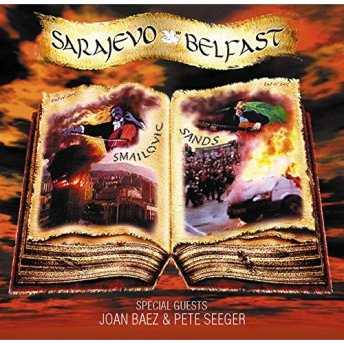
P.S. After leaving Sarajevo, Vedran Smailović collaborated with Irish singer-songwriter and peace activist Tommy Sands to create an album Sarajevo/Belfast.

P.P.S. I use the image of the CD cover because it is a photo I took of a copy of the CD I own.

Leave a comment

Filed under Current Events, Music

Loser – from Marcia Auld Glass

In a recent post, Marci Auld Glass looks both at the recent, and repeated, use of the word “loser” by the president and at the role losing plays in our lives. This post is made with her permission.

Some quotes that caught my attention follow. Check out Marci’s whole post.

At the least, equating depraved terrorists with people on the losing side of the democratic process is inadequate, requiring the word “loser” to stretch far beyond it’s meaning.

In truth, we are all losers, and we should be. When we lose, we learn–about ourselves, about others, about the level of work needed to reach our goals, and the way the world sometimes rewards people who aren’t the ones who work the hardest or who are the most qualified.

To call everyone else “losers” only reveals a shallow insult and a failure of comprehension about the value of not always coming out on top. Kareem Abdul Jabbar said, “You can’t win unless you learn how to lose”.

Marci’s words remind me that I am grateful for the times I took risks; the times I tried to do new things or things a step or two or ten beyond my capacity; the times I did my best and fell short. I am grateful for the times I have lost and what I have learned.

Thank you, Marci, for calling out the word “loser”. Thank you for the reminder of the role losing plays in life.

See you along the Trail.


Leave a comment

Filed under Current Events, Friends

Urge Members of Congress to Attend a Briefing on Life for Palestinian Children under Israeli Military Occupation

From the Presbyterian Church (U.S.A.) Office of Public Witness

50 Years of Israeli Military Occupation & Life for Palestinian Children
Thursday, June 8, 2017
9:30 AM
Cannon House Office Building, Room 122

 Confirmed speakers include:

Omar Shakir, Israel and Palestine Director, Human Rights Watch
Brad Parker, Staff Attorney and International Advocacy Officer, Defense for Children International – Palestine
Nadia Ben-Youssef, Director, Adalah Justice Project
Yazan Meqbil, Leonard Education Scholar and student at Goshen College

1912539_1519557018267999_6120668267282374878_oThe briefing marks 50 years since Israeli forces occupied the West Bank, including East Jerusalem, and the Gaza Strip. Children under 18 years old currently represent 46 percent of the 4.68 million Palestinians living in the Occupied Palestinian Territory. This current generation has grown up in the shadow of failed negotiations and with futures stifled by systemic discrimination, persistent settlement expansion, blockade, and repeated military offensives.

Panelists will examine how persistent human rights violations, systematic impunity, discrimination, and a hyper-militarized environment affect the lives of the Palestinian children growing up under a military occupation with no end in sight.

 The briefing is sponsored by Defense for Children International-Palestine and American Friends Service Committee as part of their No Way to Treat a Child campaign.

Leave a comment

Filed under Current Events, Human Rights, Presbyterian Church (U.S.A.)

Global Day of Prayer to End Famine

From the World Council of Churches:

“Food is more than a human right; it is a divine gift that cannot be impeded. As people of faith on a Pilgrimage of Justice and Peace, we are called to respond to the hunger crisis through prayer, and we encourage communities of all faiths to organize themselves around the issue of access to food.”

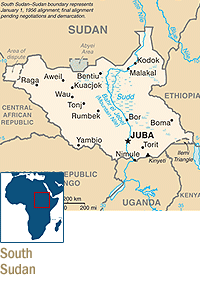
South-Sudan-map1As more people face famine today than any time in modern history, the World Council of Churches (WCC) together with the All Africa Conference of Churches (AACC) and a range of faith-based partners and networks invite a Global Day of Prayer to End Famine on 21 May 2017, in response to the hunger crisis.

To encourage people of faith and good will around the world to observe the global day of prayer on 21 May, the WCC is making available a collection of liturgical resources, prayers, photos and suggested songs to be used in faith congregations worldwide.

Join the Global Day of Prayer to End Famine, 21 May 2017

Resources

1. A Call for a Global Day of Prayer to End Famine – Letter from WCC and AACC general secretaries (pdf)

2. Global Day of Prayer to End Famine – Main messages with bible verses and reflections (pdf)

3. Fact sheet – Global Day of Prayer to End Famine (pdf)

4. Order of worship – Global Day of Prayer to End Famine 21 May 2017 (pdf)

5. Short version – Order of worship – Global Day of Prayer to End Famine 21 May 2017 (pdf)

6. Song proposals for Global Day of Prayer to End famine 2017 (pdf)

7. Ten Commandments of Food – Advocacy kit for congregations (pdf)

8. Call to Action to End Famine

Photo slideshow

Download Powerpoint (pptx)

See you in prayer and action along the Trail.

Leave a comment

Filed under Current Events, Human Rights, Presbyterian Church (U.S.A.)

I do not want his death

This is  guest post by the Rev. Dr. Margaret Aymer Oget, associate professor at Austin Presbyterian Theological Seminary. Thank you Margaret for your words and witness and for allowing them to be shared here.

I know this is not popular, but I don’t want them to execute Dylann Roof.

First, it perpetuates the culture of violence and legitimates the utterly illegitimate system of state-sponsored execution. He becomes the monster who proves the rule.

Second, it treats him as though he is some extraordinary exception that can be rooted out, like a noxious weed, rather than a young adult radicalized by white racist Christianist terrorists intent at creating a race war. Cf. Girard: the Scapegoat

Third, it means he never has to grow up, face what he did, and explain it to himself and to us, aloud. He can die a martyr and never once look in the eyes of the children whose parents he killed, the parents whose children he killed, the parishioners whose pastor he killed, or the legislators whose colleague he killed.

No, I do not want his death. I want those who radicalized him — on trial — for murder. I want their ring dismantled. I want the connections between that ring and the larger structures of systemic racism to become so plain that every and any one can read it.

Leave a comment

Filed under Antiracism, Capital Punishment, Current Events, Death Penalty

Good reasons to come to Standing Rock – to do needed physical labor

On November 15, 2016, I had the privilege to go with Native American Presbyterian leaders to the Water Protector camps at Standing Rock in North Dakota. Among the reasons for people to come to Standing Rock is to do needed physical labor.

Darkness descended on the camp as we arrived.
We stood, watching the flames of the fire dance.
woodA man fed more wood, the smoke tickling our noses. 
“We need help in the kitchen.”
The voice came from behind.
I turned and walked across the compound. ”
What can I do?”
“Here’s a knife. Get some gloves in the back.
Help debone this suckling pig.”
That had never appeared on my resume.
But it was the work needed at the moment.
For the next thirty minutes, with Estrella and Quay,
I cut and tore meat from bone.
Meat from bone.
Meat from bone as a dog stared hungrily at my work.
“Healthy food,” Quay cheerfully told all who came and asked what was for supper.
“Ready in 45 minutes,” Brandon told everyone. No matter when they asked.
From around the fire came the sound of drums and song as we cut meat from bone.
Meat from bone.
Meat from bone. Until it was done.
I left the kitchen.
The dog stared.
The drums played.
The fire danced.
The people continued.

15 November 2016
Ft. Yates, North Dakota

Note – the photo, by my friend Buddy Monahan, shows me helping move firewood, another task I did for a time, a task that did not inspire bad poetry in the same way deboning did. 

Leave a comment

Filed under Current Events, Presbyterian Church (U.S.A.)

Don’t display your solidarity, express it!

This reflection by Sung Yeon Choi-Morrow originally appeared as a guest commentary in the Presbyterian Outlook.

This is not a piece about Standing Rock and the water protectors. This is a reflection to expand the narrative of what happened during the clergy action visit to Standing Rock on November 3, 2016.

For information about Standing Rock and their struggle to protect water, please check Native news sources such as IndianCountryNews.com. I also encourage everyone to read the Standing Rock Allies Resource Packet.

A call to action
Last month, I joined with over 400 other clergy members and responded to a call for clergy to join in a solidarity action with the Oceti Sakowin and their struggle to protect water.

Central to the efforts of the Oceti Sakowin people is a ritual of sacred fire. When I arrived at the camp, Adrianne, the sacred fire keeper, greeted my friends and me and thanked us for being there. He then explained the significance of the sacred fire, that it had been going since April and how we need to understand it.

Adrianne emphasized that it was an important element of ritual to keep the fire pure. This meant that only Fire Keepers (those designated by elders) are permitted to tend the fire. To respect the sacred fire, it was explained to everyone who entered the camp that they should not take photos of the fire or throw anything into the fire (aside from sage and tobacco while offering prayer).

By the end, it was clear to me that the Fire Keeper informed everyone who entered the camp about the power and importance of the sacred fire and honor its role. I was deeply discouraged by how some members of our clergy group were ignorant of these guidelines.

A lesson in solidarity tourism
When we gathered for the clergy action orientation, the coordinator for the event, Father Floberg, told us that the next day would start with a ceremony at the sacred fire. We were informed that white Christians will repudiate the Doctrine of Discovery to native elders. In addition, the organizers of the ceremony got special permission for us to take pictures near the sacred fire for this event because it would be so historic.

With the knowledge that sacred fire was not to be photographed, why was permission requested? Why did this group of clergy feel so entitled as to think their needs to document this event were more important than honoring the intentions of the native people not to photograph near the sacred fire? The fact that this request was offered and accepted is reminder of the colonial mentality of exceptionalism and justification. It was not a request that honored the camp that hosted us.

At the ceremony, all I could see were cameras and people swarming around the sacred fire.  What was supposed to be a sacred event to show our repudiation of a doctrine that oppressed and displaced so many natives turned into what felt like a celebrity staging.

A self-serving narrative
Whose needs were being served through this event of repudiation of the Doctrine of Discovery? If it was really for the native people, if we came to honor their tradition, we would not have taken pictures. It was the needs of highlighting the clergy, not the community, and what the clergy were doing for the community that was prioritized.

After the ceremony, the clergy group walked towards the bridge where our prayer vigil was to take place. But we walked alone; not many people from the camp were with us. The giant cross at the front of our procession felt more like a crusade than a solitary action.

I left early to go to the camp. It was clear that majority of the clergy did not connect with those at the camp. Many of the folks back at camp didn’t even know what was going on with this large group of clergy who showed up. Then I heard announced across camp that the clergy were heading to Bismarck to the State Capitol.

At Bismarck, 14 clergy members were arrested, which became the dominant narrative that emerged from the whole action. The story was no longer about the Oceti Sakowin people or the Water Protectors.

Displayed vs. expressed solidarity
My main discomfort with the way the clergy group behaved was that it seemed more important to display their solidarity rather than express solidarity. When someone is concerned about displaying solidarity, they make the effort about themselves. They control the narrative and to ensure their experience is validated. They make the story about themselves and not about the people they are in solidarity with.

Expressing solidarity is to be present in the ways the people you’re standing in solidarity with want you to be present. It requires more listening than talking. It requires getting to know the stories of those who are oppressed. It requires one to not have preconceived notions of what is helpful or effective. It requires one to not have a pre-set agenda of what one wants to get out of the trip for his or her own agenda. Expressing solidarity means letting the needs of the community outweigh the needs of those providing support.

What I observed was solidarity tourism. What I witnessed was exploitive colonialism. From documenting the ceremony at the sacred fire to the clergy rally to getting arrested in Bismarck, the narrative became more about the clergy than those who were protecting water.

Words for future solidarity action
The camp is set up to receive large groups of people (with orientation every day). If you go, go straight to the camp and connect with the Native leaders directly. Go with the mentality of being useful and not with a preconceived notion of what you believe will be a significant contribution. Go with an open heart to express your solidarity rather than to display your solidarity. That may mean you spend four days chopping onion and garlic and not getting arrested. It may mean helping clean up around the camp instead of taking photos. These are expressions of solidarity.

Sung Yeon ChoimorrowSUNG YEON CHOI-MORROW serves in specialized ministry as the deputy director of programs and policy at the National Asian Pacific American Women’s Forum, an organization building a movement through organizing and advocating on issues that impact the lives of Asian American Pacific Islander women and girls in the United States. She is a member of the Chicago Presbytery, worships at Edgewater Presbyterian Church, and lives on the north side of Chicago with her spouse (Joseph Morrow) and their 2-year-old daughter Ella.

Leave a comment

Filed under Antiracism, Current Events

When incivility becomes the norm

by J. Herbert Nelson, II | Stated Clerk of the PC(USA) General Assembly

This statement is a response to the violence on America’s streets after the election of Mr. Donald Trump as President–Elect of the United States of America. It was originally posted by the Presbyterian News Service

Stated Clerk of the General Assembly, Reverend Dr. J. Herbert Nelson

LOUISVILLE – I read several post-election statements and heard news accounts of violence, riots, and protests while in Central America visiting Presbyterian Church (U.S.A.) mission partners. The news images were shocking to both our partners and me. We struggled to understand the results of the election, particularly given Mr. Trump’s stance on immigration, which was the theme of my visit. However, I was not as startled as my Central American friends. Serving as director of the Presbyterian Church (U.S.A) Office of Public Witness in Washington, D.C., for six years prior to becoming Stated Clerk prepared me to understand the outcomes we face in electoral politics. Although I have shared parts of this writing before with congregations and audiences, there seemed to always be a sense of skepticism among the hearers. I proclaim the message once again, because the apparent shock for many has left people raising the question, “What happened?”

I wish to affirm in this moment that many in our congregations and communities hold legitimate fear about their safety and the protection of their human rights. We hold close our Muslim, Hispanic, African American, immigrant, and LGBTQ neighbors, and those from other marginalized groups. We hold close the women who give us life and the poor for whom daily bread is not promised. The rash of hateful harassment [1] reported in the wake of the election insists upon the urgency of the call to be one who “… executes justice for the orphan and the widow, and who loves the strangers, providing them food and clothing. You shall also love the stranger, for you were strangers in the land of Egypt” (Deut. 10:18–20, NRSV).

This writing is not a denial of the results of the election. President-Elect Trump is our newly elected leader. However, it is my hope that the post-election anger, pain, and frustration demonstrated on the streets will lay the foundation for a transformed political system in the years to come. Through coalition building and community organizing, we have an opportunity to create a vision of shared prosperity, safety, dignity, and justice that is truly inclusive and compelling to a broad base.

I insist, though, that no matter how robust the infusion of energy into the struggle for justice, it will never be worth the pain, suffering, and yes, death, which will be wrought by the promised policies of the incoming administration. My integrity as a spiritual leader commands me to face the reality that some of our communities are under grave threat. In my recent travels to El Salvador, I spoke with many who expressed fear for their family members’ safety in the U.S.; that the violence they fled El Salvador to escape would be brought upon them tenfold if they were deported back to their country of origin. People with preexisting conditions are troubled over what a sudden loss of healthcare would do to their wellbeing. Same-gender parents are rushing to finish their adoptions and secure their rights as a family. Survivors of sexual assault are contending with a culture that would elect to our highest office a known abuser. In this dark night, the doors of the Church are open as refuge, resource, and organizing home.

As Christians, we cannot accept a nation that normalizes violence, exclusion, and racism in our political rhetoric and public policy. We know God has called us to co-create a world where a dignified life is available to all, and anything less offers no suitable worship. In the coming months and years, “… From everyone to whom much has been given, much will be required; and from the one to whom much has been entrusted, even more will be demanded” (Lk. 12:48 NRSV). We will be asked to open our church basements to late-night meetings, our sanctuaries to provide Sanctuary to those facing deportation, and to intervene in public harassment.

Just as the doors of the Church are open, so too are the doors to the movement for justice. We invite you to join us in our steadfast commitment to stand with the marginalized and our humble desire to contribute to strategy and vision that will help create the kingdom of God.

Read more.

1 Comment

Filed under Current Events, Human Rights, Presbyterian Church (U.S.A.)