Category Archives: Antiracism

White and Yellow

A short time back, I subscribed to Grace Ji-Sun Kim’s blog –  Grace Ji-Sun Kim ~ Loving Life.

In today’s post (24 April 2013), Grace reflects on race and privilege and racism.

She begins with an experience on a plane trip with her daughter. A brief encounter while leaving the plane brought the reminder that:

… an Asian is always already viewed as a foreigner no matter how long they have been living in this country.  Even fourth or fifth generation Asians are viewed as the “perpetual foreigner.”  Asian Americans have been depicted as “perpetual foreigners,” “unassimilatable,” and other stereotypes that reveal historic and persistent racism experienced by this racial/ethnic group.  For example, almost every Asian in America has been afflicted with the perpetual foreigner syndrome.  Many have been asked, “Where are you really from?”  This loaded question, which I shall call the “really-question,” differs from the usual one, “Where are you from?”  The really question figuratively and literally ejects the Asian American respondent to  Asia, because the assumption behind the question, even if the questioner is oblivious to it, is that Asian Americans cannot be “real” Americans.

From the experience on the airplane, Grace proceeds to explore being viewed as the “other” or a “perpetual foreigner.” She considers the social construction of “whiteness” and white superiority and white privilege. Race, as she notes, intersects with gender, sexuality, age, sexual orientation and more.

Her story and reflection remind me to remain ever vigilant about the role of privilege in my life. In so many ways, I am privileged.That brings me responsibility to challenge the systems and structures that create the privilege and give it to me. Sometimes I do not do that well. Sometimes I do. Always I must pay attention and try to do better.

Grace closes with a vision:

I envision a world for my daughter in which people of all races, ethnicities, sexual orientations, and social classes can come together in harmony and love.

The reality of my privilege challenges me to work to overcome racism and other systems of domination and strive to create another world. The vision encourages me to do the same. Check out Grace’s post and see how it speaks to you.

See you along the Trail.
 

2 Comments

Filed under Antiracism

More on Wounded Knee

Two responses to my post on the fortieth anniversary of the siege of Wounded Knee (one online and one via email) provide new links to share. They add more depth to the story of the siege and of the present reality on Pine Ridge.

Red Cloud Indian School Stories

Pine Ridge Community Storytelling Project

A Photographer Remembers Wounded Knee, 40 Years Later

See you along the Trail.

Leave a comment

Filed under Antiracism, Current Events, Human Rights

Tragedy, resistance, and hope

Forty years ago today, the American Indian Movement arrived in Wounded Knee on the Pine Ridge Reservation in South Dakota. Concerns focused on corruption in the tribal government and the killing of Raymond Yellow Thunder. The location profound symbolic value.

On December 29, 1890 a band of Ghost Dancers under Big Foot, a Lakota Sioux chief, was surrounded by the 7th Cavalry near Wounded Knee Creek.  The demand came for the Lakota to surrender their weapons. A shot cut through the air – it remains unclear from which side. More shots – many. many shots – followed. When the shooting stopped, Big Foot and many of his people, perhaps 150, perhaps as many as 300,  lay dead. Reports indicate that nearly half the dead were women and children. This battle, the Wounded Knee massacre, ended the Ghost Dance movement and marked the end of the war of the United States against the Plains Indians.

The events that began on February 27, 1973 led to a 71-day standoff – the siege of Wounded Knee.

The anniversary brings a time to remember both the events of the past and the current situation faced by the Oglala Lakota. Nicholas Kristoff writes:

Unemployment on Pine Ridge is estimated at around 70 percent, and virtually the only jobs are those working for the government or for the Oglala Sioux tribe itself.

There are, of course, some reservations around the country that have struck it rich with gambling or other ventures. But here in the prairies, those riches are only rumors.

Half the population over 40 on Pine Ridge has diabetes, and tuberculosis runs at eight times the national rate. As many as two-thirds of adults may be alcoholics, one-quarter of children are born with fetal alcohol spectrum disorders, and the life expectancy is somewhere around the high 40s — shorter than the average for sub-Saharan Africa. Less than 10 percent of children graduate from high school.

It is also a time to ponder signs of hope – a campaign to address youth suicide, an effort to make use of renewable energy, and Red Cloud School to name but three. National Geographic has a number of stories as well.

Past, present, and future. Tragedy, resistance, and hope. Remember, learn, and act.

See you along the Trail.

5 Comments

Filed under Antiracism, Current Events, Human Rights

Dr. Ralph J. Bunche of the UN

This originally appeared on Swords into Plowshares, the blog of the Presbyterian Ministry at the United Nations and the Presbyterian Peacemaking Program.

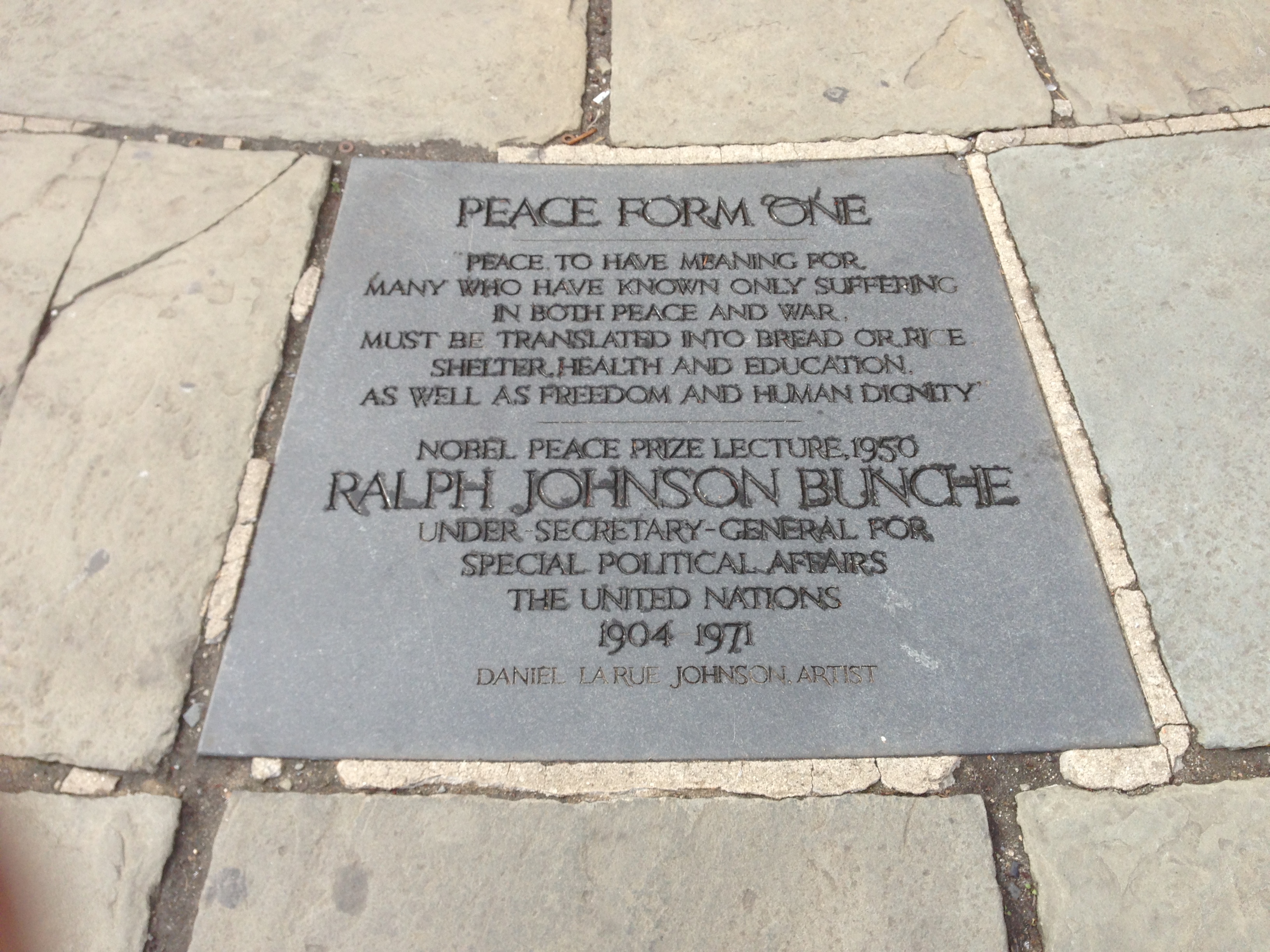
photo (8)I passed through Ralph Bunche Park at 43rd Street and First Avenue on Sunday. And it wondered me why the story of Dr. Ralph J. Bunche‘s life is not told more often.

A political scientist, academic, writer, and diplomat, Bunche took part in planning for the creation of the United Nations. He was an adviser to the U.S. delegation for the “Charter Conference” of the United Nations held in 1945. He took part in drafting the UN Charter. Along with Eleanor Roosevelt, Bunche played a key role in the creation and adoption of the Universal Declaration of Human Rights.

In 1947, Bunche served as the United Nations Special Committee on Palestine. He became the Principal Secretary of the UN Palestine Commission. He served as the Personal Representative of Secretary-General with Count Folke Bernadotte, the United Nations Mediator on Palestine. Following Bernadotte’s assassination in September 1948, Bunche became the Acting Mediator. He chaired the UN mediation efforts that led to the successful negotiation of the four armistice agreements that helped end the conflict.

For his work, Bunche became the first African-American and person of color to receive the Nobel Peace Prize. He continued to served the UN for over twenty years. His work included helping to end colonialism.

Bunche was an active and vocal supporter of the U.S. civil rights movement. He participated in the 1963 March on Washington and in the Selma to Montgomery, Alabama march, which contributed to the passage of the landmark Voting Rights Act of 1965 and federal enforcement of voting rights.

Dr. Ralph J. Bunche is one of so many people to honor – so many stories to remember – during Black History Month and always.

See you along the Trail.

3 Comments

Filed under Antiracism, Human Rights, New York, Presbyterian Ministry at the United Nations, United Nations

A resolution worth making

Several hours ago, New York television stations reported that people have already begun to gather in Times Square to welcome the New Year.

As the New Year approached 150 years ago, people across the United States prepared to welcome a moment of immense significance.

President Lincoln had issued the Preliminary Emancipation Proclamation on September 22, 1862. It provided that if the states in rebellion against the United States did not cease fighting and rejoin the Union by January 1, 1863, all slaves in those states or parts of those states would be declared free from that date forward.

The fighting did not cease. On December 31, 1862, the nation waited. African-Americans gathered for Watch Night Services awaiting the word. And the word came.

The Emancipation Proclamation did not end slavery outright. It did not immediately free anyone as the Union could not enforce the proclamation in the rebellious states. It did not address the issue of slavery in the so-called border states. It did not recognize that many people held in slavery had taken matters into their own hand and had freed themselves.

But the Emancipation Proclamation sent a message of hope to African-Americans. It sent a message of support to all who worked for freedom. It sent a message of intention to the nation and the nations. The war to preserve the Union became a war for human liberation as well.

The Emancipation Proclamation provided a measure of protection to the African-Americans who had freed themselves or who had been freed either by the efforts of the Union army or abolitionists. It paved the way for further steps such as the acceptance of African-Americans into the U.S. military and the eventual abolition of slavery.

This 150th anniversary affords an opportunity to remember the events of the past and to remember the people, our ancestors, who gave of themselves that all people might know freedom, justice, and equality.

This 150th anniversary affords an opportunity to repent, acknowledging that, while great strides have been made, the journey to racial justice remains long and challenging. We have work to do.

And so this 150th anniversary affords ourselves an opportunity, in the words of the Rev. Dr. Martin Luther King, Jr., “to rededicate ourselves to the long and bitter, but beautiful, struggle for a new world. This is the calling of the [children] of God, and our [sisters and brothers] wait eagerly for our response.”

May it be so.

See you along the Trail.

Leave a comment

Filed under Antiracism, Current Events, Human Rights

My friend Bruce is writing a book

My friend Bruce is writing a book. I am supporting his effort. You can read why below or you can just take the plunge and become a supporter too.

No . . . where are you FROM?A Book on Race by Bruce Reyes-Chow

During a trip to San Francisco, when I served as the Presbyterian Church’s associate for antiracism training, I asked a number of friends, colleagues, and wise people who I should meet for conversations about race and racial justice. A number of individuals were named, but one individual was named on a regular basis.

Bruce Reyes-Chow.

I listened. I contacted Bruce. And, over coffee, we met for the first time.

Our conversation ranged across the landscape of the social construction of race and the deconstruction of the structures put into place by racism. We explored the different perceptions of race held by different generations … the different experiences of raced lived by different generations … the differences between racism as experienced on the West Coast and in the Mid West and in other parts of our county. And we experienced the commonalities interwoven within these distinctions.

In the short time we spent together, I developed a deep respect for Bruce, the seeds of friendship were planted, and I realized that he has a voice I and others need to hear on questions related to race. Of course, listening to each other applies to all people. The difference is that Bruce is writing a book.

Bruce will self-publish No … where are you FROM?  He is in the process of raising funds through Kickstarter. I am proud to be a backer – even though I will receive no Pittsburgh Steelers swag as a result – despite my many suggestions of how that would enhance the project to my San Francisco 49ers supporting friend (comments about the results of this weekend’s games will be deleted).

Bruce describes his reason for writing as:

If you’ve ever wanted to cultivate honest conversations about race, this book is my attempt at offering ways to help make that happen.

He reflects on his hope for the book in these words:

My hope is that by sharing my story – the joys and the struggles – this book will compel folk to enter a space where they can get at some of the assumptions, misunderstandings and intentions about race so that deeper connections and relationships can be had.

You can get a sense of his perspective as well as the flavor of his writing from some of his earlier articles:

Bruce notes that:

it is also my hope that you will find the time, faith and courage to jump into these conversations with an openness that challenges the expectations of the world around race.

I plan to take that jump. I assume that Bruce’s book will challenge my expectations around race. And I hope that I will be better equipped to engage in conversations that will help me challenge expectations around race and realities around racism.

Thanks Bruce for writing this book (even if you are a heretic and you talk to your cat – it’s on the Internet, it must be true).

I’m a supporter and I urge others to become supporters as well!

See you along the Trail.

Leave a comment

Filed under Antiracism, Books, Friends, Presbyterian Church (U.S.A.)

Gallant efforts

Last night brought a “gallant effort” double feature to the Shire on the Hudson. I can’t really explain why, but my mood turned in that direction.

The evening began on the Edge of America. Directed by Chris Eyre, the story is loosely based on a true story about a black English teacher who comes to the Three Nations Reservation and ends up coaching the girl’s basketball team. The team has lost consistently. Racism, daughter-father relations, grief, cross-cultural confusion and conflict, and questions of self-esteem are among the issues that the film explores. Among the memorable scenes, a conversation between coach Kenny Williams, played by James McDaniel, and assistant coach Annie Shorty, played by Irene Bedard, stands out:

Annie: Those girls do everything you ask them to do. They practice hard, they get good grades, they win.
Kenny: Then you tell me why I’m pissed off.
Annie:  Because you’re a black man in America.
Kenny:  That’s right, I’m good and pissed off.
Annie: Well then get over it! You’re talking to Indian people here! Get over it, get on with it, or get the hell out!

Williams gets on with it. The young women play their way to the state finals. There they lose to the state powerhouse when a last-second shot bounces off the rim. Coach Williams blames himself and asks for forgiveness for failing the team and leading to the loss. As they return to a rousing welcome from the community, the players point out that they have nothing to forgive as the community and the players realize they have won in every sense of the word.

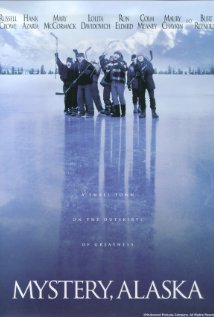
Mystery, Alaska closed the evening. A small town, Mystery loves its hockey. The sport unites the town. Each week brings “Saturday Game”, four-on-four pond hockey played on the open ice of the town’s frozen lake. Charles Danner, played by Hank Azaria, has left Mystery and become a sports writer. His story on the town and its hockey appears in Sports Illustrated. It leads to a game against the New York Rangers. Subplots weave together as the plot moves toward the climactic game – the pride of the town, father-son relations, infidelity, youth and age, a superstore moving to town, a trial of Mystery’s leading scorer. the unwillingness of the Rangers to play during their break, and more. The day of the game arrives. Little Richard, who notes that “It’s cold,” sings both the Star-Spangled Banner and O Canada to prolong the exposure of the Rangers to the frigid Alaskan air. In the first period, the Mystery team, coached by Burt Reynolds and captained by Russell Crowe, jumps out to a lead. The Rangers roar back in the second period to go ahead. Mystery closes the gap in the third period only to fall short when the game-tying shot bounces off the goalposts and into the goalie’s glove. The town, the Rangers, and eventually even the Mystery players recognize and celebrate the effort. Son Eric, friend Sparky and I noticed that several cast members appear with Crowe in 2010’s Robin Hood.

Two enjoyable films, two powerful tales of giving our all, two parables on the meaning of winning, made for a good evening.

See you along the Trail.

Leave a comment

Filed under Antiracism, Movie

Walking with Russell

We met once.

We did not speak.

But for a few moments, we walked together.

On April 4, 1994, the Cleveland baseball team opened a new stadium.

My friends and colleagues among the indigenous peoples and the antiracism activists of Cleveland have a simple message. People are people. Not mascots. The name and logo of the Cleveland baseball team need to go.

The Committee of 500 Years of Dignity and Resistance organized an educational event for the stadium opening. The event included a public witness/demonstration at the new stadium. I attended.

As the stadium opened, we gathered in its shadow. Words were said. Prayers prayed. And then we walked in silence around the stadium.

Russell Means attended the event as one of the speakers. He walked with us. And for a few moments, we walked side-by-side. We made eye contact. We smiled. But no words passed our lips.

Russell, who journeyed to the spirit world early this morning, was a big man. And I walk slowly. I did not keep up for long. But those few moments, I remember, for they were a gift, an honor.

Russell lived a life of courage – working tirelessly and faithfully for the well-being of his people – of all indigenous peoples – of all oppressed peoples – of us all.

I give thanks for his life, his work, and his witness. I give thanks that, for a few moments on one April day in Cleveland, we walked together. I give thanks for all who in any way carry on the struggle for human dignity.

The National Museum of the American Indian will present a symposium: Racist Stereotypes and Cultural Appropriation in American Sports on Thursday, November 1, 2012, 10 AM – 5:45 PM in Washington, D.C. I will not be there, but the event will be Webcast. As my friend Molly suggests, watching – and then taking action – would be an appropriate way to honor Russell Means.

People are people. Not mascots.

See you along the Trail.

Leave a comment

Filed under Antiracism, Current Events, Human Rights

Happy birthday, Nelson Mandela!

This year brings Nelson Mandela‘s 94th birthday: 18 July 2012

To celebrate this day, the UN and the Nelson Mandela Foundation invites us to give 67 minutes to help others as a way to celebrate Nelson Mandela International Day.

For 67 years Nelson Mandela devoted his life to the service of humanity — as a human rights lawyer, a prisoner of conscience, an international peacemaker and the first democratically elected president of a free South Africa.

Find 67 ideas for marking Nelson Mandela International Day. You can add your own.

Register your activity for the day.

Learn about activities and events that are already planned.

Like Nelson Mandela International Day on Facebook.

In November 2009, the UN General Assembly declared 18 July of each year as “Nelson Mandela International Day.” The day recognizes the former South African President’s contribution to the culture of peace and freedom.

Giving thanks for Nelson Mandela’s life and witness, may we follow his example on 18 July – and may we make every day a Mandela day when we serve one another.

See you along the Trail.

4 Comments

Filed under Antiracism, Current Events, Human Rights

Down by (or near) the Riverside

Saturday 30 June brought Riverside Conversations (the convention center is on the Allegheny) at the 220th General Assembly (2012) of the Presbyterian Church (U.S.A.). Commissioners, advisory delegates, and others gathered to consider a range of topics. Some conversations looked at issues before the assembly, some at broader topics in the life of the church.

My friend and colleague Irene Pak and I (our mutual friend and colleague Bruce Reyes-Chow took the photo for us) led an introductory conversation on the church’s need to address racism if we wish to live into the wondrous diversity God creates.

We started with prayer and then had participants (somewhere near 50 in number) introduce themselves and share an experience of diversity. A brief reflection on diversity, race (social construct built on the diversity God creates) and racism (people with power granting themselves privilege based on that construct) followed. We acknowledged that the Presbyterian Church has a mixed record on race and racism – as do all churches and institutions. We have helped create racism – we help perpetuate racism – and we help dismantle racism. A litany affirming God’s intention that we live together in diversity and reminding us of the Presbyterian Church (U.S.A.)’s commitment followed.

The group then heard three remarkable stories of efforts to dismantle racism: the work of the Presbytery of Pittsburgh that began with a focus on slavery in Western Pennsylvania; the New Beginning Initiative toward reconciliation between the Alaska Natives and Presbyterians; and a range of efforts that focus on racism in the criminal justice system.

Participants then used Mutual Invitation to engage in conversations about what they had heard. The event closed with the song “I’m Going to Live So God Can Use Me” as our prayer.

In my closing observations, I noted that working to dismantle racism is a calling for a life-time. It is ongoing work. It is challenging work. It involves us in encountering other systems of oppression, privilege, and domination. It is a journey. But it is a journey God calls us to make. And it is a journey on which we have wonderful traveling companions.

See you along the Trail.


Leave a comment

Filed under Antiracism, Presbyterian Church (U.S.A.)