Category Archives: Worship

Sanctuary: In Three Acts

Sanctuary: In Three Acts
Luke 11:1-4
Numbers 35:9-15
28 July 2019
First Presbyterian Church of Whitestone
The Rev. Mark Koenig 

Sanctuary. A safe place. A refuge. Act I.

You can find following story online in the Tennessean and other sources. Often, the stories include video.[i]

A man drove home in Nashville. His 12-year-old son sat beside him in the van. Did they notice the car following them? They certainly did when they pulled into their driveway and the car stopped behind them.

Two men got out and identified themselves as ICE agents. They showed no identification and they never gave their names. A statement from an ICE spokesman said the officers had a removal order based on misdemeanor convictions of the man.

The man and his family understood that ICE agents cannot enter a vehicle or a home without a warrant signed by a judge. Or unless they receive permission to enter. The man refused. His wife and neighbors alerted their friends and support community.

Neighbors arrived. Family arrived. Media arrived. Immigrant rights activists arrived. City council members arrived. Nashville police arrived, called by the ICE officers. They assessed the situation, learned they had no warrants for either the man or his son and determined their only role would be to keep the peace.

The man and his son stayed in the car. Because it was hot, neighbors brought gasoline so the man could keep the car air conditioning running.

Eventually, the ICE officers determined to leave. The neighbors formed a protective shield around the car that extended to the front door of the house. The son and then the father ran quickly inside. Family, friends, neighbors, all cheered.

The practice of sanctuary – providing a safe place of refuge is ancient. In scripture, the idea appears in the book of Numbers. Here God gives the Hebrew people instructions for their life together as they made a new beginning after leaving enslavement in Egypt.

The culture at the time was based on vengeance. If I murdered someone, that person’s family could take vengeance on me and on my family. Who could then take vengeance on that person’s family and away the cycle of violence could spin.

When the laws in Numbers establish that those who commit murder, and only those who commit the murder, could be put to death, they disrupted this cycle. The principle the laws established of “an eye for an eye” sought to define justice and minimize vengeance. And then Jesus came along and disrupted this principle with teachings of nonviolent responses to violence.[ii]

The laws established in Numbers took another step toward disrupting blood violence. The verses Beth read for us today talk about “a slayer who kills a person without intent.” In modern terms, we might speak about unintentional killing as involuntary manslaughter.[iii]

Cities of refuge were created for people who committed such acts. They could flee to one of these cities and be safe until a trial could be held.

Over time this understanding of providing a place of refuge – providing sanctuary grew. During the religious wars of the Protestant Reformation, worship spaces in churches came to be seen not only as sanctuaries where God was worshiped, they came to be seen as sanctuaries where people could flee to take refuge and safety from the violence.

In churches and barns and homes, the Underground Railroad provided sanctuary to people fleeing enslavement for freedom.

Japan and China went to war in 1937. On December 13, 1937, the city of Nanjing fell to the Japanese.[iv] The events that followed are known as the Rape of Nanjing. Between 40,000 and 300,000 Chinese people were killed. The numbers are contested. The people were killed brutally. Many were tortured. Perhaps as many as 20,000 women were raped.

Amid the horror, the Nanjing Safety Zone was established to offer sanctuary and refuge. Chinese and people in Nanjing from other countries helped create the Safety Zone. But scholars agree that the man who made it work was a businessman named John Rabe. Ready for a twist? John Rabe was German. John Rabe was the head of the Nazi Party in Nanjing. While his party was killing Jews and Slavs and gypsies and LGBTQ people by the millions in Europe, the sanctuary he helped establish and managed saved the lives of between 200,000 and 250,000 people in Nanjing.[v] Rabe was not a “good person”. He was a person who served an obscenely evil cause. But for a moment, he did the right thing.

During the Holocaust, many people provided sanctuary for Jews. Muslims in Albania among them.[vi] My friend Steve Yamaguchi tells about Chiune Sugihara, a Japanese diplomat who had served in China and Finland, and ended up at the time of the Second World War in a solo diplomatic post in Lithuania. He became an Orthodox Christian along the way. At his wife Yukiko’s strong urging, he signed visas saving over 6,000 Polish Jews. Sugihara summarized his actions by saying, “I may have to disobey my government, but if I don’t, I would be disobeying God.” His act of providing the sanctuary of Japanese ended his career as a diplomat. But within the Jewish community he is viewed with deep affection.[vii]

In the 1980s, people fled violence in El Salvador and Guatemala. They arrived in the United States as undocumented refugees. The Immigration and Naturalizations Service implemented a policy of returning people to their country without allowing them to apply for asylum. “On March 24, 1982, six congregations in Arizona and California declared themselves “sanctuaries” and began building communities of support for the growing number of refugees seeking asylum.”[viii] Other congregations across the country joined them. Other congregations and people of faith and good will joined in establishing safe places of refuge.

Fast forward to 2019. People come to the United State fleeing violence and poverty in their home countries. The book of Leviticus teaches the people of God to treat the foreigner as a citizen.[ix] Jesus proclaims that when we welcome the stranger, we welcome him.[x]

Yet our government’s responses seem designed to deny safety and refuge to those in need. Families are separated. Individuals are detained in horrific conditions. The processing of asylum requests and citizenship processes slows to a crawl or a complete stall. That happens to people on the border and it happens to people in the country. As do deportations. We have begun to hear stories of citizens detained and deported; of immigrant men and women who have served in the United States military being deported.

Conversations about sanctuary have been ongoing for some time, perhaps since as long ago as 2007. They have taken on renewed urgency recently. Some congregations have opened their doors and host people in their buildings. Other congregations provide them support. Some congregations make sure their neighbors know their rights in relation to ICE. Individuals volunteer to accompany neighbors to ICE check-ins or deportation hearings. There are a variety of ways for individuals and congregations to become involved.

I invite you to pray and think about this situation. If the Holy Spirit moves you to learn more; if God calls you to consider how you or we together might respond, let me know. We can set up a conversation to explore what we might do.

Sanctuary. A safe place. A refuge. Act II.

In 1969, legal segregation remained the rule across much of the United States. Among other places, swimming pools had signs saying, “White only.” Just five years earlier a famous photo was taken of a hotel manager pouring acid into a swimming pool filled an interracial group of young people who were trying to integrate the pool.[xi]

May 9, 1969. A gentle, peacemaking Presbyterian minister enters the set of his children’s television show he has developed. I have not been able to track down the video, so I don’t know if Mr. Rogers sings, “It’s a beautiful day in the neighborhood”. I don’t know if he goes to the closet and carefully takes off his coat and put on his sweater and then zips it all the way up and then halfway back down.

From both the online episode summary and the book Peaceful Neighbor, I do know that he carries a wading pool. After carefully explaining what the pool is, he takes it outside and fills it with water.

He says that “on hot days he enjoys soaking his feet in cool water.” As he sprays his feet with a hose, Mr. Rogers spots Officer Clemmons nearby and invites him to sit down and join him. When Officer Clemmons says he does not have a towel, Mr. Rogers says they can share. Officer Clemmons pulls up a chair. He takes off his boots and socks, and the camera provides a closeup of four feet sharing the same small pool. Two white feet. Two black feet. When they are done, Officer Clemmons and Mr. Rogers share the same towel to dry off.[xii]

Remember that Mr. Rogers is also the Rev. Rogers. He knows the story of the Last Supper as told in John’s Gospel. Where Jesus washes the feet of his followers and then dries them. Jesus does so to model for his followers loving service.[xiii] The Rev. Fred Rogers got the message.

By sharing a cool pool and a dry towel on a hot day with an African American police officer, Mr. Rogers demonstrated that we are made for each other. We are not made for separation and enmity. We are made for love. For those of us who know and love Jesus, Mr. Rogers made that demonstration out of the Gospel.

And for a moment. He created sanctuary. In a segregated world, Mr. Rogers made a safe place. A refuge.

Friends, whether it is with family, with friends, with church members, with people we know only a little, with people we have just met, we can create sanctuary.

When we listen or provide help when requested.

When we smile and act kindly.

When we act for justice, show mercy, and do our best to walk with God.

When we love.

And when we pray for each other. We create sanctuary.

May we heed the urgings of the Holy Spirit to do so.

Sanctuary. A safe place. A refuge. Act III.

“Lord, teach us to pray.” It was a request from his disciples to Jesus.

“Lord, teach us to pray.” In response, Jesus provided the words the church has adapted a bit over time, and we know as the Lord’s Prayer.

“Lord, teach us to pray.”

In prayer we turn to God. And God meets us, accepts us, loves us as we are. The gift of prayer is a gift of sanctuary. It is a safe place. A refuge.

As the Rev. Shawna Bowman posted on Facebook:

God hears our prayers,
broken prayers,
silent prayers,
angry prayers,
joyful prayers,
prayers given through tears,
prayers given with no conviction, rushed prayers,
prayers shouted with rage,
prayers that come from our deepest places,
prayers that connect us, one to another,
prayers that remind us that we belong to God.

Friends, pray. Open yourself to God. Tell God what is on your heart. Pray aloud. Pray in silence. Pray by thinking. Pray by calling images to mind … friends in needs … situations for which you are concerned.

Two ideas for how to pray when we need help.

First, Anne Lamott offers a three-fold pattern for prayer: Help. Thanks. Wow.[xiv]

God, help me with …

God, thank you for …

God, I stand in awe of …

Or we could use the prayer Jesus teaches us. Pray those familiar words again and again and again.

Pray. Knowing that when we pray for others, we help create a sanctuary for them.

Pray Knowing that however we pray when we take our lives—our joys—our concerns—our whole selves to God in prayer, God will take and shield us. And we will find a solace … a refuge … a safe place … a sanctuary there.

Thanks be to God. Amen.

[i] https://www.tennessean.com/story/news/2019/07/25/viral-video-ice-agents-tried-arrest-man-nashville-immigration/1828008001/ – this article, as well as other uncited online sources, provide the basis for the first eight paragraphs of the sermon.

[ii] Matthew 5:38-42

[iii] https://www.justia.com/criminal/offenses/homicide/involuntary-manslaughter/

[iv] http://www.eyewitnesstohistory.com/nanking.htm

[v] http://day1.org/614-who_is_my_neighbor and https://en.wikipedia.org/wiki/Nanjing_Massacre and https://en.wikipedia.org/wiki/John_Rabe

[vi] https://www.yadvashem.org/yv/en/exhibitions/besa/index.asp

[vii] http://day1.org/614-who_is_my_neighbor

[viii] https://religionandpolitics.org/2017/02/21/the-sanctuary-movement-then-and-now/

[ix] Leviticus 19:34

[x] Matthew 25:35

[xi] https://www.npr.org/2014/06/13/321380585/remembering-a-civil-rights-swim-in-it-was-a-milestone

[xii] Michael G. Long, Peaceful Neighbor: Discovering the Countercultural Mister Rogers (Louisville, KY: Westminster John Knox Press, 2015),p. 88.

[xiii] John 13:3-10.

[xiv] https://www.amazon.com/dp/B008EKMBDM/ref=dp-kindle-redirect?_encoding=UTF8&btkr=1

Leave a comment

Filed under First Presbyterian Church of Whitestone, Worship

Of Love and π

Luke 13:31-35
I Corinthians 13
First Presbyterian Church of Whitestone
March 17, 2019
The Rev. W. Mark Koenig

What comes to mind when you hear the word pie?

Perhaps your favorite pizza?

For me, the word takes me back to  childhood. My mother made better pies than cakes. We celebrated my birthday with chocolate cream. My brother chose Boston Cream. My sister blueberry. At least one of us made a semi-healthy choice.

Of course, mathematicians may think not of pie but of pi. Pi.  A number that designates the ratio of the circumference of a circle to its diameter.

In Greek, perimetros means circumference. Staying in Greek, Pi is the first letter in perimetros. Because of the influence of Greeks on early European mathematics, pi became the word used to describe this number.[i]

To put pi in numbers, one begins with 3.14. At some point in time, March 14 became known as Pi day. People share bad jokes. Bakeries and restaurants offer deals on pie.

Pi Day came last Thursday. I ate no pie. But I received reminders that Pi is both infinite.

Pi is infinite. It’s decimal representation never ends. It starts 3.14 and then goes on forever. Mathematician Emma Haruka Iwao recently computed over 31 trillion digits of pi. In an interview with the BBC, she said, “There is no end with pi, I would love to try with more digits.”[ii]

Reflecting on the infinite nature of Pi, reminds me of a conversation I had with a friend, Joanne Westin. Her teen-age daughter had died in a drowning accident. We talked of Jennifer and we talked of loss. And Joanne observed that, “Grief is infinite.” After a pause, she added, “And so is love.”

“Love bears all things, believes all things, hopes all things, endures all things. Love never ends.”[iii] Love is infinite, because God is love.

I know that. I believe that. I preach that. But I need to hear that this week. This heart-wrenching week.

29542890_10214989437271181_7380570066821968457_nIn Louisville, I worked with the Rev. Robina Winbush, our church’s staff person for ecumenical and interfaith relations. On Tuesday morning, returning from a visit with our church partners in the Middle East, Robina stepped from the plane and into the everlasting, ever-loving arms of God. As she deplaned at JFK, Robina collapsed. Airline personnel and EMTs could not revive her.
Tuesday evening, Mike Miller, the acting chief financial officer for the national church in Louisville, died of a massive heart attack.

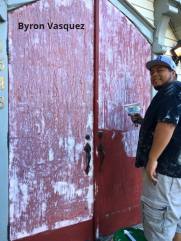
53786357_10156864546396063_7080109362454200320_nWednesday evening, my phone buzzed with a text from Rex bearing the heartbreaking news that Byron Vasquez had died. A gentle, good man gone too soon, too young. Byron made a commitment and gave of himself to the United States – where too often the sin and hate of white supremacy “othered” him as it does to brown and black people.  Labelling him as “less than” and telling him to return to his country.

On Friday, New Zealand time, white supremacy struck in New Zealand. A man who posted a statement rooted in white supremacy and white nationalism, opened fire in the Masjid Al Noor and Linwood Masjid Mosque in Christchurch. As the Muslim community gathered to worship. As they prayed. At least 50 people died; many others were wounded. In the words of the New Zealand Herald:

“They are fathers, mothers, grandparents, daughters and sons.
They are refugees, immigrants and New-Zealand born.
They are Kiwis.”[iv]

Around the world, white supremacists distort the message of the Gospel in a effort to justify their heinous and heretical beliefs. The good news of Jesus Christ diametrically opposes any idea of supremacy. The idea that one group of people is supreme in any way violates everything that Jesus taught. It is a sin. Jesus calls us to love. To love God. To love neighbors. To love neighbors who love us. To love neighbors who do not love us. To love neighbors who have many similarities to us. To love neighbors from whom we differ in every imaginable way. Love, not hate, not division, not superiority, not supremacy. Love is the message of the Gospel.

Friday evening, my phone buzzed. Rex and Camilla’s friend Eugene Lloyd had died. Another good man gone.

A heart-wrenching week.

Our passage from Luke shows Jesus lamenting Jerusalem: “Jerusalem, Jerusalem, the city that kills the prophets and stones those who are sent to it!”[v]

Jesus goes on to express a desire to gather the city and its people in a protective embrace of love. “How often have I desired to gather your children together as a hen gathers her brood under her wings.”[vi] His lament continues as he acknowledges that will not happen. “You were not willing.”[vii]

Of course, we know the rest of the story. Jesus will proceed to Jerusalem. He will endure betrayal and denial. He will experience torture and execution. And three days later God will raise him from the dead. God’s infinite love will have the final word.

Valerie Kaur is a human rights activist and a member of the Sikh faith who knows something about love. She notes that the shooting in New Zealand transports her back to Oak Creek, Wisconsin. In 2012, a white supremacist opened fire at the gurdwara – the Sikh place of worship and gathering. The community was preparing their communal meal known as a langar. Kaur writes: “I see the blood of Sikh uncles & aunties in the prayer hall. What helped me breathe then… and now: love. Love as sustained practical care. Love as courage.”[viii]

At the Masjid Al Noor and Linwood Masjid Mosque, love as both courage and practical care were displayed. The first responders. People on the streets. I saw an interview with a woman who provided care to a wounded man. When told she was a hero, the woman responded. “I am not. I did what needed to be done.” That’s not a bad definition of a hero. It is certainly a definition of love.

Ava Parvin and her husband, Farid, left Bangladesh and settled in New Zealand in 1994. Farid grew ill and had to use a wheelchair. On Friday, as the terrorist aimed at Farid, Ara jumped in front of the bullets. He lived. She died. Love never ends.

Forty years ago, Haji Daoud Nabi fled war in his native Afghanistan and resettled his family in New Zealand. On Friday the 71-year old sat at the back of Al Noor Masjid. And when hate came through the door, Nabi shielded a friend with his body. Haji Nabi died. His friend lives. [ix] Love never ends.

Halfway through the shooting at the Al Noor mosque, Naeem Rashid rushed the shooter. He was killed. But in that instant, with no weapons, just his hands, he tried to stop the horror. [x] And when the shooter arrived at the Linwood Masjid, Abdul Aziz ran at him, throwing a credit card reader and then a gun that had been dropped. As the shooter drove away, Aziz continued to follow the car. Practical. Courageous.[xi] Love never ends.

My phone buzzed again on Thursday. The Session had begun the discussion that would result in the decision to receive an offering to help send Byron Vasquez’s body home. Words from a South African song from the days of apartheid went through my head:

Courage, our friend, you do not walk alone
We will walk with you, and sing your spirit home[xii]

Through our gifts, we will walk with Byron as his body returns to his home. Expressing the love that binds us together in Jesus Christ, we accompany Byron even as he is held in God’s eternal embrace of love.

I asked the Session if could I post about the offering on the church’s Facebook page and on my own Facebook page. I thought a friend or two might contribute.

Several have. Among them Janice Stamper. A Presbyterian minister, she left her church in Alaska to provide care for her aging father in Kentucky. After a lengthy illness, her father died a year ago. We prayed for her and “Ol Pap” as she called him. She sent me a message on Facebook asking how to mail a check. As I teared up, I typed back that this was amazingly kind. Jancie replied, “I sold my father’s truck. I have some money. People helped me bury my father. This is my turn to help someone else.” Love never ends.

In response to one of my first posts about the shooting in Christchurch, a friend wrote: “It’s a wicked world we live in, Mark.”

It’s a wicked world we live in. I have thought about those words ever since. I will probably continue to think about them for a long time to come.

And I don’t agree. I will stand with Louis Armstrong. We live in a wonderful world. God’s creation bears incredible beauty. People can be incredibly kind and loving. We experience tender mercies and moments of grace regularly.

People suffer. People die. People die suddenly and for reasons we may never understand. People die far too young. People die because they have difficulty accessing medical care.

Sin exists in this wonderful world. Evil exists. Wickedness, to use my friend’s word.

People do wicked things. Incredibly wicked things.

Systems and structures are shaped in ways that benefit some people and disadvantage and violate other people.

The world is broken and fearful and frightening.

In this broken, fearful, frightening world where sin, evil, and wickedness are so strong, I have chosen love. Or perhaps it would be more accurate to say God’s love has chosen me and in response I choose to love as well as I am able.

“We love because God first loved us.”[xiii] We find those words in the first letter of John. They are the essence of the Biblical narrative. Out of love, God creates. For love, God creates. God makes us to love God and one another and again and again, God invites us to love. And God acts to show us how to love. Jesus lived, died, and has been raised to show God’s love for us and to open us to love.

God embraces us in merciful love that extends to the whole human family. God challenges us to address the issue of “othering” people from whom we differ. Othering is what Byron and so many people experience when they are falsely told they have less value, they do not belong, there is something wrong with them because of where who they are. In the place of such othering, God invites us – demands from us that we see all people as our siblings.

Tommy Sands sings:

Let the circle be wide ‘round the fireside
And we’ll soon make room for you
Let your heart have no fear, there are no strangers here,
Just friends that you never knew[xiv]

Grace Ji-Sun Kim puts it in more theological language: “God sent the Son and the Spirit to descend into humanity’s darkness and despair, bringing the light of love and hope … As God has embraced us in merciful love, we now warmly embrace the wounded and the excluded in world as a testimony to the merciful love of the Triune God.”[xv]

Or as Robina Winbush wrote in a reflection published on Valentine’s Day, “Love is the essence of God in our midst … [in God’s] love we discover that there is no “other” there is only LOVE manifested and waiting to be known.”[xvi]

In this wonderful, wicked world, love has encountered me, love has grasped me, and I have said yes. As well as I am able, I will love. And in love’s name, I will work to end hate, disrupt white supremacy, and create justice, equity, and peace.

For those who make the choice to love, phones will still buzz. People, friends will die. Wickedness will take place.

Heads will spin. Hearts will ache. Pain and wounds will be endured.

We will be hard pressed. But not broken.

For love never ends.

Love never ends.

Thanks be to God,

Love never ends.

After a brief pause, I issued the following invitation:

Loved by God, we can love one another. We can love at any time. We can love at every time. We can love now. I invite you to greet one another in the love of God, the peace of Christ, and the fellowship of the Holy Spirit.


[i] https://en.wikipedia.org/wiki/Pi

[ii] https://www.bbc.com/news/technology-47524760

[iii] I Corinthians 13:6-7

[iv] https://www.nzherald.co.nz/nz/news/article.cfm?c_id=1&objectid=12213358

[v] Luke 13:34

[vi] Ibid

[vii] Ibid

[viii] https://auburnseminary.org/voices/auburn-senior-fellows-respond-to-christchurcheart-auburn-senior-fellows/

[ix] https://www.washingtonpost.com/world/2019/03/15/among-new-zealand-mosque-victims-parents-children-refugees/?utm_term=.7784361577c4

[x] https://www.stuff.co.nz/national/111335681/heroic-worshipper-tackled-gunman-at-linwood-mosque-during-christchurch-terror-attack

[xi] https://www.newsroom.co.nz/2019/03/17/492509/when-gunman-advanced-one-man-ran-at-him

[xii] My first experience of this song is the use of these lines in Eric Bogle’s song, “Singing the Spirit Home.” Here is a video of the song being sung – https://www.youtube.com/watch?v=JidpXcKZits – in an incredibly brave move, I led the congregation in singing the song today

[xiii] I John 4:19

[xiv] https://www.irish-folk-songs.com/let-the-circle-be-wide-lyrics-and-chords-by-tommy-sands.html

[xv] Grace Ji-Sun Kim, Embracing the Other (Grand Rapids, MI: William B. Eerdmans Publishing Company, 2015). P. 169

[xvi] http://blog.oikoumene.org/posts/love-the-very-essence-of-god-in-our-midst

4 Comments

Filed under Antiracism, Current Events, First Presbyterian Church of Whitestone, Friends, Gun Violence, Human Rights, New York, Presbyterian Church (U.S.A.), Worship

Hope’s daughters

Worship this morning at the First Presbyterian Church of Whitestone focused on responding to gun violence. Planned and led by our confirmation class and youth group, the service invited us to connect with hope’s daughers: anger at the way things are, and courage to see that they do not remain the way they are. (Augustine)

Leave a comment

Filed under Current Events, First Presbyterian Church of Whitestone, Gun Violence, Human Rights, Worship

25 Dec #Celebrate #AdventWord 2018

48391553_10156356621014440_5197715648628654080_oThe Advent devotional project, #AdventWord  is offered by the Society of St John the Evangelist. Each day a word is provided and participants are invited to share images and/or reflections and to use hashtags so our reflections may be included in an Advent Calendar with others from around the world.

Leave a comment

Filed under Advent, First Presbyterian Church of Whitestone, Photo, Worship

20 Dec #Ablaze #AdventWord 2018

20 Dec #Ablaze

Closing worship at the Montreat Youth Conference, August 3, 2018.

The Advent devotional project, #AdventWord  is offered by the Society of St John the Evangelist. Each day a word is provided and participants are invited to share images and/or reflections and to use hashtags so our reflections may be included in an Advent Calendar with others from around the world.

Leave a comment

Filed under Advent, First Presbyterian Church of Whitestone, Photo, Worship

A mystery I am thankful for

43417509_10156194516314440_6384968948546273280_o (1)

World Communion Sunday.
7 October 2018
First Presbyterian Church of Whitestone

Traci Smith, author of Faithful Families: Creating Sacred Moments at Home has provided a gift of the November 2018 Gratitude Every Day calendar. I am using it as an opportuity to revisit photos and post them as they speak to gratitude.

Leave a comment

Filed under First Presbyterian Church of Whitestone, Worship

A Cup of Water

Mark 9:38-41
A Cup of Water
30 September 2018
First Presbyterian Church of Whitestone
The Rev. W. Mark Koenig

On the night of December 13, 1862, the Confederate army held the high ground outside of Fredericksburg, Virginia. They had dug in behind a stone wall on Marye’s Heights that rose about 50 feet above an empty plain that stretched some 600 yards from the town itself.

That day, fifteen different Federal units had attacked the Heights – moving across the plain in futile rush after futile rush. The closest the Federal troops came to the wall was 25 yards in some locations, 40 yards in others.

In the darkness, ambulances removed the wounded soldiers. But they could not reach the men who had advanced the farthest against the storm of lead that poured upon them from behind the wall.

As the dawn broke on December 14, wounded, dying men still lay where they had fallen. They called for loved ones. They cried out for a merciful death to ease their pain. They begged for water.

After what must have seemed an eternity, an amazing thing happened. A Confederate soldier crossed the wall and went to the wounded, dying men to offer water from a canteen. When they realized what he was doing, the Federals held their fire. The man, probably Sergeant Richard Kirkland from South Carolina, is known as the “Angel of Marye’s Heights” because of his efforts to ease the suffering of those from the other side.[i] Sergeant Kirkland was killed in action before the war ended; that is one of the reasons the identity of the Angel is uncertain.

Jesus taught that in the least of the human family, in the most oppressed, the most vulnerable, we meet him.[ii] A soldier lying wounded under the guns of those who are called the enemy seems to be vulnerable, seems to be the least. What the “Angel of Marye’s Heights” did was certainly done to Jesus.

image_123923953“I tell you, whoever gives you a cup of water to drink because you bear the name of Christ will by no means lose the reward.”
I may never fully appreciate the power of Jesus’s words. I have been thirsty from time to time. There have been days when the water has been shut off for a few hours. I can remember once or twice when we had to boil water. But for 99% of my life, I have been able to turn on a spigot and receive safe, clean water.

People who live in Flint, Michigan. People who live on the Navajo Nation. People who live in other places in our country and around the world where there is no water, or the water is filled with lead or some mineral runoff or other poison know too well how important water is.

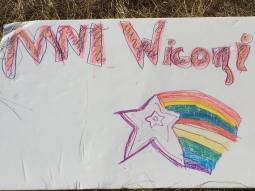
The people who heard Jesus understood. The land where Jesus lived is not a desert in the sense of miles and miles of sand dunes. But it is an arid land. It is a place where water is scarce and water is precious. The people who lived in Judea and Samaria almost 2,000 years ago knew well what the indigenous peoples who gathered at Standing Rock to protect the Missouri River remind the world: “Mni Wiconi – water is life.” Little reason that Jesus praised giving a cup of water to drink as a sacred act.

Our country passed through an emotional wringer this past week. The nomination of Judge Brett Kavanaugh to serve on the Supreme Court has been contentious and controversial from the moment it was made. The drama and the trauma exploded exponentially when women came forward with allegations of sexual assault by the nominee.

After much wrangling, the Senate Judiciary Committee agreed to hear one of those women, Dr. Christine Blasey Ford, testify. On Thursday, Dr. Blasey Ford told her story to the committee and responded to questions. The nominee did the same. It was a grueling day for those in Washington and for those across the country who relieved painful violations as the questioning proceeded and the news media dissected every statement.

The Committee reconvened on Friday to consider what to say to the full Senate. After several hours of statements and debate the Senators voted, along straight party lines, to send the nomination forward with a recommendation for approval. Although, one Senator voted yes only with the understanding that there be an FBI investigation, within a week, of Dr. Blasey Ford’s allegations. Such an investigation appears to be moving forward.

The process was emotional. Painful. Wrenching. Disconcerting. Anger, deep anger, bubbled near the surface and sometimes spewed forth like unrestrained lava bursting from a volcano. Two exceptions, two individuals who showed no little or anger, were Dr. Blasey Ford and attorney Rachel Mitchell who asked questions for the Republicans for a portion of the hearing. Both women.

Senators behaved badly. Barely restraining their words. Attacking each other. Raising their voices. Resorting to exaggeration and hyperbole. Demeaning each other. Attributing base motives to their colleagues with no evidence.

Twitter and social media exploded with fury at all the parties involved. In the days before the hearing, we learned that Dr. Blasey Ford had received death threats. During the hearing, we learned that Judge Kavanaugh had received death threats. After the hearing, we learned that Senator Flake who helped broker the compromise to have an FBI investigation, has received death threats.

This was far from the Senate’s finest moment. This was far from the finest moment for the United States.

The Senate Judiciary Committee hearing takes place at a time when we have heard a great deal about sexual assault, sexual violence, and sexual abuse. Bill Cosby was recently sentenced to prison following his conviction on charges of drugging and sexually assaulting Andrea Constand at his home 14 years ago. As many as 60 other women have made similar charges.[iii]

Women, and men, have charged other individuals with inappropriate sexual contact of various sorts. Some have lost jobs. Some appear to go on with life as though nothing had happened. A few, a very few, have admitted their actions and resigned from their jobs or stepped out of the limelight.

Sexual assault is primarily directed against women and girls, but it happens to men and boys as well. Most perpetrators of sexual assault are men, but there are a few instances of women perpetrating such assaults against men or other women.

The church is not immune. Recent reports from Germany and Pennsylvania indicate widespread abuse of children by a number of Roman Catholic clergy over extended periods of time.[iv][v]

But abuse is not limited to the Roman Catholic Church. It has happened in our own Presbyterian Church (U.S.A.). Children have been abused on the mission field where Presbyterians served.[vi] Abuse has also occurred by Presbyterian youth leaders and pastors in this country.[vii]

A 2016 study revealed that 84 percent of Presbyterian female clergy have experienced discrimination, prejudice or harassment based upon their gender.[viii] While discrimination, prejudice, and harassment do not necessarily rise to the level of assault, they may. And they create an atmosphere in which assault may occur. Former Co-Moderator, the Rev. Denise Anderson writes, “most heinous behaviors have their beginnings elsewhere. They are undergirded by our commonly accepted practices and the things we never interrogate. When we don’t take care to pay women with equity, it doesn’t happen. When we aren’t intentional about examining our biases and respecting women’s leadership, it doesn’t happen. And if we can’t even trust women to make decisions about something as simple as their hair, how will we ever believe them when they come forward with their stories of abuse?”[ix]

The multiple allegations spurred the #MeToo movement in which women, transgender people, and men, told their stories and added the hashtag #MeToo. For people unwilling to share their story, who found it too painful to tell their story, who felt unsafe if they were to tell their story, who could not bring themselves to tell one more time a story that had been consistently disbelieved, denied and dismissed, the simple use of the #metoo hashtag served to affirm their experience.

#ChurchToo became used to refer to assault or abuse in the church. One of my seminary professors writes “I can’t even remember the names of all the men on my #ChurchToo list.”[x]What she remembers is the power and the privilege they held. In the end, sexual assault is not about sex. It is about power and control; privilege and violence.

No matter the gender or age of the person who commits the assault; no matter the gender or age of the person who is assaulted; all such actions are sin. The state defines different actions as different types of crime. To those who follow Jesus, all such actions violate the image of God in which each person is made and so are sin.

There’s a lot to process in what I have already said. I have identified some important dynamics and pointed in some necessary directions. I am happy to have further conversations with folks about the issues and concerns I have raised.

This morning, I want to say two more things.

First, we have witnessed amazing courage this week. Bruce Springsteen sings about “courage you can understand.”[xi] As I watched Dr. Blasey Ford testify, I saw courage I cannot understand. I stood in awe of her grace and strength as she presented her story and responded to questions in a hostile setting under enormous pressure and the glare of the world media. Her courage proved contagious and people found their voices and told their stories because of her.

But know this. If someone has sexually abused or sexually assaulted you and you are a human being, you are courageous. You are courageous for working through and living with that trauma every single day. You are courageous if you find your voice and lift it protest and a call for justice. And you are courageous even if you never speak a word aloud. You are courageous. You are not alone. You are stronger than you imagine. And you are beloved by God. Do not ever forget that.[xii]

Second, I believe that amid the stress and trauma of the days before the hearing and the stress and the trauma of the hearing and the vote and the stress and trauma of waiting for what comes next, I believe there were moments of kindness, glimpses of grace, tender mercies, acts of love. To use the image of Jesus in our gospel lesson, cups of water were shared.

We learned that 10-year-old Liza Kavanagh prayed for Dr. Blasey Ford. A cup of water.

Maria Gallagher from Westchester and Ana Maria Archila, who is a native of Queens confronted Arizona Senator Jeff Flake at an elevator inside the U.S. Capitol.[xiii] As they spoke, Mr. Flake nodded and looked down, his eyes darting between the women, the floor, and the elevator walls. “I was sexually assaulted and nobody believed me,” Ms. Gallagher said. “I didn’t tell anyone, and you’re telling all women that they don’t matter.” Fighting back tears, she demanded the senator’s attention. “Don’t look away from me,” she said. “Look at me and tell me that it doesn’t matter what happened to me.” This marked one of the first times either woman had publicly shared their accounts of sexual assault. Ms. Archila said she was moved to tell her story after seeing Dr. Blasey’s testimony.[xiv] Sometimes cups of water are delivered with tough love.

Senator Flake took his stand for an FBI investigation after conversation with colleagues, Republican and Democrat alike. While reports indicate he talked to several Senators, it seems likely that his conversation with Senator Chris Coons proved pivotal. Senators Flake and Coons rarely vote together but they have become friends. For a moment that friendship became a cup of water as friendships often do.

Women and men, who had profoundly painful memories rekindled, and grievous wounds reopened, found comfort in Facebook posts by strangers and in the presence of friends. Cups of water.

Friends I have known for years thanked me for my simple words of kindness and support posted on Facebook. They shared parts of their story with me that I did not know and for which I weep. They reminded me that courage is contagious. And sometimes we do not know when we pass along a cup of water.

18836062_10155210720946063_1533898934229885746_n“I tell you, whoever gives you a cup of water to drink because you bear the name of Christ will by no means lose the reward.”
In the week ahead, I give you two homework assignments.

Look around you for people who are sharing cups of water.

Look around you for ways you can share cups of water in the name of Christ.

Presbyterian minister, the Rev. Fred Rogers, or Mister Rogers as he is better known, said that “When I was a boy and I would see scary things in the news, my mother would say to me, ‘Look for the helpers. You will always find people who are helping.’”[xv]

I believe that in our passage for today, Jesus says something similar with the image of sharing a cup of water.

When scary things happen, when life become unsettling and threatening, look for the people who are acting with kindness, who are showing love, who are sharing cups of water.

When scary things happen, when life become unsettling and threatening, be the people who act with kindness, who love, who share cups of water in the name of Jesus.

May it be so. Amen.


[i] https://opinionator.blogs.nytimes.com/2012/12/14/the-angel-of-maryes-heights/

[ii] Matthew 25:31-46

[iii] https://www.thewrap.com/60-bill-cosby-accusers-complete-list-breakdown-guilty/

[iv] https://www.nytimes.com/2018/09/12/world/europe/german-church-sex-abuse-children.html. A study in Germany reports that more than 3,600 children, most age 13 or younger, were sexually abused by Catholic clergy members over the past seven decades by at least 1,670 church workers.

[v] https://www.cnn.com/2018/08/19/us/catholics-react-pennsylania-sex-abuse/index.html. In August, a study notes that over the past 70 years in six Pennsylvania dioceses, 300 Catholic priests abused more than 1,000 children.

[vi] https://www.presbyterianmission.org/wp-content/uploads/iarp_final_report.pdf

[vii] https://pres-outlook.org/2018/09/a-letter-to-church-that-i-love/

[viii] https://www.presbyterianmission.org/story/1217-convo/

[ix] http://www.ecclesio.com/2018/02/never-starts-assault-overlooked-ways-church-enables-abuse-denise-anderson/

[x] https://www.christiancentury.org/blog-post/guest-post/i-cant-even-remember-names-all-men-my-churchtoo-list

[xi] “Nothing Man,” https://songmeanings.com/songs/view/3458764513820554674/.

[xii] This paragraph grew out of a Facebook exchange with Hannah Truxell.

[xiii] http://gothamist.com/2018/09/28/jeff_flake_elevator_protest.php

[xiv] https://www.nytimes.com/2018/09/28/us/politics/jeff-flake-protesters-kavanaugh.html

[xv] https://www.huffingtonpost.com/2012/12/17/mister-rogers-helpers-quote_n_2318793.html

1 Comment

Filed under Current Events, Family, First Presbyterian Church of Whitestone, Friends, Worship

An act of commitment

19622780_492922141049366_7685019939471622144_n(1)

Staff and friends of the Presbyterian Church (U.S.A.) gathered this morning at the Presbyterian Center for a chapel service in response to racism and white supremacy in Charlottesville and other places. (An archived live stream of the service is available.)

My colleague and friend, José Luis Casal, director of World Mission, helped celebrate communion.

During the Words of Institution, José Luis observed that, “The bodies of all who have been victims of injustice, the victims of rejection, the victims of violence…are the body of Jesus Christ.”

He reminded us that to come to the table and to partake of the bread and the cup is to commit ourselves personally to stand on the side of love with Jesus and to work against racism, white supremacy, every form of systemic oppression, violence and all that harms any of God’s precious children.

Silently, I shouted “Amen” as loudly as I could.

And I wondered—when the Presbyterian Center or any church or worshipping community gathers to celebrate communion, isn’t that organization making a similar statement? The act of gathering at Christ’s table is, for the community as well, a radical act of commitment to Jesus and to justice, to love and to grace.

May it be so. Amen.

See you along the Trail.

Thanks to my friend and colleague Marissa Galván who posted some of José Luis’s word and inspired me to write this post. The image appeared on the cover of the worship bulletin this morning. View the bulletin for the service

Leave a comment

Filed under Antiracism, Current Events, Friends, Presbyterian Church (U.S.A.), Worship

Purple flowers, First Presbyterian Church of Allentown 1

unnamed

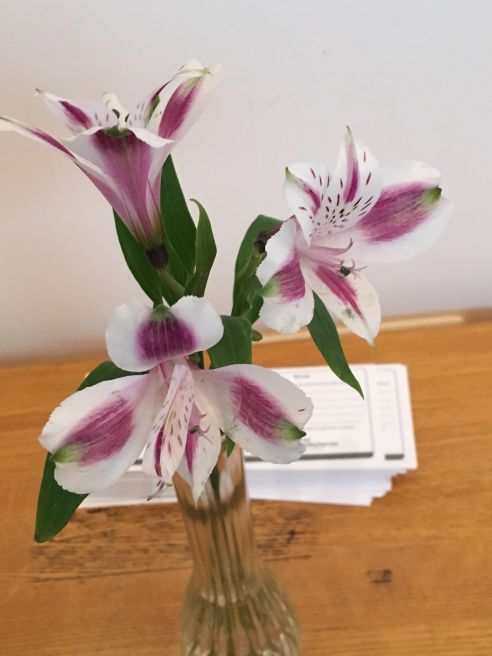
I was in Allentown to help lead an workshop on antiracism at First Presbyterian Church of Allentown on February 25. Sunday, February 26 saw me bring greetings to the six worship services on behalf of the Presbyterian Mission Agency. My friend Sheila Clever brought some purple flowers to brighten the day.

Leave a comment

Filed under Antiracism, Friends, Worship

The Until We Meet Again Tour – 14 August 2016

The Until We Meet Again Tour hopped a 1 Train, which some riders claim are hotter than the infernal regions although I have no frame of reference to judge that, and went to Good Shepherd-Faith Presbyterian Church to preach.

As with all the congregations visited on the tour, Good Shepherd-Faith holds a special place in my heart. Good Shepherd-Faith was one of the first congregations to invite me to preach in New York. It may have been the first. It definitely was the first congregation where I preached on Easter Sunday.

On this day that came a day after the killings of Imam Maulama Akonjee and Thara Uddin near the Al-Furqan Jame Masjid mosque in the Ozone Park neighborhood in Queens; and day after the killing of Sylville K. Smith by a police officer in Milwaukee and the protests that followed, it was a challenge and an honor to preach and search for words of hope in a time of profound grief.

This was the last Sunday I will preach in New York – until we meet again.

IMG_3681 (800x571)IMG_3690 (800x600)

Thanks to Elder Michael Nelson for taking the photo that includes me.

Leave a comment

Filed under Current Events, Easter, New York, Photo, Worship