Category Archives: Human Rights

Tragedy, resistance, and hope

Forty years ago today, the American Indian Movement arrived in Wounded Knee on the Pine Ridge Reservation in South Dakota. Concerns focused on corruption in the tribal government and the killing of Raymond Yellow Thunder. The location profound symbolic value.

On December 29, 1890 a band of Ghost Dancers under Big Foot, a Lakota Sioux chief, was surrounded by the 7th Cavalry near Wounded Knee Creek.  The demand came for the Lakota to surrender their weapons. A shot cut through the air – it remains unclear from which side. More shots – many. many shots – followed. When the shooting stopped, Big Foot and many of his people, perhaps 150, perhaps as many as 300,  lay dead. Reports indicate that nearly half the dead were women and children. This battle, the Wounded Knee massacre, ended the Ghost Dance movement and marked the end of the war of the United States against the Plains Indians.

The events that began on February 27, 1973 led to a 71-day standoff – the siege of Wounded Knee.

The anniversary brings a time to remember both the events of the past and the current situation faced by the Oglala Lakota. Nicholas Kristoff writes:

Unemployment on Pine Ridge is estimated at around 70 percent, and virtually the only jobs are those working for the government or for the Oglala Sioux tribe itself.

There are, of course, some reservations around the country that have struck it rich with gambling or other ventures. But here in the prairies, those riches are only rumors.

Half the population over 40 on Pine Ridge has diabetes, and tuberculosis runs at eight times the national rate. As many as two-thirds of adults may be alcoholics, one-quarter of children are born with fetal alcohol spectrum disorders, and the life expectancy is somewhere around the high 40s — shorter than the average for sub-Saharan Africa. Less than 10 percent of children graduate from high school.

It is also a time to ponder signs of hope – a campaign to address youth suicide, an effort to make use of renewable energy, and Red Cloud School to name but three. National Geographic has a number of stories as well.

Past, present, and future. Tragedy, resistance, and hope. Remember, learn, and act.

See you along the Trail.

5 Comments

Filed under Antiracism, Current Events, Human Rights

Lent 8: evil

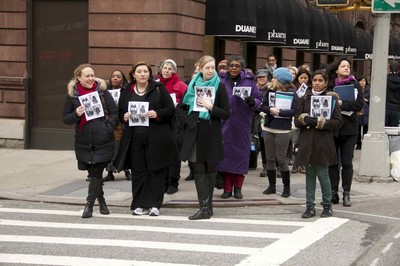
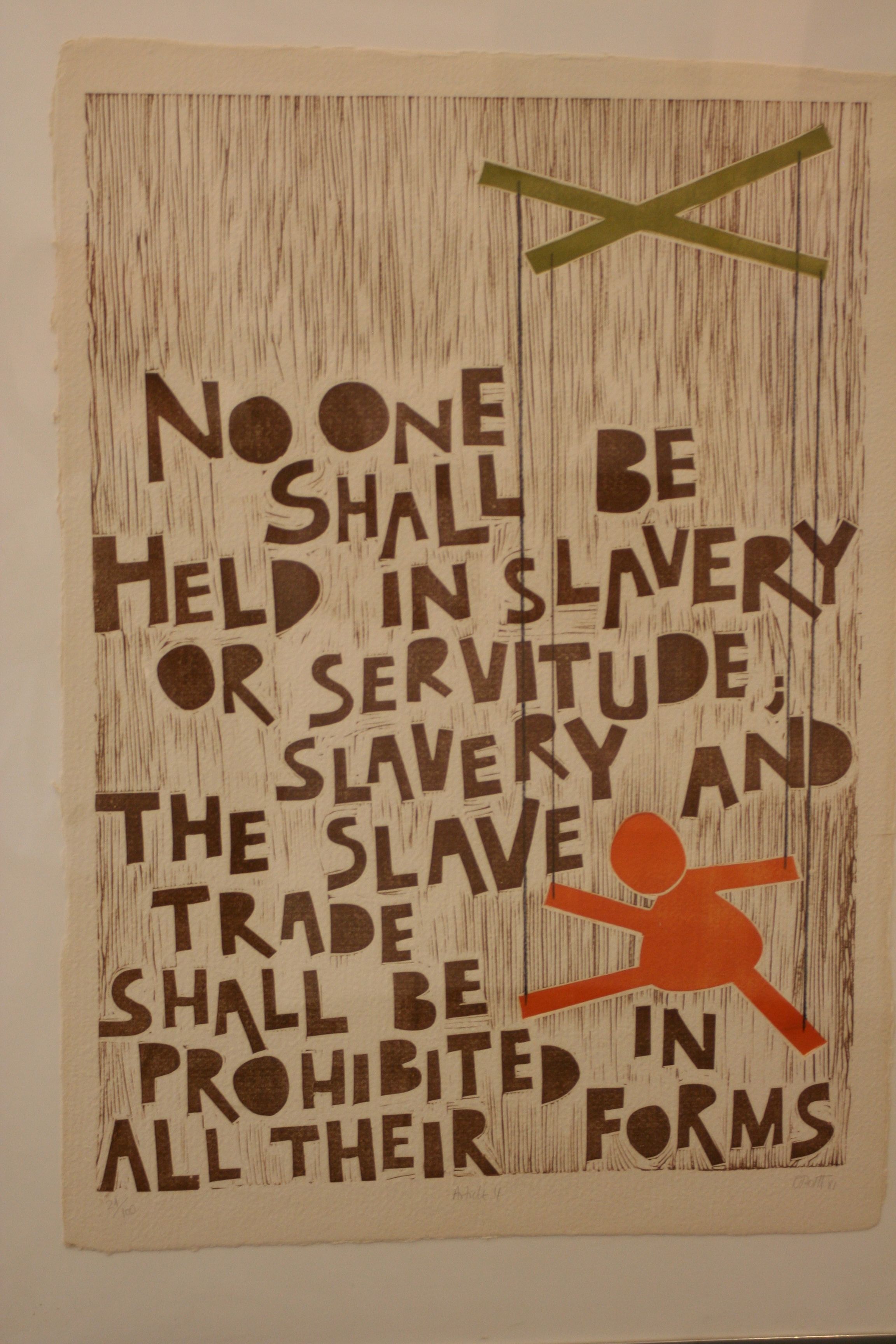
F20 Evil UN Tour 9 October 2011


One of a series of posters focusing on the
Universal Declaration of Human Rights
United Nations

Manhattan, NY
9 October 2011

Leave a comment

Filed under Human Rights, Lent, Photo, United Nations

Dr. Ralph J. Bunche of the UN

This originally appeared on Swords into Plowshares, the blog of the Presbyterian Ministry at the United Nations and the Presbyterian Peacemaking Program.

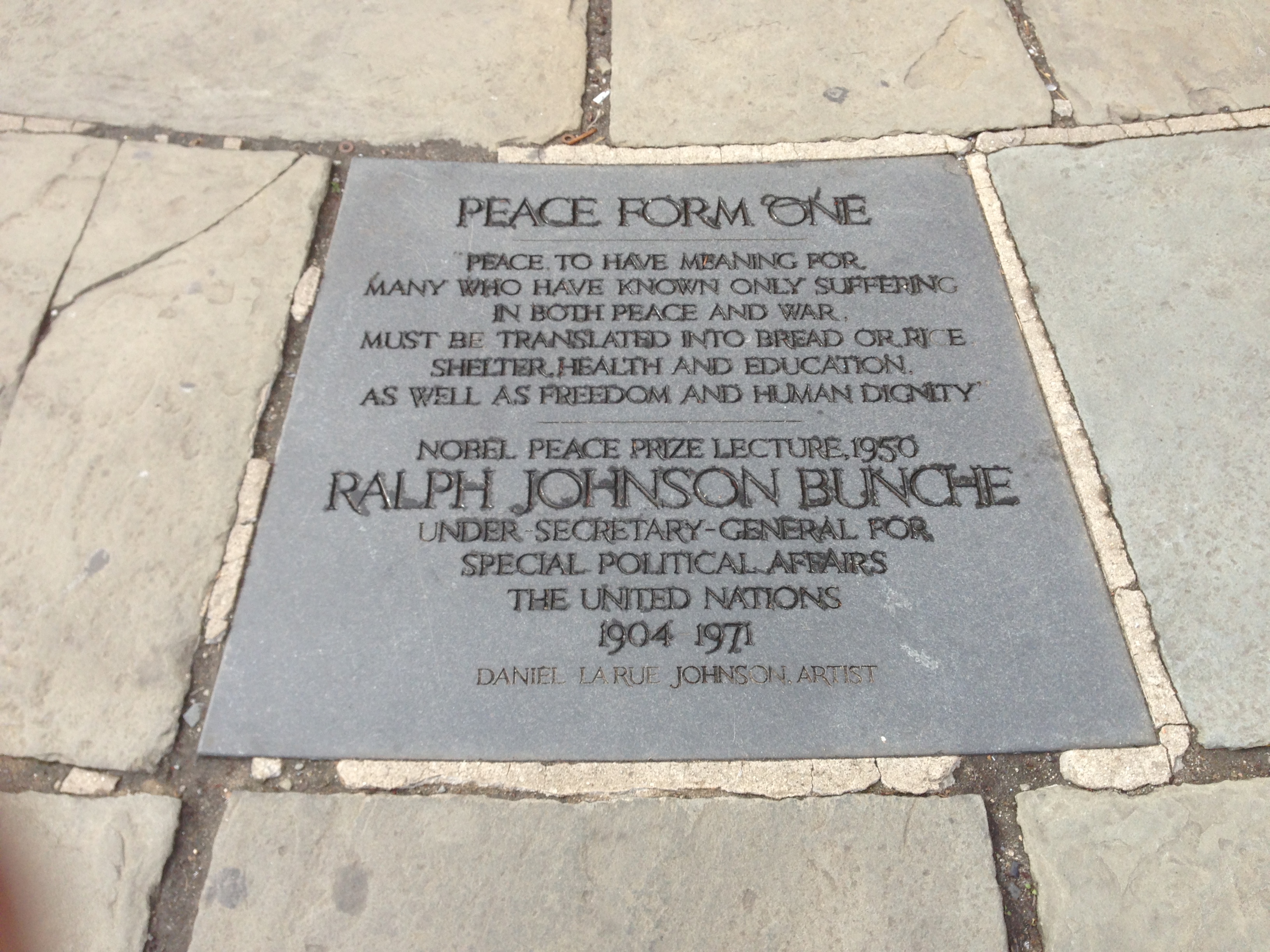
photo (8)I passed through Ralph Bunche Park at 43rd Street and First Avenue on Sunday. And it wondered me why the story of Dr. Ralph J. Bunche‘s life is not told more often.

A political scientist, academic, writer, and diplomat, Bunche took part in planning for the creation of the United Nations. He was an adviser to the U.S. delegation for the “Charter Conference” of the United Nations held in 1945. He took part in drafting the UN Charter. Along with Eleanor Roosevelt, Bunche played a key role in the creation and adoption of the Universal Declaration of Human Rights.

In 1947, Bunche served as the United Nations Special Committee on Palestine. He became the Principal Secretary of the UN Palestine Commission. He served as the Personal Representative of Secretary-General with Count Folke Bernadotte, the United Nations Mediator on Palestine. Following Bernadotte’s assassination in September 1948, Bunche became the Acting Mediator. He chaired the UN mediation efforts that led to the successful negotiation of the four armistice agreements that helped end the conflict.

For his work, Bunche became the first African-American and person of color to receive the Nobel Peace Prize. He continued to served the UN for over twenty years. His work included helping to end colonialism.

Bunche was an active and vocal supporter of the U.S. civil rights movement. He participated in the 1963 March on Washington and in the Selma to Montgomery, Alabama march, which contributed to the passage of the landmark Voting Rights Act of 1965 and federal enforcement of voting rights.

Dr. Ralph J. Bunche is one of so many people to honor – so many stories to remember – during Black History Month and always.

See you along the Trail.

3 Comments

Filed under Antiracism, Human Rights, New York, Presbyterian Ministry at the United Nations, United Nations

Can we seek another way?

An execution always raises questions of morality.

Brutal, horrific crimes that violate our sisters and brothers do so as well.

But when the state kills – on behalf of we the people who are the state – is it a matter of justice? Or revenge? Is it an act of retribution? And is that the best we can do? Do executions make us safer? Do they convey the message that violence is the most appropriate answer to violence? Do they demean us all and fuel a cycle of violence?

The pending execution of Warren Lee Hill, Jr., currently scheduled for February 19 in Georgia, raises all these questions and more.

Hill was serving time for the murder of his girl friend when he was convicted of killing another inmate and sentenced to death. There is no question of his guilt.

The question in this case, beyond those in any execution, revolve around Hill’s mental capacity. His IQ is reported to be 70. This raises the question of his mental capacity and his awareness to understand his acts.

The U.S. Supreme Court addressed the issue of capacity in the 2002 decision Atkins. v. VirginiaThe American Psychological Association summarizes that decision as follows:

The Supreme Court, in a 6-3 decision, ruled that executions of mentally retarded criminals are “cruel and unusual punishments” prohibited by the Eighth Amendment. The Court cited the growing number of states prohibiting the execution of persons with mental retardation as a reflection of society’s view that offenders considered to have mental retardation are categorically less culpable than the average criminal. The Court also reasoned that it was “not persuaded that the execution of mentally retarded criminals will measurably advance the deterrent or the retributive purpose of the death penalty.”

However, Georgia has a high standard of proof for proving mental retardation: the standard of proving mental incapacitation beyond a reasonable doubt. Georgia does not believe that standard has been met in Hill’s case.

His attorney and those concerned for Hill are not seeking a pardon. They ask that he be granted clemency and incarcerated for life. The U.S. Supreme Court could prevent Hill’s execution in the next few days.

I grieve for Myra Wright and Joseph Handspike who were killed by Warren Lee Hill, Jr. and for their family and friends.  There can be no defense for Hill’s crimes.

But that is not all the story. What does it say about our society – about us – that we resort to execution in the case of an individual with the mental capacity and awareness of Hill? Can we not find another way?

See you along the Trail.

1 Comment

Filed under Capital Punishment, Current Events, Death Penalty, Human Rights

25 January – an Orange Day

Orange DayToday, January 25, and the 25th of each month, is an Orange Day – a day to witness and work for an end to violence against women and girls.

On this day, I:

Work remains. Much work remains.

See you along the Trail.

Leave a comment

Filed under Current Events, Human Rights, Presbyterian Church (U.S.A.), Presbyterian Ministry at the United Nations, United Nations

Seriously? The House failed to do what?

The U.S. House of Representatives – primarily the Republicans in the U.S. House of Representatives – failed to reauthorize the Violence Against Women Act. The Senate approved reauthorization in a bipartisan vote. The House – the Republicans in the House – let the law expire. Apparently the new version is too supportive of immigrants, the LGBT community, and Native Americans.

For the first time since 1994, the Violence Against Women Act is no more. And state and local governments will receive far fewer resources to address sexual and domestic violence.

It can sometimes be said that laws are not renewed because they are no longer needed. That does not work here.

An effort to revive the Violence Against Women Act can begin in the new Congress. Anyone who loves, or who has ever loved, a woman needs to be part of that effort.

See you along the Trail.


3 Comments

Filed under Current Events, Human Rights

A resolution worth making

Several hours ago, New York television stations reported that people have already begun to gather in Times Square to welcome the New Year.

As the New Year approached 150 years ago, people across the United States prepared to welcome a moment of immense significance.

President Lincoln had issued the Preliminary Emancipation Proclamation on September 22, 1862. It provided that if the states in rebellion against the United States did not cease fighting and rejoin the Union by January 1, 1863, all slaves in those states or parts of those states would be declared free from that date forward.

The fighting did not cease. On December 31, 1862, the nation waited. African-Americans gathered for Watch Night Services awaiting the word. And the word came.

The Emancipation Proclamation did not end slavery outright. It did not immediately free anyone as the Union could not enforce the proclamation in the rebellious states. It did not address the issue of slavery in the so-called border states. It did not recognize that many people held in slavery had taken matters into their own hand and had freed themselves.

But the Emancipation Proclamation sent a message of hope to African-Americans. It sent a message of support to all who worked for freedom. It sent a message of intention to the nation and the nations. The war to preserve the Union became a war for human liberation as well.

The Emancipation Proclamation provided a measure of protection to the African-Americans who had freed themselves or who had been freed either by the efforts of the Union army or abolitionists. It paved the way for further steps such as the acceptance of African-Americans into the U.S. military and the eventual abolition of slavery.

This 150th anniversary affords an opportunity to remember the events of the past and to remember the people, our ancestors, who gave of themselves that all people might know freedom, justice, and equality.

This 150th anniversary affords an opportunity to repent, acknowledging that, while great strides have been made, the journey to racial justice remains long and challenging. We have work to do.

And so this 150th anniversary affords ourselves an opportunity, in the words of the Rev. Dr. Martin Luther King, Jr., “to rededicate ourselves to the long and bitter, but beautiful, struggle for a new world. This is the calling of the [children] of God, and our [sisters and brothers] wait eagerly for our response.”

May it be so.

See you along the Trail.

Leave a comment

Filed under Antiracism, Current Events, Human Rights

Events to remember

December 29, 1890 – the massacre at Wounded Knee. The band of Chief Big Foot was attacked by the 7th Cavalry. Reports indicate that between 150 and 300 Lakota were killed – many of them women and children. The shooting began either as or after the Lakota were disarmed.

December 26, 1862 – in the largest mass execution in U.S. history, 38 Dakota were hanged in Mankato, Minnesota. The U.S.-Dakota war, as it is named, began in August 1862 fueled by hunger and broken promises. When the fighting ended, the Dakota people were driven from Minnesota.  392 Dakota were tried, 303 were sentenced to death, and 16 were given prison terms. President Lincoln reviewed the transcripts and reduced the number of death sentences to 39. One man received a reprieve at the last minute.

Remember.

See you along the Trail.

Leave a comment

Filed under Human Rights

You Made Us In Your Image

Pastor and hymnwriter Carolyn Winfrey Gillette writes new words to old hymns. Over the years she has written several hymns for peace and justice ministries of which I have been and am a part.

You Made Us in Your Image is a hymn Carolyn wrote for Human Rights Day at the request of the Presbyterian Ministry at the United Nations.

Here’s a sample of the lyrics:

You made us to be equal; you made us to be free —
To speak the truth with courage, to change society,
To follow our own conscience, to choose the words we pray.
O God, may all your children enjoy these gifts each day.

Check out the full hymn – use it for personal devotions or in a worship service:

You Have Made Us in Your Image (pdf)
You Have Made Us in Your Image (text)

See you along the Trail.

Leave a comment

Filed under Human Rights, Music, Presbyterian Ministry at the United Nations

Orange flowers: End violence against women and girls.

Today’s flowers are orange. They serve as a reminder that November 25 is an Orange Day – it is the International Day for the Elimination of Violence against Women. In fact, the UN Secretary-General’s UNiTE to End Violence against Women campaign has designated the 25th of every month is an Orange Day to end violence against women and girls.

On November 25 and the 25th of each month, orange your day: wear orange and act for a world free of violence against women and girls.

See you along the Trail.


2 Comments

Filed under Human Rights, Presbyterian Ministry at the United Nations, United Nations