Category Archives: Antiracism

9 August – International Day of the World’s Indigenous Peoples

From the United Nations Department of Pubic Information:

The International Day of the World’s Indigenous Peoples (9 August) was first proclaimed by the General Assembly in December 1994, to be celebrated every year during the first International Decade of the World’s Indigenous People (1995 – 2004).

In 2004, the Assembly proclaimed a Second International Decade, from 2005 – 2014, with the theme of “A Decade for Action and Dignity.” The focus of this year’s International Day is “Indigenous peoples building alliances: Honouring treaties, agreements and other constructive arrangements.”

The theme aims to highlight the importance of honouring arrangements between States, their citizens and indigenous peoples that were designed to recognize indigenous peoples’ rights to their lands and establish a framework for living in proximity and entering into economic relationships. Agreements also outline a political vision of different sovereign peoples living together on the same land, according to the principles of friendship, cooperation and peace.

A special event at UN Headquarters in New York will be held on Friday, 9 August, starting at 3pm, featuring the UN Secretary-General, the Chairperson of the UN Permanent Forum on Indigenous Issues, a delegate of Panama, a representative of the Office of the UN High Commissioner of Human Rights, and an indigenous representative. The event will be webcast live at webtv.un.org.

Also on 9 August, hundreds of indigenous and non-indigenous rowers are scheduled to arrive at Pier 96 at 57th Street in Manhattan at 10am, after having collectively travelled thousands of miles on rivers and horsebacks to honour the first treaty -– the Two Row Wampum -– concluded between Dutch immigrants and the Haudenosaunee (a confederacy of six nations, with capital in the Onondaga nation, in NY State) 400 years ago, in 1613. They will gather with members of the UN Permanent Forum on Indigenous Issues at Dag Hammarskjold Plaza at 1:30pm.

See you along the Trail.

1 Comment

Filed under Antiracism, Current Events, United Nations

To a community of accountability – thank you!

My friend Laura Mariko Cheifetz has recently written twice about communities of accountability. As she notes:

I could operate all by myself as an individual, but that would be a lie. I am who I am because of the communities that form(ed) me and support(ed) me.

Laura notes that in some instances, she reports to communities of accountability. In other cases, while that word might be too strong, she still exist in, and nurtures, relationship with that community.

After reflecting on some of the communities to which she is accountable, Laura poses the question:

What are your communities of accountability? Your church? Your neighborhood? How do you stay accountable to them?

I would name a number of such communities in my life. The list that follows is not necessarily in order of importance. It is the communities in the order that they occur to me – bearing in mind that I am on a new allergy medication at the moment. I am accountable to:

  • family
  • the Presbytery of New York City
  • the Presbyterian Church (U.S.A.)
  • the staff of the Presbyterian Ministry at the United Nations
  • the Compassion, Peace, and Justice Ministry
  • the Presbyterian Mission Agency Board
  • colleagues within the UN community and across the church who work for justice
  • the community where I live
  • a circle of friends built through the years – a circle that expands and contracts as we move through life
  • people of color (and white people) with whom I seek to challenge racism
  • women (and men) with whom I seek to challenge sexism
  • LGBT sisters and brothers (and straight brothers and sisters) with whom I seek to challenge heterosexism
  • young people (and older people) with whom I seek to challenge ageism

How do I stay accountable? In different ways with different groups at different times. Sometimes accountability comes in filling in forms and making reports. Sometimes accountability comes through being together and engaging in conversation. Sometimes accountability comes from recalling lessons taught and values shared. Sometimes accountability comes in remembering – allowing people’s faces and voices to fill my mind when we are far apart.

Two areas for further work come to me as I reflect on communities of accountability:

  1. Where do my communities intersect? Who is part of more than one community? What does that mean? Is it something to nurture intentionally? How would I do that?
  2. Where do I need to build new communities of accountability? The area of economic justice and injustice is one area that comes to mind immediately. Where else? What will that take on my part?

I have much to ponder. And I am grateful to Laura for opening this area of thought for me.

But before I close, I want to give a shout-out to a community of accountability that means a great deal to me at the moment. About two months ago, I decided to make another effort at self-care. I have made some remarkable progress although a long, long, long way remains to go. The effort combines exercise (walking at the moment) and reducing calories. I regularly bore Facebook with the information about my exercise for each day. That simple act somehow helps hold me accountable. Friends comment from time to time – different friends each time. Their feedback matters; but it is the posting that makes the difference.

I have also created a community of accountability – pulling together a number of friends and family who have expressed concern for my health – and who have voiced support for my efforts. This group receives weekly and monthly updates on my progress in terms of eating and exercise and weight loss and blood sugar control.

Some individuals have asked to be part of the group. Others I have drafted. I blind copy the group with the emails so they do not necessarily know who else is a member.

Each report receives a few responses – no one responds all the time – everyone responds once in a while. I deeply appreciate the responses. But even more deeply, I appreciate that the group members are willing to receive my updates.

To the members of this accountability group – to my family and friends – I say thank you. With your support, I have made a great start. The journey continues.

See you along the Trail.


3 Comments

Filed under Antiracism, Exercise, Family, Food, Friends, Presbyterian Church (U.S.A.), Presbyterian Ministry at the United Nations

Of life and death; of family and mentors

My friend Laura Mariko Cheifetz has created a blog. Her intelligence, creativity, imagination, love, and passion for justice will make this worth reading.

Her recent post on the death of Satoru Nishita, her grandfather, and Bert Tom, one of her mentors, provides an introduction to her work and an example of what to expect when you subscribe. Here are a couple of excerpts:

My grandfather, Satoru Nishita, and my mentor Bert Tom died last week. I sent a text to a Korean American pastor friend of mine saying, “All these old guys are leaving us.”
This, of course, was not meant to be a theological statement.
This was a statement that was perfectly me: a bit dramatic. I am struggling with the passing of a generation of Asian Americans who faced racism and the assorted foibles of their professions with dignity. The generation of my grandparents, born in the U.S. but imprisoned by its own government for being of Japanese descent during World War II, is a generation that left a profound imprint on my generation and my mother’s generation, and it is slipping away before we get a chance to hear all the stories.

She concludes:

These old guys. While death claimed my grandfather and my mentor, in very different ways their lives taught me to struggle against Death, against powers and principalities, against environmental destruction and racism. They leave us with a legacy of commitment to justice, and a desire that the beauty of the world be revealed.

As she celebrates her family in the post  Laura invites me to remember and give thanks for family members and mentors who taught and shaped me through the years. As I read, I saw Bert’s face (I knew him) and imagined the face of Satoru – I met him through Laura and her mother. As I read, I also saw the faces of those who have been and who now are part of my life. I give thanks for the life of Satoru and Bert. I give thanks for my family and mentors. And I realize I have some calls to make and letters to write.

Check out In Life & In Death, We Belong to God. Remember. Give thanks.

See you along the Trail.

1 Comment

Filed under Antiracism, Family

Making the Fourth of July a day for us all

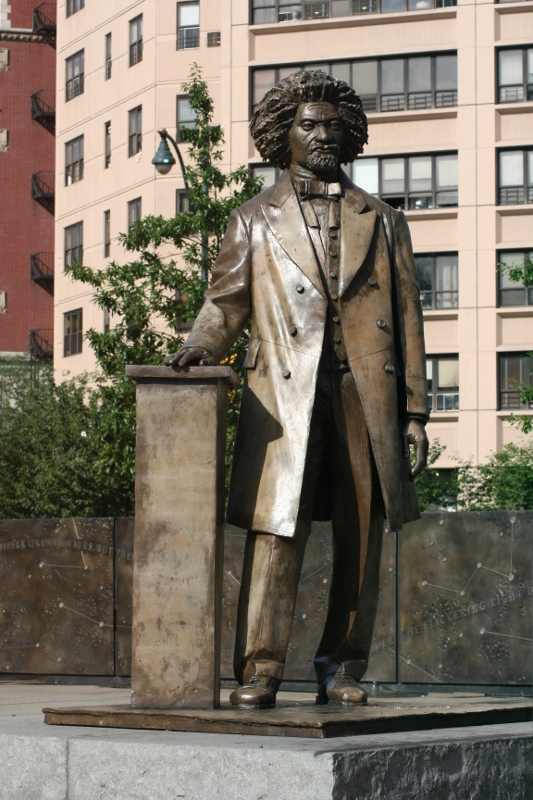
IMG_2530 (533x800)Whose holiday is the Fourth of July?

We like to think of this day as a day of celebration for all the citizens of the United States of America. But as Frederick Douglass proclaimed over 150 years ago, for many people – people living in this country – the Fourth of July serves as a painful reminder and a mockery.

When he spoke, the issue was slavery. Millions lived in the chains of chattel slavery. Those chains have fallen, thanks in large part, to Frederick Douglass and other African-Americans who resisted enslavement.

But many still do not enjoy fully  the vision of freedom. Racism persists. A number of states greeted the recent Supreme Court decision on the Voting Rights Act by moving ahead with Voter ID laws, some of which have been rejected under the voting rights act. Immigrants face challenges as they seek to make a new life. Supreme Court decisions have made it possible for our LGBTQ brothers and sisters to marry – in certain states. An economic gulf looms between the rich and many people who struggle to find ends, let alone to make them meet. Men, women, and children are trafficked for labor and for sex. Slavery has morphed; it has not disappeared. For many, the promises of freedom and the United States remain unrealized. For all of us, the words of Frederick Douglass ring true.

Frederick Douglass was born in a slave cabin in Maryland. The date and year remain unknown even to Douglass. The condition of enslavement resulted in such a lack of knowledge for many. Douglass endured the violation and horrors of slavery. And he resisted. His first attempt to escape failed. Then he tried again and, in early September 1838, disguised as a sailor, he escaped to freedom – precarious freedom, but freedom none the less.

During a visit to the African Burial Ground National Monument in Manhattan, Tricia and I opted to take a tour that focused on slavery, resistance, and abolition efforts in New York. We learned that Douglass made his first stop in New York City. He did not stay because of the city’s support for slavery. In New York, Douglass married Anna Murray. They went to New Bedford, Massachusetts to live.

Douglass became a leader in the abolitionist movement. A talented speaker, he would spend about six months each year travelling and speaking. Douglass attended the Seneca Falls Convention and became a supporter of women’s rights including the right to vote. This connection led Anna and Frederick to move their family to Rochester, New York, perhaps to be near Susan B. Anthony.

On July 5, 1852, in Rochester, Douglass spoke at an event commemorating the signing of the Declaration of Independence: the Fourth of July, U.S. Independence Day.  Perhaps they anticipated his words and tone. Most likely they did not. Douglass reminded his audience that, “This Fourth of July is yours, not mine. You may rejoice, I must mourn.” He went on to note:

What, to the American slave, is your 4th of July? I answer; a day that reveals to him, more than all other days in the year, the gross injustice and cruelty to which he is the constant victim. To him, your celebration is a sham; your boasted liberty, an unholy license; your national greatness, swelling vanity; your sound of rejoicing are empty and heartless; your denunciation of tyrants brass fronted impudence; your shout of liberty and equality, hollow mockery; your prayers and hymns, your sermons and thanks-givings, with all your religious parade and solemnity, are to him, mere bombast, fraud, deception, impiety, and hypocrisy — a thin veil to cover up crimes which would disgrace a nation of savages. There is not a nation on the earth guilty of practices more shocking and bloody than are the people of the United States, at this very hour.

Douglass did not end there, however. He observed that, despite his experience and the painful realities,  “I do not despair of this country.” He closed with a  poem of hope written by William Lloyd Garrison that begins:

God speed the year of jubilee
The wide world o’er!

The poem ends with an affirmation remaining engaged in the struggle for liberty, freedom, and justice – of working to make the promise of the Fourth of July real for all.

Frederick Douglass devoted himself to that struggle.

May I do the same.

See you along the Trail.

Leave a comment

Filed under Antiracism, Current Events, Human Rights, National Park, Photo

Bruce Reyes-Chow: “But I Don’t See You as Asian”

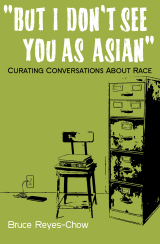
racecoversmallMy friend Bruce Reyes-Chow has written a book on race that I look forward to reading: But I Don’t See You as Asian: Curating Conversations about Race.

Bruce describes his reason for writing as:

If you’ve ever wanted to cultivate honest conversations about race, this book is my attempt at offering ways to help make that happen.

He reflects on his hope for the book in these words:

My hope is that by sharing my story – the joys and the struggles – this book will compel folk to enter a space where they can get at some of the assumptions, misunderstandings and intentions about race so that deeper connections and relationships can be had.

You can get a sense of his perspective as well as the flavor of his writing from some of his earlier articles:

Bruce notes that:

It is also my hope that you will find the time, faith and courage to jump into these conversations with an openness that challenges the expectations of the world around race.

I plan to take that jump. I assume that Bruce’s book will challenge my expectations around race. And I hope that I will be better equipped to engage in conversations that will help me challenge expectations around race and realities around racism. I will let you know.

Here’s how you can get a copy and learn more:

PURCHASE: [paperback $14.99] [kindle $9.99] [itunes $9.99] [nook $9.99] [signed gift copy $14.99]
CONNECT: [twitter] [facebook page] [reviews on Pinterest] [reviews on amazon]
AUTHORGRAPH: [Have your electronic copy signed]

See you along the Trail.

Leave a comment

Filed under Antiracism, Books, Friends

Holy ground

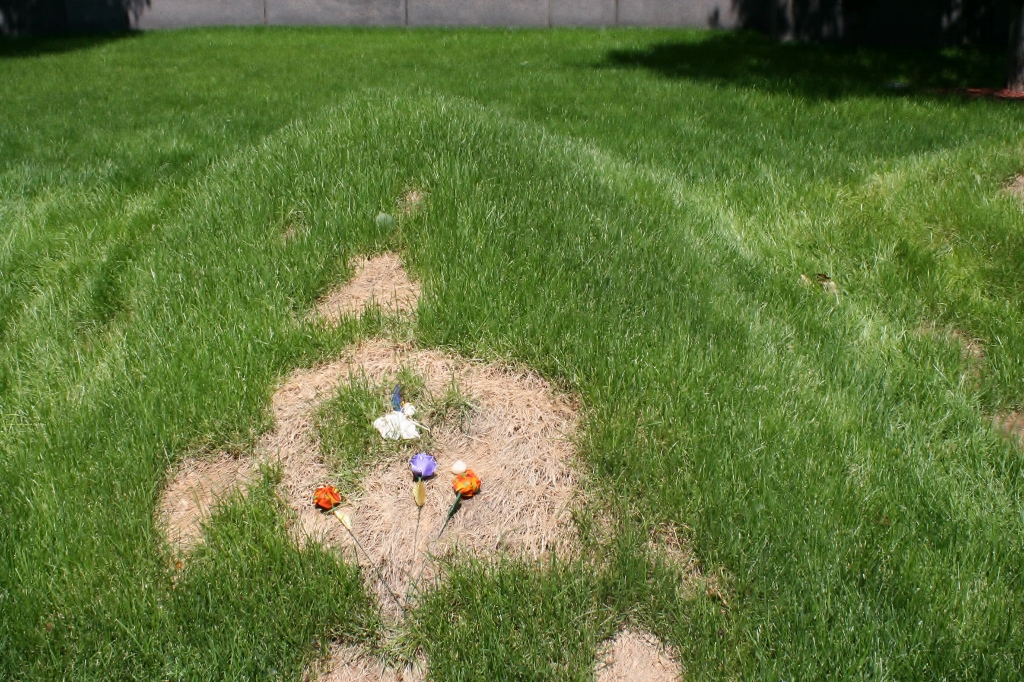
IMG_1758 (1024x665)I stood today on holy ground. Of course all ground is holy for God creates all ground and entrusts it to our care. Still some ground bears special meaning because of what happened there.

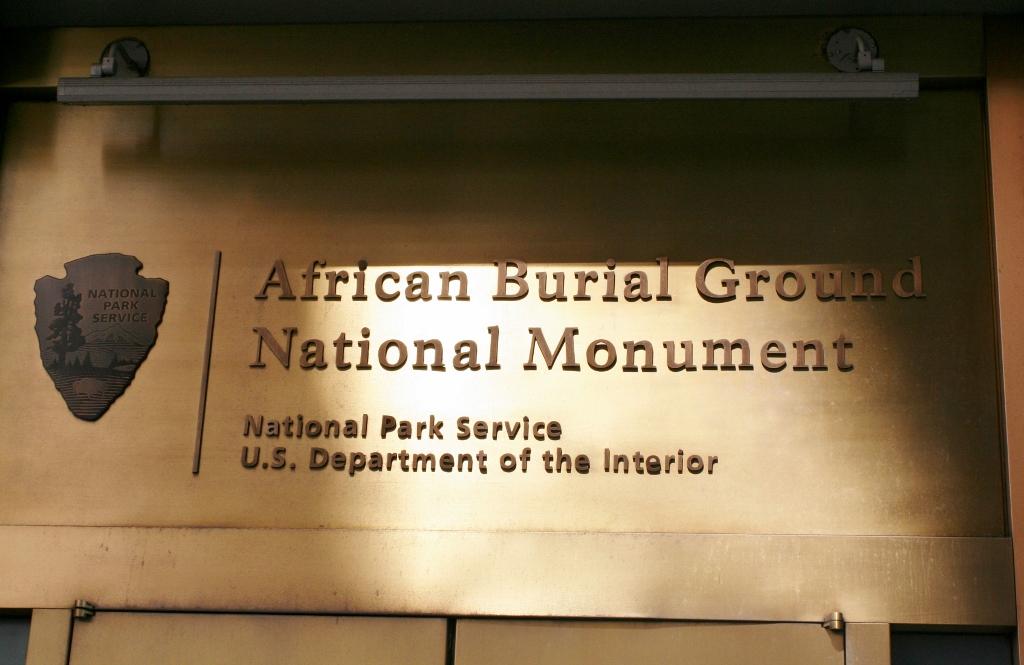
My quest to visit National Parks took Tricia and me to the African Burial Ground in Manhattan today. It is a well done park that tells a significant story.

New York’s African Burial Ground is the nation’s earliest known African and African American cemetery. Enslaved Africans played a key role in building Manhattan as they played  key roles in building this entire country. The Nation notes that:

In 1703, 42 percent of New York’s households had slaves, much more than Philadelphia and Boston combined. Among the colonies’ cities, only Charleston, South Carolina, had more.

From the late 1600s until 1794, both free and enslaved Africans were buried in a 6.6-acre burial ground in Lower Manhattan, outside the boundaries of the settlement of New Amsterdam, later known as New York. The National Park Service notes that “an estimated 15,000 men, women and children were buried here.

Africans resisted enslavement in countless ways: from rebellions to running away to educating children and more. The care they showed their loved ones was another form of resistance. Faced with the brutal dehumanization of enslavement, honoring those who died (or were killed) served to affirm the humanity and dignity of the individual and the community.

Lost to history due to landfill and development, the grounds were rediscovered in 1991 as a consequence of the planned construction of a Federal office building. The African-American community in New York led a campaign to have the remains honored and remembered. Their efforts, after some controversy and hard work, succeeded. The remains were taken to Howard University for analysis.

After the scientists finished their work, the remains were placed in new coffins and taken back to New York for reburial. The New York Historical Society reports:

The ceremonial journey stopped in five cities along the way, so that people in Washington D.C., Philadelphia, Baltimore, Wilmington, and Newark could pay their respects. Then the remains arrived by boat in New York City, at the same spot where slave ships had docked two centuries earlier. After days of rituals that included horse-drawn hearses, drummers in African kente cloth, singing, dancing, and prayers, the remains were returned to the earth in lower Manhattan.

IMG_1763 (1024x682)The community’s efforts resulted in the designation of the African Burial Ground as New York City Historic District, a National Historic Landmark and, on February 27, 2006, a National Monument.

Today, the African Burial Ground National Monument includes a visitor center with four exhibit areas, a theater where a 20-minute video tells the story of the burial ground, and a bookstore. A short walk away stand the graves and a memorial.

Holy ground.

See you along the Trail.

2 Comments

Filed under Antiracism, Human Rights, National Park, New York

White and Yellow

A short time back, I subscribed to Grace Ji-Sun Kim’s blog –  Grace Ji-Sun Kim ~ Loving Life.

In today’s post (24 April 2013), Grace reflects on race and privilege and racism.

She begins with an experience on a plane trip with her daughter. A brief encounter while leaving the plane brought the reminder that:

… an Asian is always already viewed as a foreigner no matter how long they have been living in this country.  Even fourth or fifth generation Asians are viewed as the “perpetual foreigner.”  Asian Americans have been depicted as “perpetual foreigners,” “unassimilatable,” and other stereotypes that reveal historic and persistent racism experienced by this racial/ethnic group.  For example, almost every Asian in America has been afflicted with the perpetual foreigner syndrome.  Many have been asked, “Where are you really from?”  This loaded question, which I shall call the “really-question,” differs from the usual one, “Where are you from?”  The really question figuratively and literally ejects the Asian American respondent to  Asia, because the assumption behind the question, even if the questioner is oblivious to it, is that Asian Americans cannot be “real” Americans.

From the experience on the airplane, Grace proceeds to explore being viewed as the “other” or a “perpetual foreigner.” She considers the social construction of “whiteness” and white superiority and white privilege. Race, as she notes, intersects with gender, sexuality, age, sexual orientation and more.

Her story and reflection remind me to remain ever vigilant about the role of privilege in my life. In so many ways, I am privileged.That brings me responsibility to challenge the systems and structures that create the privilege and give it to me. Sometimes I do not do that well. Sometimes I do. Always I must pay attention and try to do better.

Grace closes with a vision:

I envision a world for my daughter in which people of all races, ethnicities, sexual orientations, and social classes can come together in harmony and love.

The reality of my privilege challenges me to work to overcome racism and other systems of domination and strive to create another world. The vision encourages me to do the same. Check out Grace’s post and see how it speaks to you.

See you along the Trail.


2 Comments

Filed under Antiracism

More on Wounded Knee

Two responses to my post on the fortieth anniversary of the siege of Wounded Knee (one online and one via email) provide new links to share. They add more depth to the story of the siege and of the present reality on Pine Ridge.

Red Cloud Indian School Stories

Pine Ridge Community Storytelling Project

A Photographer Remembers Wounded Knee, 40 Years Later

See you along the Trail.

Leave a comment

Filed under Antiracism, Current Events, Human Rights

Tragedy, resistance, and hope

Forty years ago today, the American Indian Movement arrived in Wounded Knee on the Pine Ridge Reservation in South Dakota. Concerns focused on corruption in the tribal government and the killing of Raymond Yellow Thunder. The location profound symbolic value.

On December 29, 1890 a band of Ghost Dancers under Big Foot, a Lakota Sioux chief, was surrounded by the 7th Cavalry near Wounded Knee Creek.  The demand came for the Lakota to surrender their weapons. A shot cut through the air – it remains unclear from which side. More shots – many. many shots – followed. When the shooting stopped, Big Foot and many of his people, perhaps 150, perhaps as many as 300,  lay dead. Reports indicate that nearly half the dead were women and children. This battle, the Wounded Knee massacre, ended the Ghost Dance movement and marked the end of the war of the United States against the Plains Indians.

The events that began on February 27, 1973 led to a 71-day standoff – the siege of Wounded Knee.

The anniversary brings a time to remember both the events of the past and the current situation faced by the Oglala Lakota. Nicholas Kristoff writes:

Unemployment on Pine Ridge is estimated at around 70 percent, and virtually the only jobs are those working for the government or for the Oglala Sioux tribe itself.

There are, of course, some reservations around the country that have struck it rich with gambling or other ventures. But here in the prairies, those riches are only rumors.

Half the population over 40 on Pine Ridge has diabetes, and tuberculosis runs at eight times the national rate. As many as two-thirds of adults may be alcoholics, one-quarter of children are born with fetal alcohol spectrum disorders, and the life expectancy is somewhere around the high 40s — shorter than the average for sub-Saharan Africa. Less than 10 percent of children graduate from high school.

It is also a time to ponder signs of hope – a campaign to address youth suicide, an effort to make use of renewable energy, and Red Cloud School to name but three. National Geographic has a number of stories as well.

Past, present, and future. Tragedy, resistance, and hope. Remember, learn, and act.

See you along the Trail.

5 Comments

Filed under Antiracism, Current Events, Human Rights

Dr. Ralph J. Bunche of the UN

This originally appeared on Swords into Plowshares, the blog of the Presbyterian Ministry at the United Nations and the Presbyterian Peacemaking Program.

photo (8)I passed through Ralph Bunche Park at 43rd Street and First Avenue on Sunday. And it wondered me why the story of Dr. Ralph J. Bunche‘s life is not told more often.

A political scientist, academic, writer, and diplomat, Bunche took part in planning for the creation of the United Nations. He was an adviser to the U.S. delegation for the “Charter Conference” of the United Nations held in 1945. He took part in drafting the UN Charter. Along with Eleanor Roosevelt, Bunche played a key role in the creation and adoption of the Universal Declaration of Human Rights.

In 1947, Bunche served as the United Nations Special Committee on Palestine. He became the Principal Secretary of the UN Palestine Commission. He served as the Personal Representative of Secretary-General with Count Folke Bernadotte, the United Nations Mediator on Palestine. Following Bernadotte’s assassination in September 1948, Bunche became the Acting Mediator. He chaired the UN mediation efforts that led to the successful negotiation of the four armistice agreements that helped end the conflict.

For his work, Bunche became the first African-American and person of color to receive the Nobel Peace Prize. He continued to served the UN for over twenty years. His work included helping to end colonialism.

Bunche was an active and vocal supporter of the U.S. civil rights movement. He participated in the 1963 March on Washington and in the Selma to Montgomery, Alabama march, which contributed to the passage of the landmark Voting Rights Act of 1965 and federal enforcement of voting rights.

Dr. Ralph J. Bunche is one of so many people to honor – so many stories to remember – during Black History Month and always.

See you along the Trail.

3 Comments

Filed under Antiracism, Human Rights, New York, Presbyterian Ministry at the United Nations, United Nations