Tag Archives: refugees

Stand with immigrants, refugees, and asylum seekers

This material is probably most helpful to Presbyterians and people who live in New York City. But as long as it is assembled, it seems worth sharing … if it can help one person in such a time as this.

FOR IMMIGRANTS, REFUGEES, ASYLUM SEEKERS AND THEIR FAMILY AND FRIENDS

Helpful Numbers
Call the ActionNYC hotline at 1-800-354-0365 to receive free and safe immigration legal help.

Report an ICE Raid to the New Sanctuary Coalition. Call 646-395-2925 or send an email to info@newsanctuarynyc.org.

Know Your Rights
Know Your Rights – The Immigrant Defense Project provides two-page flyers in multiple languages that explain what your rights are and what to do in an encounter with ICE.

Know Your Rights Community Toolkit – these toolkits are available from the New York Immigration Coalition in many languages.

Know Your Rights – New Sanctuary Coalition

Immigrants & New York – a coalition of groups has created this infographic resource for immigrants in English, Spanish, and French.

Home Raids Poster – The Immigrant Defense Project provides a poster to hang in the home (and your church) with a reminder of your rights, what to say, and what to document in case of an ICE raid.

Preparations
How to Prepare Yourself for an Immigration Raid – Informed Immigrant

Prepare for an ICE Raid – New Sanctuary Coalition

Discernment and Planning Tools for Those Facing Deportation – this resource can help individuals who face deportation and their families explore options – PC(USA) Office of Immigration Issues

Use an English or Spanish Family Care to help undocumented members individuals prepare a family care plan so that they can ensure that their children will be cared for, their prescriptions can be filled, and they can have some sense of control over their lives in the event that they are detained – PC(USA) Office of Immigrations

Sanctuary
Find Sanctuary in New York – New Sanctuary Coalition

Sanctuary – what do people who may want to enter sanctuary need to think about – PC(USA Office of Immigration Issues

Sanctuary Discernment Guide – the PC(USA) Office of Public Witness offers this guide for congregations considering declaring themselves as a sanctuary congregation.

WHAT CAN WE DO? FOR EVERYONE
Pray.

Build and nurture relationships with immigrants, refugees, and asylum seekers in your neighborhood.

Contact Senator Gillibrand and Senator Schumer. Contact your Representative (or call 202-225-3121 and ask for your Representative by name to be connected to their office). Share your concerns. Ask what they will to do.

Help Detained Children identifies organizations providing aid to migrants. Donate, volunteer, and support these organizations.

Participate in the July 12th, 2019, Lights for Liberty: A Vigil to End Human Detention Camps – 7:00 PM on Foley Square.

Support the New Sanctuary Coalition’s Live In Faith Everyday Bond Fund that bonds out individuals who are detained so they can fight their cases from their communities instead of behind. It matters to children.

Learn about the Presbyterian Peace Fellowship’s Accompaniment Program in Aqua Prieta.

Give to and volunteer with groups working on immigration issues in New York City:

Use the We Choose Welcome Action Guide from the PC(USA) to welcome refugees.

Join Presbyterians for Just Immigration to receive information updates and action suggestions.

Leave a comment

Filed under Current Events, Human Rights, New York, Presbyterian Church (U.S.A.), Presbytery of New York City

Throwing off Cloaks or Be Like Bart

Mark 10:46-52
28 October 2018
First Presbyterian Church of Whitestone
The Rev. Mark Koenig

46They came to Jericho. As he and his disciples and a large crowd were leaving Jericho, Bartimaeus son of Timaeus, a blind beggar, was sitting by the roadside. 47When he heard that it was Jesus of Nazareth, he began to shout out and say, ‘Jesus, Son of David, have mercy on me!’ 48Many sternly ordered him to be quiet, but he cried out even more loudly, ‘Son of David, have mercy on me!’ 49Jesus stood still and said, ‘Call him here.’ And they called the blind man, saying to him, ‘Take heart; get up, he is calling you.’ 50So throwing off his cloak, he sprang up and came to Jesus.51Then Jesus said to him, ‘What do you want me to do for you?’ The blind man said to him, ‘My teacher, let me see again.’ 52Jesus said to him, ‘Go; your faith has made you well.’ Immediately he regained his sight and followed him on the way. 

IMG-8424Bartimaeus – the son of honor. Once could see. Lost his sight. Encountered Jesus. The crowd tried to keep him away. Jesus called Bartimaeus to him. The man who was blind threw off his cloak and went to Jesus. After a conversation, Jesus healed him. He regained his sight and followed Jesus on the way. Remember Bartimaeus who threw off his cloak. We will come back to him.

Events of the week rocked my world.

People make up a significant part of our worlds. Family. Friends. Members of Christ’s body. They touch and enrich us.

Values make up a significant part of our worlds. Faith in Jesus Christ. The principles which guide us.  The practices by which we act.

Places make up a significant part of our worlds. Places we have lived. Places we have visited. Places that shape and form us and give us meaning. In the words of Archibald Graham, the one-time baseball player who found his true calling as a doctor in small-town Minnesota in the movie Field of Dreams, “This is my most special place in all the world. Once a place touches you like that, the wind never blows so cold again. You feel for it, like it was your child.

People. Values. Places. Events rocked all three of those parts of my life this week.

People. On Wednesday my brother’s father-in-law had died. Charles Wilt – Chuck as we all called him – had been ill for a while, but still his death was a bit unexpected. He worked for state of Pennsylvania on water safety. I saw him at every family gathering. He was a kind, gentle, thoughtful man with one flaw. He liked Notre Dame football. He was buried yesterday wearing Notre Dame socks. It was a blessing to know him.

Values. Today we mark Reformation Sunday. We Presbyterians trace our roots in the Reformed tradition to John Calvin.

John Calvin followed Jesus and knew that Jesus was a refugee. Fearing what Herod might do, Joseph and Mary took the infant Jesus to Egypt for safety (Matthew 2:13-15). Calvin was French, he left his home and went to Switzerland where he eventually found a leadership role among the followers of Jesus in Geneva.

These itinerant experiences of our ancestors have made welcome an important value for my understanding of what it means to follow Jesus and to be in ministry. The separation of families at our border grieves me. What impact does that have on the parents and children involved? What does that say about us as a nation that such separations have happened and continue?

Many responses to the people coming from Honduras, Guatemala, and El Salvador and other countries grieve me. People are leaving their homes and making a perilous journey to what they perceive as greater safety. “These individuals are largely asylum seekers, families of people who are seeking safety. How we react to them says a lot about how we value them as human beings,” said Teresa Waggener, immigration attorney for the PC(USA)’s Office of Immigration Issues. How we react to them says even more about who we are as human beings. For whatever reason they flee their homes, they all have rights under international law. They all have a claim on us as people made in the image of God. What does it say about us as a nation that our leaders encourage us to respond with fear rather than to love?

By training, Calvin was an attorney. He believed that God is God, as I heard in a sermon last week. God is God. And God is God of all of life. We follow Jesus in all our living. Every part. That includes our public life – our life together – the ways in which policies are made and implemented. Calvin referred to the office of “civil magistrate” – the authorities – as the “most sacred, and by far the most honourable, of all stations in mortal life.

While I have never had the desire to be a civil magistrate or to run for public office, I have long understood advocacy as part of my calling as a follower of Jesus and a teaching elder in the Presbyterian church. This involves communicating with elected officials and supporting positions on issues. It does not involve publicly supporting any individual candidates. I will encourage you to vote. I will never say vote for a specific individual. But I will say vote.

My heart broke in June 2017 when a gunman opened fire on Republican congress people as they practiced on a baseball field. My heart broke this week as I learned that pipe bombs described by the FBI as “potentially destructive devices” were mailed to people across the country. The recipients include Democratic public officials, former government employees, and a funder of progressive candidates and causes. Any political violence – in whatever form, be it overt or subtle – tears at my values and rips at our society.

Places. On Wednesday, Mr. Maurice Stallard and Ms. Vickie Jones were killed at a Kroger grocery store in Jeffersontown, Kentucky. Race played a role in the killings. Mr. Stallard and Ms. Jones were African-American. The shooter is white. He tried to enter an African-American Baptist Church before going to the Kroger. I lived in Jeffersontown for six years when I worked in Louisville. My go-to grocery store was the Kroger on Taylorsville Road where Mr. Stallard and Vickie Jones were killed.

Yesterday, a shooting took place at the Tree of Life Synagogue in Squirrel Hill, Pennsylvania. 11 people are reported to have been killed and 4 police officers and two others wounded. The gunman reportedly made anti-Semitic remarks during the shooting. In addition, his social media account indicates his anti-Semitism. It is also reported he expressed criticism of the Hebrew Sheltering and Immigrant Aid Society (HIAS) for its work with immigrants and refugees. The link between HIAS and the Tree of Life remains unclear; one report indicates the synagogue recently hosted a HIAS event.

I noted that the names of those killed at the Tree of Life had been released shortly before our service but I had not been able to find them. Clerk of Session Lisa Sisenwein did so during the service and I read the names:

Squirrel Hill is a neighborhood in Pittsburgh. It’s Mr. Rogers’ neighborhood. He lived there. A Presbyterian minister, Mr. Rogers was not a member of a congregation. But he was an active participant in Sixth Presbyterian Church, located about  a 10-minute walk from the synagogue. On Saturday evening, Sixth Presbyterian Church hosted an interfaith prayer vigil with neighbors – neighbors – of all faiths and no faith. While I never actually lived in Pittsburgh, I spent most of my early life in Western Pennsylvania – within the orbit of Pittsburgh. It remains one of my “most special places.” When pushed to name a place as home, I reference Pittsburgh.

Events of the past week rocked the people, values, and places of my world. Perhaps these or other events rocked your world.

What do we do? What do we who follow Jesus do in times such as these?

We grieve.  We weep.  We rail and rant and rave.  Sometimes we grieve hard.

IMG-8432We pray. We light candles. We make music and sing songs, even when they are cold and broken Hallelujahs. As another Leonard, Bernstein in this case, once said, “This will be our reply to violence: to make music more intensely, more beautifully, more devotedly than ever before.

We remember.

We remember that, as challenging as life becomes, God is God and God is with us. God never promises to make life go the way we would like. God never promises a life free of pain and struggle. What God promises is God’s presence. In all things. Whatever life brings.  God holds us . . . strengthens us to rebuild . . . frees us to care for one another . . . inspires us to work for new beginnings . . . God loves us . . . God leads us to new life.

We remember Jesus. Jesus knew the sorrow and pain of this life. He lived under the oppression of the Roman Empire He encountered sickness and hunger. His earthly life ended in arrest, torture, and execution. And his closest friends? His followers? One betrayed him. One denied him. Others fled from him. Only the women remained.

But, God raised Jesus from death to life overcoming the power of sin and death. In so doing, God affirmed Jesus’ life and witness that we are made for each other. We are made to be loved. We are made to be love.

We remember the followers of Jesus. The disciples through the centuries. Those who took in the spirit of Bartimaeus, I told you he would be back. We remember the people who heard the call of Jesus and jumped up and threw off their cloaks and followed him.

This seems a particularly appropriate day to remember Jesus’ followers. Today we celebrate 147 years of witness and ministry by that part of Christ’s body known as the First Presbyterian Church of Whitestone. We stand in the long tradition of followers of Jesus. Particularly, we stand in the tradition of those good folk who threw off their cloaks and followed Jesus in Queens. Some are long gone, and we follow in their footsteps. Others sit in the pews around us. We remember that today. And we give thanks that we do not have to work alone.

Because after we grieve and after we remember, we have work to do. As Rabbi Rick Jacobs said, the shooting at the Tree of Life synagogue, and other attacks on places of worship and acts of hate, reveal that “the fabric holding our nation together is fraying. It is our task to ensure that it does not come apart.” We have work to do.

We need to challenge speech that is hateful or that incites violence when we hear it expressed. Words do not pull the trigger on guns. Words do not build explosive devices. But words create an atmosphere in which some people think it is OK to build and send bombs and shoot guns. Pastor Gregory Bentley reminds us that “Words create worlds. The power of life and death is in the tongue. Choose life and speak life!” When we hear words that express hate or stoke violence, we need to find ways to respond. We can tell the President and other public servants to stop the hate. We can stand up to bullies. We can refuse to laugh at jokes or comments that demean or degrade.

We need to recognize that all people are made in God’s image. All people are precious to God. Anti-Semitism, white supremacy, patriarchy, nationalism, racism, sexism, homophobia and other prejudices and systems that divide us and that say some have people have more value than others, cannot go unconfronted. When we find ourselves in gatherings where someone says something racist or anti-Semitic or homophobic or otherwise hateful, those of us who hear can no longer look at each other uncomfortably. This has to end. We – I – have to find the courage to disrupt such thinking whether it is our living room or on the Internet or at public events. We must also work to dismantle the systems build on such lies. The Rev. William Barber tweeted “I am reminded of what Dr. King said after four little girls were murdered in an Alabama church: ‘we must be concerned not merely about who murdered them, but about the system, the way of life, the philosophy which produced the murderer.’

We need to learn about the issues we face. The Presbyterian Peace Fellowship has created a resource about addressing gun violence. We could do a study about that if we wanted to do so. Our Presbyterian Office of Public Witness and Office of Immigration have made available resources to help us learn about the people fleeing Honduras, Guatemala, and El Salvador. A few copies of those resources are on the table in Fellman Hall. We can make more. Various organizations including the Presbyterian Church can help us address racism. More Light Presbyterians and others provide insight and support for overcoming the oppression of our LGBTQ siblings.

We can welcome each other. We can share our condolences and support with our Jewish friends. Or we can make the effort to make Jewish friends.

We can give. I made a small contribution to Muslims Unite for Pittsburgh Synagogue, a fund started by Muslims in Pittsburgh to help with the expenses faced by families who had a loved one killed or wounded in the shooting. I am happy to tell anyone who might like to consider making such a gift. I know that Presbyterian Disaster Assistance is in conversation with Pittsburgh Presbytery and may provide opportunities for giving. But there is something immensely satisfying to me to be a Christian contributing to a fund organized by Muslims to reach out to a Jewish community in the aftermath of religious violence that can strike any faith community.

We can reach out to our African-American friends. We can reach across the wondrous diversity that God creates and build the community for which God creates us, for which Jesus redeems us, and for which the Holy Spirit inspires us. To adapt a statement by Paul Brandeis Raushenbush of Auburn Seminary, this is time for “people of all faiths [and no faith] to come together, reject the hate and work for the future of our nation where there is no supremacy by any one group, and all are welcome, there is equity for all and that the tree of life bears fruit for all.”

To do that, we double down on love. It might be tempting to withdraw from the world around us. To try to create insulated pockets of safety. To circle the wagons and hunker down. To make it through life as individuals. Safe and secure.

But Jesus revealed that God does not make us for isolation. God does not make us to live as individuals. God does not make us for safety and security. Jesus revealed that God makes us for relationships. God makes us for love.

And as Lin-Manuel Miranda, speaking as he received a Tony award about twenty-four hours after the horrific slaughter of members of the LGBTQ community at the Pulse nightclub in Orlando:

When senseless acts of tragedy remind us
That nothing here is promised, not one day.
This show is proof that history remembers
We lived through times when hate and fear seemed stronger;
We rise and fall and light from dying embers, remembrances that hope and love last longer
And love is love is love is love is love is love is love is love cannot be killed or swept aside.

In the face of difficult days and troubling events that shake our worlds, we have the opportunity to be like Bart. To hear the call of Jesus and throw off our cloaks and with hearts shattered in pieces and tears streaming down our faces and voices cracking with emotion and knees knocking with fear, to love one another, to love everyone as disciples of Jesus. To love fiercely. To love graciously. To love, by the grace of God, as well as we are able. May it be so. Amen.


Leave a comment

Filed under Antiracism, Current Events, Family, First Presbyterian Church of Whitestone, Friends, Gun Violence, Human Rights, Louisville, Presbyterian Church (U.S.A.)

Choose welcome

Here’s a piece written by Ryan Smith, my colleague at the Presbyterian Ministry at the United Nations about responding to the call of the Rev. Gradye Parsons to “chose welcome” in relation to refugees. 

Our Stated Clerk, the Reverend Gradye Parsons invited Presbyterians to take a selfie with a banner saying “We Choose Welcome,” responding to fear of Syrian refugees. This week, my colleagues at the Presbyterian Center in Louisville joined together in the chapel to choose welcome themselves.

As I sat in my office in New York, across the street from the United Nations, I thought about welcome. I thought, as Rev. Parsons reminded us of the innkeeper not welcoming Mary and Joseph. I thought about our recognition of World AIDS Day and was reminded that it wasn’t until 2009 that HIV/AIDS status was no longer something that could block entry or green card status here in the United States.

I watch the flags float in front of the United Nations and am reminded that the UN, an intergovernmental body’s own Charter begins with “We the peoples…”

I am reminded that we are all “we the peoples.” No matter where you are born, where you live, what faith you practice, who you love, what race you are, or so much more. We the peoples are determined (as the United Nations Charter reminds us) “to reaffirm faith in fundamental human rights, in the dignity and worth of the human person, in the equal rights of men and women and of nations large and small…” “to practice tolerance and live together in peace with one another as good neighbours…”

So we choose welcome!

The Presbyterian Ministry at the United Nations joins others in the faith community in advocating justice and peace within the United Nations system, including with governments from across the globe. The United Nations Charter sets the goal to “save succeeding generations from the scourge of war, which twice in our lifetimes has brought untold sorrow to mankind…”

While we have not seen a third World War, the succeeding generations of the authors of the United Nations Charter have seen war, conflict, strife. We know that right now, the UN estimates that more than 60 million people are displaced by violence and conflict. Presbyterians join ecumenical, interfaith and secular partners in advocating here at the United Nations, the one global roundtable.

A refugee himself, John Calvin in his Institutes of the Christian Religion said, “We are not to reflect on the wickedness of men but to look to the image of God in them, an image which, covering and obliterating their faults, an image which, by its beauty and dignity, should allure us to love and embrace them.” We should love and embrace all, no matter who they are or where they are from.

In this Advent season of anticipation and hope, I am thankful to be part of a community who today, across the street from the United Nations, joined Presbyterians in affirming “We Choose Welcome!”

Leave a comment

Filed under Current Events, Presbyterian Church (U.S.A.), Presbyterian Ministry at the United Nations, United Nations

An invitation to “Choose Welcome”

I have posted one of my sermons about refugees as well as sermon from the Rev. Randy Clayton. Here’s a post from the blog of the Rev. Gradye Parsons, Stated Clerk of the General Assembly of the Presbyterian Church (U.S.A.).

I can count on one hand the number of times I have spent Christmas in my own home as an adult. We have shared that day with grandparents and other family. In a pre-Amazon era, we hid presents among the luggage and spent those days on the road just like Joseph and Mary. But of course I knew that my bed was there to welcome me when it was all over.saint mark presbyterian church holding a sign saying we choose welcome

Right now the United Nations says there are more than 60 million people displaced on our war-weary planet who will probably never see their home again. That’s the largest number ever recorded. They have left their homes because of violence, poverty, and fear. There is a story repeated around the world. Some armed men come to your house. They demand money from the parents. They demand that the son joins their gang. They want to sell the daughter into the sex trade underworld. You can’t go to the authorities because the gang is the authorities. What do you do as parents? You flee with your family.

As a church of 1.6 million people we can’t take in 60 million even if our government allowed it. But we can help change the way people talk about the 60 million. I recently put out a Facebook challenge asking congregations to take a selfie with a We Choose Welcome banner. The challenge was to send the photo to their public officials. One congregation that accepted the challenge is St. Mark Presbyterian Church in Rockville, Maryland. I want to give them a shout out.

Maybe your congregation is not ready to go on record on this issue. But sometime over the next Advent days we are going to once again bash the innkeeper for having no room for Joseph and Mary. So perhaps that can be a teachable moment for all of us.

Thank you Gradye!

See you along the Trail.

1 Comment

Filed under Advent, Presbyterian Church (U.S.A.), United Nations

A Thanksgiving prayer for Syrian refugees

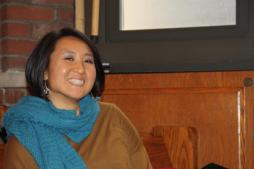
My friend, the Rev. Sung Yeon Choimorrow works for Interfaith Worker Justice. She recently wrote a reflection on Syrian and Iraqi refugees in which she 535553_418699534886667_1200697668_nexpresses her “prayer that the spirit of hospitality and generosity will rule this nation. It is my prayer that we give thanks that we get to partner with our creator in this journey of seeking justice and peace.”

She reminds us that the U.S. “narrative of exclusion and oppression isn’t a new one. It is one that has repeated and continues to repeat itself in history.”

And she challenges us to make sure that

Fear does not win. When people who live in hope and fight for justice work together, we can and do drive out fear. We, the people of faith must act on our convictions to stand up against Islamophobia that is driving our legislators to pass a bill that would stop women and children fleeing war from coming to our shores. We, the people of faith must act on our convictions to stand up against splitting up families due to deportations. We, the people of faith must act on our convictions to stand up against poverty wages and corporate greed that puts profits before people.

For her words, which I encourage you to read, I say “Thanks.”

To her prayer, I humbly say “Amen.”

See you along the Trail.

The photo shows the Rev. Sung Yeon Choimorrow attending the UN Commission on the Status of Women in 2013 and was taken by our mutual friend, Bruce Reyes-Chow.

Leave a comment

Filed under Human Rights

Another take on refugees and fear and faith

I posted “The Refugee Jesus“, the sermon I preached yesterday at Rutgers Presbyterian Church. It focused on Christ the King Sunday and Jesus the Refugee and what it meant to affirm a refugee as king in times when acts of terror occur and leaders and pundits fan the flames of fear.

Today I discovered that my friend Randy Clayton preached a similar sermon at Brown Memorial Woodbrook Presbyterian Church: “Of Kings and Kingdoms.”

Here are some excerpts:

But King Jesus is certainly not just a figurehead whose only role is to make us stick out our chests in pride; nor is King Jesus a despot who takes and oppresses, ready to pounce on us for one wrong move, unable to forgive and set us right again.  In fact, King Jesus didn’t even proclaim he was king, but his actions and his love showed us the real truth.

He was a king yes, but his kingdom didn’t look anything like Pilates’ kingdom, or the Roman Empire.  Jesus was a king, yes. He had royal bloodlines that stretched back to King David, but his kingdom looked like none the world had seen. He is king, but his reign of truth and life is based on love and peace and trust rather than coercion, division and fear. He is not a king surrounded by body guards and armored cars, but he was a king surrounded by the poor and the hurting, the outcast and the lonely, the grieving and the prisoner, the powerless and the refugee.

To align ourselves with Christ’s rule and God’s kingdom is certainly to oppose acts of terror, calling them the evil they are, that’s for sure. But at the same time it is to work to end the poverty and the hopelessness across the world that gives rise to desperation and fuels the terror’s flames. To align ourselves with God’s kingdom and Jesus’ rule is to welcome the widow and the orphan as Jesus did, to risk what we have so that others might find life, as Jesus did, and to get worked up about the same things that Jesus got worked up about. And maybe especially in these frightening and scary times, it is to follow Jesus’ example and refuse to live in fear,  to refuse to let our actions be guided by fear, and to let our lives and all we do we shaped and molded by the affirmation that both in life and in death we belong to God.

I encourage you to check out the whole sermon.

See you along the Trail.

1 Comment

Filed under Presbyterian Church (U.S.A.), United Nations, Worship

The Refugee Jesus

A sermon preached at Rutgers Presbyterian Church on 22 November 2015. I rarely post sermons, however this one received enough positive feedback that I make an exception. Note that this is the manuscript that went into the pulpit; the sermon that came out no doubt differed in several ways.FullSizeRender

The Refugee Jesus
John 18:33-37
Rutgers Presbyterian Church
November 22, 1015
Christ the King Sunday 

Fear.We have to talk about fear this day if we wish to talk about refugees.

Fear always creeps into conversations about refugees and immigrants—a fear of the other—of people from whom we differ.

But this day, we gather after

a bombing in Baghdad

a bombing in Beirut

an attack with guns and bombs on Paris

a bombing in Yola, Nigeria

a bombing in Kano, Nigeria

an attack on a hotel in Bamako, Mali

yet more bombings in Baghdad.

And fear has entered the conversation.

Fear of Daesh and other terrorist groups.

Fear of Muslims even though Muslims have been the targets and victims of many of the attacks.

Fear of refugees, particularly refugees from Syria and Iraq.

Political leaders and candidates and pundits have pandered to the fear and fed the fear.

Governors have said their states will not accept refugees from Syria. The U.S. House of Representatives has voted to make the vetting process for refugees from Syria and Iraq more difficult, it not impossible. Some leaders have essentially said “No Muslims need apply” or “Christians only.” Both phrases resonate with nativist and racist language from our past.

In at least one instance, the internment of Japanese American citizens during World War II has been cited as a model for refusing Syrian refugees rather than the evil act of racism that is was.

And one candidate for President called for a mandatory registry of Muslims in the United States, a call that evokes the horror of the Holocaust.  The New York Times reports he may be pulling back from that position somewhat.[i]

We cannot talk about refugees on this day without talking about fear.

Some pastors may preach that we should be afraid. We should hunker and hide in fear. And we should allow fear to guide us in our behavior and relationships with refugees. I will not do that.

Surrendering to fear in relation to our brothers and sisters who flee for their lives flies in the face of everything I believe as a follower of Jesus. It goes against everything I believe as a citizen of this country and a resident of our great city where in the harbor stands a statue with a poem:

Give me your tired, your poor,
Your huddled masses yearning to breathe free,
The wretched refuse of your teeming shore.
Send these, the homeless, tempest-tost to me,
I lift my lamp beside the golden door!”[ii]

And it goes against the policy statements and congregational actions of the Presbyterian Church (U.S.A.). Presbyterians have supported refugee resettlement since the refugee crisis created by World War II. The 160th General Assembly (1948) of the Presbyterian Church in the United States of America stated, “The United States should pass legislation to bring in at least four hundred thousand displaced persons during the next four years.” (Minutes, PCUSA, 1948, Part I, p. 204). [iii] Presbyterian congregations have helped resettle thousands of our brothers and sisters through the years.

Some pastors may preach today that we have nothing to fear. After all, fear not is what Jesus told his disciples on several occasions. Sermons will proclaim that that God is completely in control, life is working out according to God’s plan, God will protect us, and we have no reason for fear. I will not do that.

The world is a broken and fearful place. I know that and you know that. I fear for my African American friends, Native American friends, Hispanic, Latino/Latina friends, Asian American friends in their encounters with law enforcement and in their daily lives within a racist system. I fear for the gun violence that too often tears lives and communities apart. I fear for the homeless on our streets, particularly as winter comes. I fear for my transgendered sisters and brothers. I fear for sisters and brothers who struggle with addiction, or lack access to health care, or who have lost jobs. I fear for those who serve in our military and come home to inadequate support and care. I fear what those who resort to terror might do. Acts of terror are, after all, a form of public theater intended to provoke fear. I fear the possibility, however small, that despite our best screening efforts, a person who wishes to commit and act of terror may be admitted to our country as a refugee. Megan McCardle observes, “There’s no perfect way to screen out Syrian terrorists from Syrian refugees. It may be that someone we let in will, eventually, do something horrible. In fact, that’s a risk with any immigrant we let in, or for that matter, any baby we allow to be born.”[iv]

We live in a broken and fearful world.

And so it is right and natural that we fear.

But, we fear as those who follow the Jesus – as those who proclaim Christ as ruler. And that makes all the difference.

We fear. But we refuse to allow fear to rule our actions and decisions.

We recognize that courage is not the absence of fear; it is going ahead despite our fear. Indeed as John McCutcheon puts it, “courage has no meaning without fear.”[v] Jesus had his moment in Gethsemane where he first prayed that the cup before him might be removed before he prayed that God’s will be done.

We realize that we need to understand fearful situations as well as we can. For example, we might learn about the vetting process for refugees. It is long and complicated. And it is available online from the White House. Refugees are the most carefully screened travelers to the United States.[vi] We might learn about our country’s history with refugees and immigrants. We might look at what other countries are doing in response to refugees and acts of terror. We might consider how important it is to integrate refugees into society.

We remember that Jesus was a refugee. The 1951 Refugee Convention spells out that a refugee is someone who “owing to a well-founded fear of being persecuted for reasons of race, religion, nationality, membership of a particular social group or political opinion, is outside the country of his nationality, and is unable to, or owing to such fear, is unwilling to avail himself of the protection of that country.”[vii] There was no UNHCR at the time. And the borders may not have been as clearly delineated as they are today. But under the terms of that definition, when Mary and Joseph took the infant Jesus to Egypt to keep him safe from Herod, they became refugees.[viii]

Jesus teaches us that what the way we individually and collectively treat the least of our sisters and brothers is the way we treat him. That would seem particularly appropriate in relation to our brothers and sisters who are refugees—in the world’s refugees we encounter the Refugee Jesus.

The Refugee Jesus is the one who we celebrate today on this Christ the King Sunday. Lots of causes and commitments and things vie to have first place in our hearts and minds and souls and strength. But today we reaffirm our intention that Jesus is Lord. Jesus and no one else. Jesus and nothing else. We know we we will fall and fail as we try to live out that proclamation, but we also know that by God’s grace we can pick ourselves back up and try again. We are not who we should be – but we are not who we used to be – and we know that God in Christ can help us become who we could be.

On this day, our Gospel reading seems a bit out of place. We are at the end of the church year—Christ the King Sunday. And we read part of the confrontation between Jesus and Pilate that follows his arrest and precedes his execution. It’s the stuff of Holy Week. But here it is for today.

The reason lies in the content of the discussion between Pilate and Jesus. Pilate wants to know who Jesus is. The buzz on the street says that Jesus is a king. The Twitter feeds were filled with #Jesus #King of the Jews. “King” is a political term. And Pilate is a political person. He needs to know what is going on.

“Are you the King of the Jews?” Pilate asks.

Jesus turns the question back on Pilate. He asks Pilate the question he asked his followers—the question he asks all people—the question he asks us. “Who do you say, I am?” He does not put it that directly. But that’s the heart of Jesus’ response. For who we say Jesus is makes all the difference in how we live.

Pilate tries again. He notes that Jesus has been “delivered” to him by others. He wants to know why. “What have you done?”

Jesus ignores this question and returns to the idea of kingship.  “My kingdom is not of this world.”  He is a different style of leader from what is contained in Pilate’s political understanding of being a king. The reign of Jesus is not “of the world” of political calculation, accusation, and contending interests.

Pilate, tries one more time: “So you are a king?”

Jesus replies, “You say that I am a king.” And again, Jesus describes what type of a king – a ruler – a leader – he is. Jesus spoke to Pilate – but his words have echoed to all people since – his words speak to us today.

The political understanding of a king involved struggle and domination. When we listen to Jesus – not just in this passage – but to his voice as consistently revealed in the Gospels – we know that his reign is about the dignity and equality of all – it is about love and caring and sharing.

Jesus’ ministry and mission is “to testify to the truth” – to proclaim the Good News of God’s love and grace – to call women and men to live in new ways –rooted in God’s love and justice – living as Jesus lived, loving as Jesus loves.

The reign of Christ has no geographical boundaries. Christ’s reign is about faith and hope and grace and love. His reign consists of followers who listen to his voice and seek to do his will and share love in his name and trust in his grace.

So we give thanks today for Jesus in whom God came among us.  We give thanks that the story of Jesus did not end in a cold, smelly barn.  It did not end as the Jesus and his parents fled to Egypt, becoming refugees. It did not end even on the cross.  God raised Jesus and the story continues.

We give thanks for Jesus who invites us to live in new, abundant ways.  We give thanks that Jesus calls us to enter into the story—to love one another. To welcome the newcomer. To build relationships across the diversities God creates.

As we consider responding to our sisters and brothers who are refugees, we quickly realize we cannot do everything to meet their needs. But as Archbishop Oscar Romero taught us, each of us can do something.

Perhaps we can write a letter to elected officials. Or give money. Or work with refugees who have arrived—providing transportation—becoming friends—helping gather needed household supplies. I have a number of friends who have recently had their first babies. They are participating in the Carry the Future project started by a mother from California that provides baby carriers to families that arrive in Greece.[ix] That is not everything. But it is something. And if you have ever carried a baby, you know it is something that can make a difference. Each of us can do something. Each of us can find concrete ways to love as we follow the Refugee Jesus who is Christ the King.

In his statement, “Choose welcome, not fear,” the Rev. Grady Parsons, Stated Clerk of the General Assembly of the Presbyterian Church (U.S.A.) noted that, after the crucifixion of Jesus, his disciples hid in fear. They gathered in an upper room and locked the doors. But God had other plans. Jesus appeared to them and said, ‘Peace be with you. As the Father has sent me, so I send you’.[x] We who proclaim Christ as King were not meant to hide. We were meant to walk out in hope and compassion. Fear feeds terror. The Refugee Jesus calls us, invites us, challenges us, transforms us to witness to the Gospel with generous hospitality—to live as Jesus lived—to love as Jesus loves.[xi]

In the face of terror and in the face of fear, hope and faith and love are the way forward; they are the way to life.

As we follow the refugee Jesus; as we proclaim Christ the King, may we live in hope, faith, and love. Today and all days.

Amen.


[i] http://www.nytimes.com/2015/11/21/us/politics/donald-trump-sets-off-a-furor-with-call-to-register-muslims-in-the-us.html?_r=0

[ii] http://www.libertystatepark.com/emma.htm

[iii]http://oga.pcusa.org/site_media/media/uploads/oga/pdf/call_to_write_for_syrian_refugees_and_governors%5B1%5D.pdf

[iv] http://www.bloombergview.com/articles/2015-11-20/six-bad-arguments-for-u-s-to-take-in-syrian-refugees

[v] http://www.folkmusic.com/lyrics/here-islands

[vi] https://www.whitehouse.gov/blog/2015/11/20/infographic-screening-process-refugee-entry-united-states

[vii] http://www.unhcr.org/pages/49c3646c125.html

[viii] Matthew 2:13-15

[ix] https://www.facebook.com/carrythefuture/

[x] John 20:21

[xi] This paragraph draws heavily on the Rev. Gradye Parsons’ statement posted at http://www.pcusa.org/news/2015/11/17/choose-welcome-not-fear/

2 Comments

Filed under Presbyterian Church (U.S.A.), Worship

Lent 11: Live

M19 Dream

United Nations Tour
New York, New York
31 July 2012

Leave a comment

Filed under Lent, New York, Photo, United Nations

Perspective 2

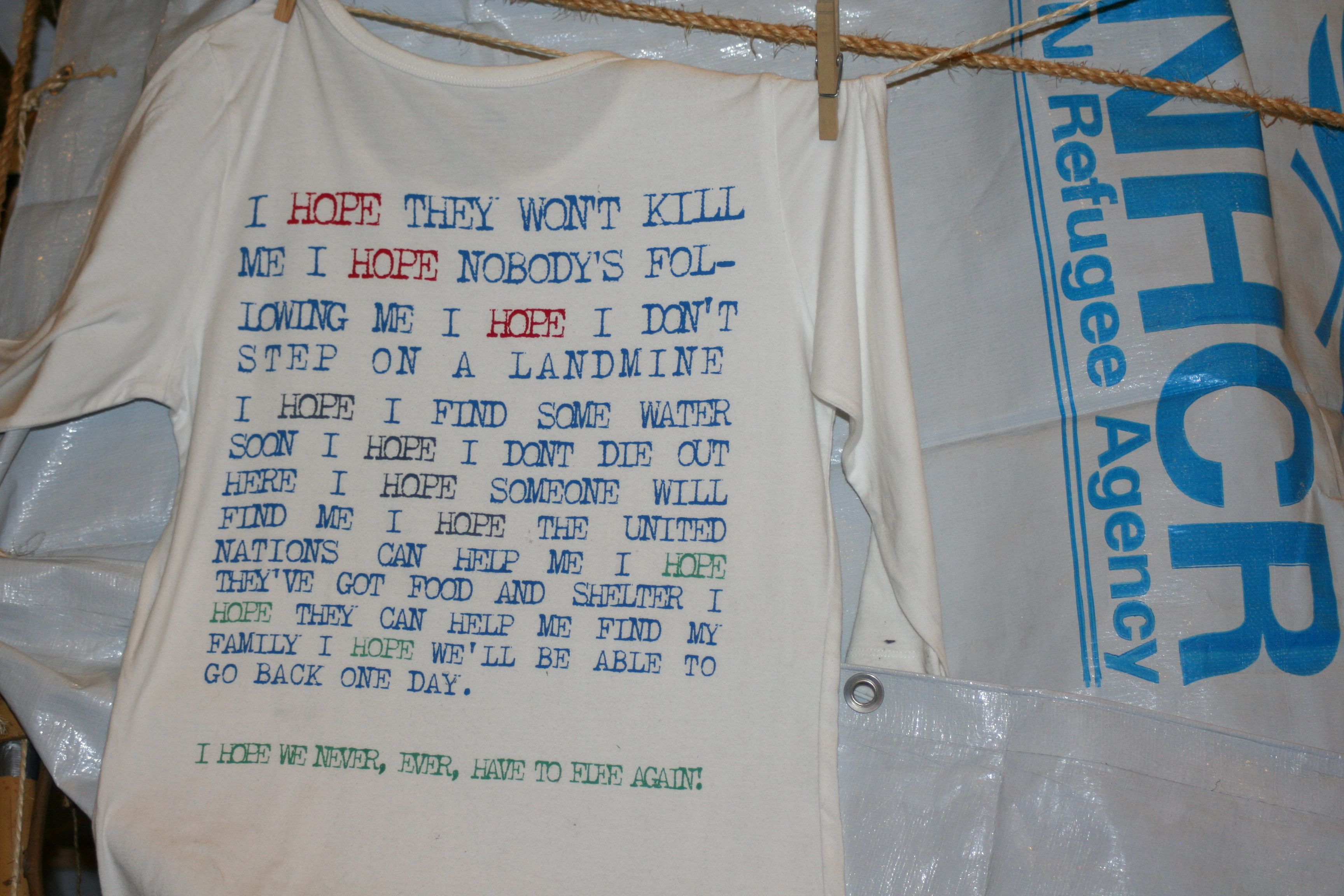
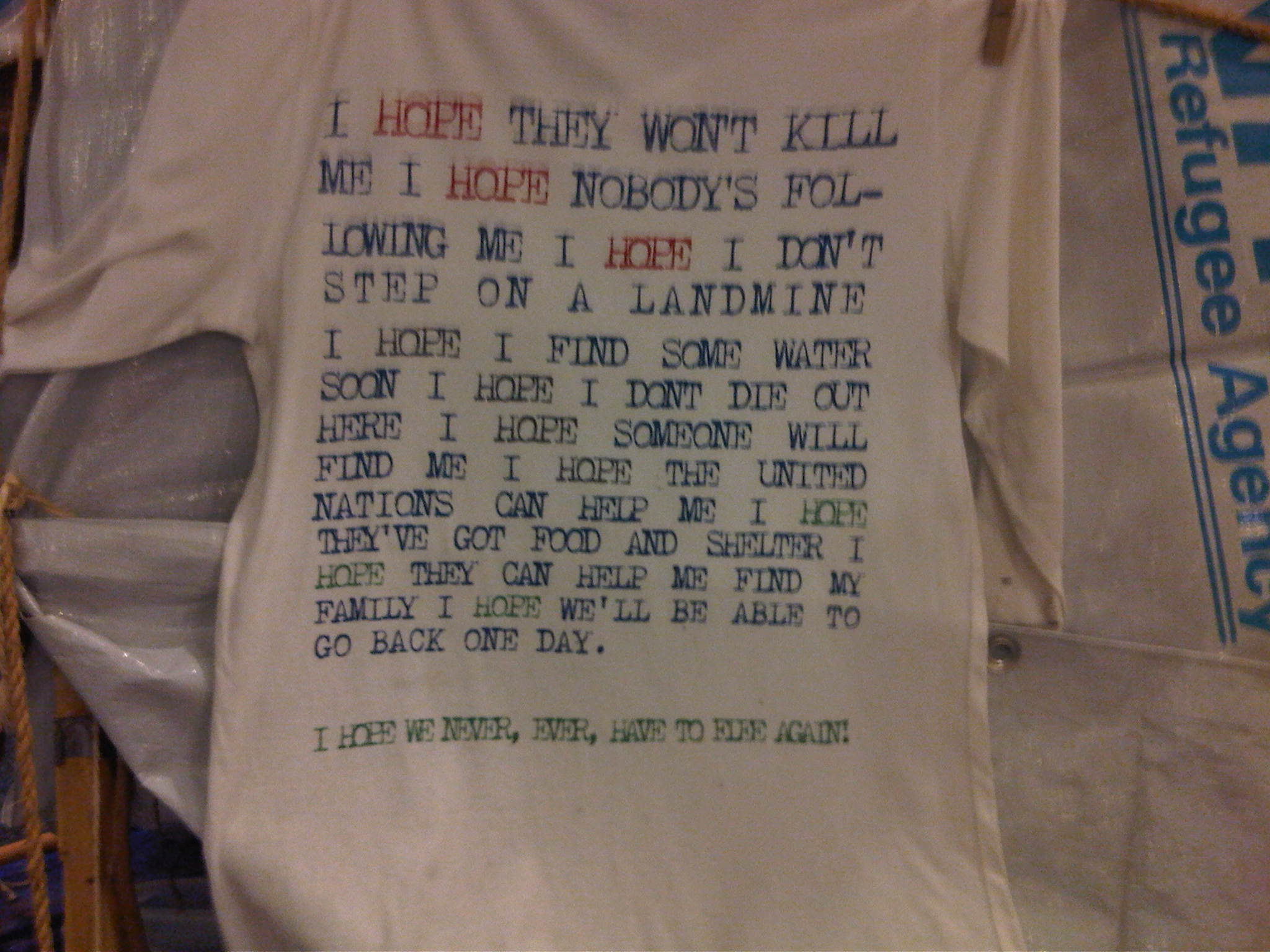
A while back, when tempted to whine about the heat, I reflected on perspective with the help of some friends. Today, while touring the United Nations headquarters with a group from China I saw a t-shirt that further deepens my perspective on the challenges of life – the real challenges of life. The t-shirt hangs on the display about displacement – hangs there every day – hangs there every time I accompany a group on a tour. I see it every time. Today, though it spoke to me with a power not present before.

The photo lacks in quality – next time I will bring a better camera – but it conveys the message.

May all who share such hopes have them realized.

May I help answer these hopes of my sisters and brothers.

See you along the Trail.

Leave a comment

Filed under New York, Photo, Presbyterian Ministry at the United Nations