Tag Archives: Grace Ji-Sun Kim

Theological Reflections on “Gangnam Style”: Endorsements

Check out this information about my friend Grace Ji-Sun Kim’s new book. I am looking forward to reading it – hope you are too.

gracejisunkim's avatarGrace Ji-Sun Kim

ShowJacket.aspMy new book, Theological Reflections on “Gangnam Style”: A Racial, Sexual and Cultural Critique (Palgrave Macmillan) co-written with Joseph Cheah is now available for pre-order on Amazon.

This new book is the first one in the book series, “Asian Christianity in the Diaspora“(Palgrave Macmillan) for which Joseph Cheah and I are both serve as co-editors.  Special thanks to our editor Burke Gerstenschlager for his guidance, trust and encouragement.

View original post 828 more words

1 Comment

Filed under Antiracism, Friends

Donald Sterling, the NBA and Racism

Much has been said and written about the case of Donald Sterling and the racism that continues to haunt our society. Here are some reflections by my friend Grace Ji-Sun Kim.

gracejisunkim's avatarGrace Ji-Sun Kim

BKN-CLIPPERS-OWNER-DONALD STERLING Here is my latest for The Huffington Post.  It is on the latest controversy surrounding Donald Sterling.  I would love to hear your comments.

Los Angeles Clippers owner Donald Sterling, in a recorded conversation pleaded with a woman to not bring black people to Clippers games and to not publicize pictures she had taken of Magic Johnson, a black basketball all-star.

View original post 900 more words

1 Comment

Filed under Antiracism, Friends

Do you Speak English? Racial Discrimination and Being the Other

Grace Ji-Sun Kim reflects on being viewed and treated as the other.

gracejisunkim's avatarGrace Ji-Sun Kim

fsrThis is my latest post for Feminist Studies in Religion, “Do you Speak English? Racial Discrimination and Being the Other”.  I would love to hear your comments or feedback.

I speak fluent English, conversational Korean and textbook French. I am proud to be trilingual and I always encourage my children to speak Korean with me. They never do. I do my best to speak to them in Korean, unless I am disciplining them. Then, only English comes out of my mouth.

View original post 923 more words

1 Comment

Filed under Antiracism, Friends

The Invisibility of Asian Americans: the Feminist Wire

Thanks to Grace Ji-Sun Kim for this reflection on the invisibility of Asian Americans in the news media. She provides examples of how this happens and reflects on why.

gracejisunkim's avatarGrace Ji-Sun Kim

Headshot4_small-300x225 Kenneth Bae source: http://freekennow.com

There is too much racism within our society.  Here is my latest for the Feminist Wire.  So thankful to everyone at the Feminist Wire but especially to Tamura A. Lomax and Aishah Shahidah Simmons.

As we reflect on racism….let us continue to pray for Kenneth Bae and his family.

Where is the public face of Asian Americans in our society? As we follow the case of Kenneth Bae, the only Asian American faces we see on the television news are those of Kenneth Bae and his family. Relatively few Asian American analysts, commentators or advocates (with the exceptions of Connie Chung, Julie Chen, Ann Curry, Sanjay Gupta, and Kaity Tong) appear on the news media.

View original post 1,103 more words

1 Comment

Filed under Antiracism, Current Events, Friends

Ecclesio.com and Grace Ji-Sun Kim in conversation

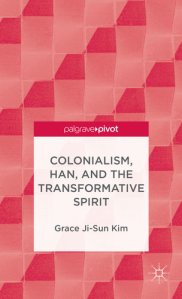
The blog Ecclesio.com has featured Grace Ji-Sun Kim  and her book, Colonialism, Han and the Transformative Spirit this week.

The series features an excerpt from her book that focused on Consumerism and Overconsumption.

Related posts include a brief review of Colonialism, Han and the Transformative Spirit by Cynthia Holder Rich of Ecclesio.com and two conversations between Cynthia and Grace:

A Conversation with Grace Ji-Sun Kim, Part I

A Conversation with Grace Ji-Sun Kim, Part II

Lots of good stuff here. Thanks to Cynthia and Grace for this series!

See you along the Trail.


1 Comment

Filed under Books, Friends

Grace Ji-Sun Kim on Consumerism and Overconsumption

Graces BookIn a post that originally appeared in Ecclesio.com and then on her own blog, Grace Ji-Sun Kim shares an excerpt from her book, Colonialism, Han and the Transformative Spirit.

Here are some teasers that may inspire you to check out the blog and the the book:

One of the problems the Western world is facing today is how to live a life so that all of humanity can flourish and not just a select few wealthy people.

When one looks at the world today, an inescapable fact is the vastly unequal distribution of assets, wealth, affluence, and life prospects. We live in a world where a relatively small number of people, about one-sixth the world’s total population of approximately seven billion people, have a preponderant share of the planet’s wealth and resources, while a significant majority of the remaining six billion lead lives marked by insecurity, poverty, misery, disease, and death.

Today, as capitalism and consumerism drive the modern version of colonization known as globalism, the gap between the haves and have-nots widens beyond anything ever known in history. This unequal distribution of wealth is taking a toll on the fragile planet and ecosystems that we all belong to. What drives the rich to consume all the resources is understood to drive the economy, so many of the rich people’s practices are not challenged or even questioned.

After reflecting on the perils that the drive to consume pose to people and planet alike, Kim presents an alternative vision:

The real wealth of a nation is its people, and the purpose of development is to create an environment for people to enjoy long, healthy, and creative lives.  The good life is defined by the use of money to help people have decent, fulfilling lives. The good life is not having “more and more” but “enough” …

Kim addresses the tension within which humans live – a tension between freedom and limits – a tension expressed in Genesis 3. She goes on to explore the human role as a “steward.” She notes that too often humans chose to act, not as the stewards God intends us to be, but as bandits: cue Kurosawa and The Seven Samurai. 

The image of the steward intrigues me. Tolkien plays with the question of stewardship in The Lord of the Rings trilogy. In 1992 – as the United States marked the 500th anniversary of the invasion by or arrival of (depending on one’s point of view) of the Europeans in what we now know as the Americas – I preached a sermon contrasting the role of conquistador with steward. As Kim notes,  “It is not easy being God’s stewards, living in a garden where so much more is possible than is beneficial.”

Kim notes the warnings we are receiving about the consequences of our current consumer lifestyle of overconsumption. And she wonders if we will heed the signs and examine and change our ways of “being and living.”

There is much to ponder in the post. There are many topics for conversation. I encourage you to check it out!

See you along the Trail.


2 Comments

Filed under Books

The power of words

Words matter.

That’s the message of a recent post by my friend Grace Ji-Sun Kim. She reflects on Bill Maher’s observations about Paula Deen. As one who makes his living using words, Maher reportedly said, “It’s just a word, it’s a wrong word, she’s wrong to use it, but do we always have to make people go away?”

Grace joins a number of people, that apparently include Maher’s guest at the time of his statement, who remind us of the power of words.

As children, we grow up with the schoolyard phrase: “Sticks and stones will break my bones, but words may never hurt me.” Children say this because they know, too well, that words may hurt them.

Agreed.

If we look back in our lives, we will realize that there were certain words that people said to us that have stuck with us for a long time.

Agreed.

In both cases, my agreement arises from practical, personal experience as well as observation and reflection.

Words have power. Power to degrade. Power to inspire. Power to touch and move. Power to abase and wound.

Totalitarian regimes have long recognized the power of words. When the military junta seized power Chile, they arrested, tortured, and killed Victor Jara. His crime? He used the words of his songs to support the government of Salvador Allende.

As Grace writes:

Words influence our thoughts and our ideas. Words shape how we see the world, by causing us to stress certain things and ignore other things.

Once we realize the power of words, we recognize that we can actually start to embrace one another through words.

Our words should be used for moving us and making us into meaningful people who seek to encourage and motivate others. Once we realize the importance and power of our words, we can become more careful with what we say because we know that what we say matters.

Thanks Grace for your reminder about the power of words. May I choose mine carefully, lovingly, and justly.

See you along the Trail.

P.S. In the pile of books I hope to read soon is The Grace of Sophia by Grace Ji-Sun Kim. I look forward to the read.

Leave a comment

Filed under Current Events, Friends

WCC Assemby in Korea to Urge Pursuit of Peace, Justice

My friend Grace Ji-Sun Kim recently went to a planning meeting for the World Council of Churches Assembly that will take place in Korea in October. I wish I were going to the Assembly – I have fond memories of Korea.

gracejisunkim's avatarGrace Ji-Sun Kim

This is my latest post for Ethicsdaily.com.  It is a reflection of my recent participation at a World Council of Churches Meeting in Geneva.

Many mainline denominational churches, such as the Lutherans, Presbyterians, Episcopalians and Methodists, are struggling to survive in North America.

View original post 860 more words

Leave a comment

Filed under Current Events, Friends, Human Rights

White and Yellow

A short time back, I subscribed to Grace Ji-Sun Kim’s blog –  Grace Ji-Sun Kim ~ Loving Life.

In today’s post (24 April 2013), Grace reflects on race and privilege and racism.

She begins with an experience on a plane trip with her daughter. A brief encounter while leaving the plane brought the reminder that:

… an Asian is always already viewed as a foreigner no matter how long they have been living in this country.  Even fourth or fifth generation Asians are viewed as the “perpetual foreigner.”  Asian Americans have been depicted as “perpetual foreigners,” “unassimilatable,” and other stereotypes that reveal historic and persistent racism experienced by this racial/ethnic group.  For example, almost every Asian in America has been afflicted with the perpetual foreigner syndrome.  Many have been asked, “Where are you really from?”  This loaded question, which I shall call the “really-question,” differs from the usual one, “Where are you from?”  The really question figuratively and literally ejects the Asian American respondent to  Asia, because the assumption behind the question, even if the questioner is oblivious to it, is that Asian Americans cannot be “real” Americans.

From the experience on the airplane, Grace proceeds to explore being viewed as the “other” or a “perpetual foreigner.” She considers the social construction of “whiteness” and white superiority and white privilege. Race, as she notes, intersects with gender, sexuality, age, sexual orientation and more.

Her story and reflection remind me to remain ever vigilant about the role of privilege in my life. In so many ways, I am privileged.That brings me responsibility to challenge the systems and structures that create the privilege and give it to me. Sometimes I do not do that well. Sometimes I do. Always I must pay attention and try to do better.

Grace closes with a vision:

I envision a world for my daughter in which people of all races, ethnicities, sexual orientations, and social classes can come together in harmony and love.

The reality of my privilege challenges me to work to overcome racism and other systems of domination and strive to create another world. The vision encourages me to do the same. Check out Grace’s post and see how it speaks to you.

See you along the Trail.


2 Comments

Filed under Antiracism