Tag Archives: community

I need to try again

Communities of accountability have a way of intersecting.

The same people often appear in different communities to which we are accountable. A person may play a key role in one community and stand on the periphery of others. Or a person may hold a key place in several communities.

Make rosters of my communities of accountability and you will find Merdine T. Morris on many of those lists. A few years ago, I described her in these words:

Merdine T. and I have been friends for more than 20 years. Friend really does not do our relationship justice, she is my mentor, teacher, challenger, comforter, disturber of my peace, guide, anchor . . . the list goes on.

Today I add, Merdine T. Morris is practically a one person community of accountability for me.

Three years ago, Merdine T.’s health failed and I reflected on what I thought might be our last visit.

Merdine T. recovered.

On Tuesday, Tricia, Eric and I went to see her. We arrived and told the receptionist we wanted to visit Merdine T. She paused a moment and said, “I don’t think Merdine T. is here.”

She checked a list and informed us that Merdine T. had gone to lunch with a group. On the one hand, this was disappointing. On the other, it was great, good news.

I carry Merdine T. in my heart and head and will always do so. But I give thanks to know that she can get out and around.

And I need to try to see her again before I leave for New York.

See you along the Trail.

Leave a comment

Filed under Family, Friends

To a community of accountability – thank you!

My friend Laura Mariko Cheifetz has recently written twice about communities of accountability. As she notes:

I could operate all by myself as an individual, but that would be a lie. I am who I am because of the communities that form(ed) me and support(ed) me.

Laura notes that in some instances, she reports to communities of accountability. In other cases, while that word might be too strong, she still exist in, and nurtures, relationship with that community.

After reflecting on some of the communities to which she is accountable, Laura poses the question:

What are your communities of accountability? Your church? Your neighborhood? How do you stay accountable to them?

I would name a number of such communities in my life. The list that follows is not necessarily in order of importance. It is the communities in the order that they occur to me – bearing in mind that I am on a new allergy medication at the moment. I am accountable to:

  • family
  • the Presbytery of New York City
  • the Presbyterian Church (U.S.A.)
  • the staff of the Presbyterian Ministry at the United Nations
  • the Compassion, Peace, and Justice Ministry
  • the Presbyterian Mission Agency Board
  • colleagues within the UN community and across the church who work for justice
  • the community where I live
  • a circle of friends built through the years – a circle that expands and contracts as we move through life
  • people of color (and white people) with whom I seek to challenge racism
  • women (and men) with whom I seek to challenge sexism
  • LGBT sisters and brothers (and straight brothers and sisters) with whom I seek to challenge heterosexism
  • young people (and older people) with whom I seek to challenge ageism

How do I stay accountable? In different ways with different groups at different times. Sometimes accountability comes in filling in forms and making reports. Sometimes accountability comes through being together and engaging in conversation. Sometimes accountability comes from recalling lessons taught and values shared. Sometimes accountability comes in remembering – allowing people’s faces and voices to fill my mind when we are far apart.

Two areas for further work come to me as I reflect on communities of accountability:

  1. Where do my communities intersect? Who is part of more than one community? What does that mean? Is it something to nurture intentionally? How would I do that?
  2. Where do I need to build new communities of accountability? The area of economic justice and injustice is one area that comes to mind immediately. Where else? What will that take on my part?

I have much to ponder. And I am grateful to Laura for opening this area of thought for me.

But before I close, I want to give a shout-out to a community of accountability that means a great deal to me at the moment. About two months ago, I decided to make another effort at self-care. I have made some remarkable progress although a long, long, long way remains to go. The effort combines exercise (walking at the moment) and reducing calories. I regularly bore Facebook with the information about my exercise for each day. That simple act somehow helps hold me accountable. Friends comment from time to time – different friends each time. Their feedback matters; but it is the posting that makes the difference.

I have also created a community of accountability – pulling together a number of friends and family who have expressed concern for my health – and who have voiced support for my efforts. This group receives weekly and monthly updates on my progress in terms of eating and exercise and weight loss and blood sugar control.

Some individuals have asked to be part of the group. Others I have drafted. I blind copy the group with the emails so they do not necessarily know who else is a member.

Each report receives a few responses – no one responds all the time – everyone responds once in a while. I deeply appreciate the responses. But even more deeply, I appreciate that the group members are willing to receive my updates.

To the members of this accountability group – to my family and friends – I say thank you. With your support, I have made a great start. The journey continues.

See you along the Trail.


3 Comments

Filed under Antiracism, Exercise, Family, Food, Friends, Presbyterian Church (U.S.A.), Presbyterian Ministry at the United Nations

Writing down words

An interchange from the movie Indiana Jones and the Last Crusade remains with me. Indiana (Harrison Ford) and his father Professor Henry Jones (Sean Connery) seek the Holy Grail. Nazis have also joined the quest. Henry Jones has long sought the Grail, finding a map and compiling a diary. To keep them safe, Henry sent the materials to his son and colleague Marcus Brody. Learning that the Nazis have kidnapped Henry Jones, Brody set off with the map.  Indiana went to rescue his father. After a series of adventures, father and son escape. The following conversation occurs:

Professor Henry Jones: Stop, wait, stop! Stop! You’re going the wrong way. We have to get to Berlin.
Indiana Jones: Brody’s this way.
Professor Henry Jones: My diary’s in Berlin.
Indiana Jones: We don’t need the diary, dad; Marcus has the map.
Professor Henry Jones: There is more in the diary than just the map.
Indiana Jones: All right, Dad. Tell me.
Professor Henry Jones: Well, he who finds the Grail must face the final challenge.
Indiana Jones: What final challenge?
Professor Henry Jones: Three devices of lethal cunning.
Indiana Jones: Booby traps?
Professor Henry Jones: Oh, yes. But I found the clues that will safely take us through them in the Chronicles of St. Anselm.
Indiana Jones: Well, what are they? As his father sits silently, Indiana continues in an annoyed voice. Can’t you remember?
Professor Henry Jones: I wrote them down in my diary so that I wouldn’t have to remember.

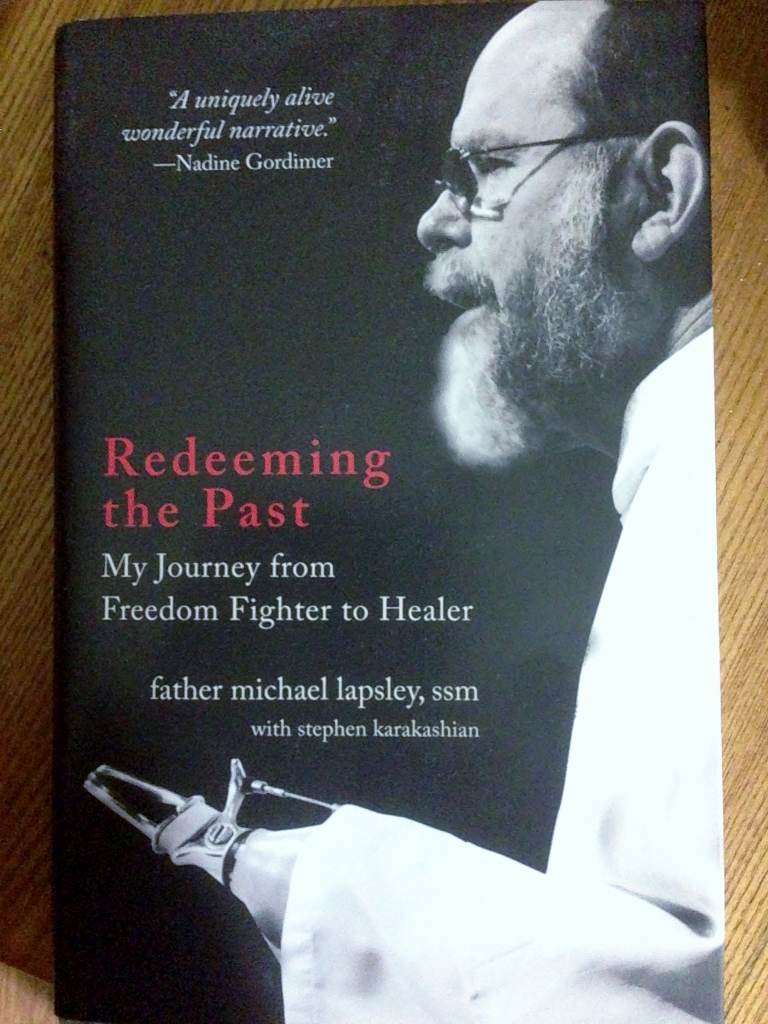
I have always found wisdom in Henry Jones’ plan. I find more as I grow older. Redeeming the Pastby Father Michael Lapsley, is one of several books I am reading.

photo (7) (768x1024)An Anglican priest, Father Lapsley took an active role in the struggle against South Africa’s apartheid. In 1990, he opened a letter bomb that nearly killed him. The blast took his hands and one of his eyes. His book tells his story of the faith journey that led him to pursue justice, the explosion, his recovery, and how Father Lapsley has drawn on his experience of trauma to help his sisters and brothers in South Africa and around the world seek healing.

Many of his words bear repeating and remembering. I write down a few:

 As we who are disabled demand a place in the sun, we are not just asking people to be nice to us; we are saying, “Actually you can’t be a real community without us.” We don’t ask for pity; we ask for justice. We say, “Don’t just include us in your community. Instead, come, let’s create one together.” That’s a very different concept.

Profound, challenging, humbling, hopeful words. Words that apply in so many situations – in any situation of privilege and oppression and exclusion. Words to ponder, to remember, and to seek to live by.

We cannot be a real community until everyone is a part and we build that community together. May it be so.

See you along the Trail.

4 Comments

Filed under Books, Human Rights, Movie