Category Archives: Presbyterian Church (U.S.A.)

It’s not fluff

It started with a post by my colleague Christine Hong who does interfaith work for the Presbyterian Church (U.S.A.). She wrote a profound reflection on how important that work is following a hate crime attack on Dr. Prabjhot Singh in New York. I reprint her post with her permission.

Interfaith work is not fluffy. It is advocacy on the deepest level. The more authentically we engage in conversation and life with our neighbors of different faith traditions the more we become aware that interfaith work saves lives. Interfaith education and service not only bridges communities but it also prevents hate crimes and tackles the felt needs of humankind. The interfaith community works to seek justice, not selectively, but holistically. It is a community holding onto one another in order to thrive and survive in a world that often seems to be quickly unraveling.

This past weekend the PC(USA) brought together 60 Presbyterians along with panels of ecumenical and interfaith guests to think through the writing of an interfaith stance for the church. One of our panelists was Simran Jeet Singh, a doctoral student at Columbia University, a peacemaker, and an advocate for the Sikh community. Singh encouraged Presbyterians to build love into the foundation of our interfaith stance. The love Singh spoke of champions justice and lives courageously and hopefully into the future.

I received an email from Simran yesterday. After he had spent the day offering Presbyterians encouragement and affirmation for our interfaith efforts he came home to find that his friend and colleague at Columbia University, Dr. Prabhjot Singh, had been the victim of a hate crime. On Saturday night Dr. Singh was attacked in Manhattan. His attackers yelled “Get Osama” and “terrorist” as they beat him.

Reading Simran’s note and his Huffington Post blog on the incident broke my heart. It reaffirmed for me that what we are doing is of the utmost importance. Not only because we are working at understanding the dynamics of interfaith engagement as Presbyterians, but because our friends like Simran and Dr. Prabhjot Singh are hurting. Our encouragers, those who challenge us to be bold, dynamic, and cultivate peace are living in a world, our mutual world, where they fear physical harm because of the color of their skin and articles of faith. This should matter to us. It should hurt us because they are hurting.

Interfaith work is advocacy on the deepest level. It is advocacy not only for faith communities at large but also for the people we share our lives with on the daily: our neighbors, friends, and families. In a very real sense interfaith work is also advocacy for ourselves, for our shared world and future. Interfaith work is the accompaniment of faith communities who, like us, want to raise their children in a world where violence is not the way human differences are handled. Interfaith work will break your heart, but if we can move past the fluff and remember that what we do saves lives, it will also start to mend it.

I give thanks for Christine and Simran and Dr. Singh and all who engage in interfaith work. I pray for healing for Dr. Singh. I pray that the hurts endured by my brothers and sisters because of their articles of faith or the color of their skin will hurt me enough that I will find ways to engage more deeply in heart-breaking, heart-mending interfaith work.

See you along the Trail.
1 Comment

Filed under Antiracism, Current Events, Human Rights, New York, Presbyterian Church (U.S.A.)

A call to act on Syria

Photos by Paul Jeffrey, ACT

Dr. Mary Mikhael of the National Evangelical Synod of Syria and Lebanon reflects on the crisis in Syria.

Watch other videos.

Find ideas for action.

See you along the Trail.

Leave a comment

Filed under Current Events, Presbyterian Church (U.S.A.)

May insight into Syria lead to action

1236420_590326721006111_1853073050_nConcerned about the crisis in Syria? Want to learn more? Want to respond?

In a series of video clips, Dr. Mary Mikhael of the National Evangelical Synod of Syria and Lebanon helps provide insight and understanding of the situation in Syria.

There are several ways to help the people of Syria. Here are some responses through the Presbyterian Church (U.S.A.)

Additional resources from the Presbyterian Church (U.S.A.) related to Syria are also available. 

Since the outbreak of armed conflict in Syria, Dr. Mary Mikhael has been interpreting the consequences of this tragedy for the Syrian and Lebanese people, particularly the Christian communities, on behalf of the National Evangelical Synod of Syria and Lebanon. From 1994­ to 2011, Dr. Mikhael was president of the Near East School of Theology (NEST), Beirut, Lebanon, the first woman seminary president in the Middle East. She served on the NEST faculty from 1984 until her retirement. She received her Masters degree from the Presbyterian School of Christian Education in Richmond, Virginia, and her EdD from Columbia University and Union Theological Seminary. A Presbyterian born in Syria to Greek Orthodox parents, Dr. Mikhael is active in ecumenical and interfaith initiatives. She is a noted authority on the church in the Middle East and the role of women in the church.

On September 10, 2013 the Office of Public Witness arranged a day of visits for Dr. Mikhael on Capitol Hill in Washington, DC. On September 12 and 13, 2013 the Presbyterian Ministry at the United Nations arranged visits for her in the UN community. Public events for Dr. Mikhael to speak to Presbyterians were held in both Washington and New York.

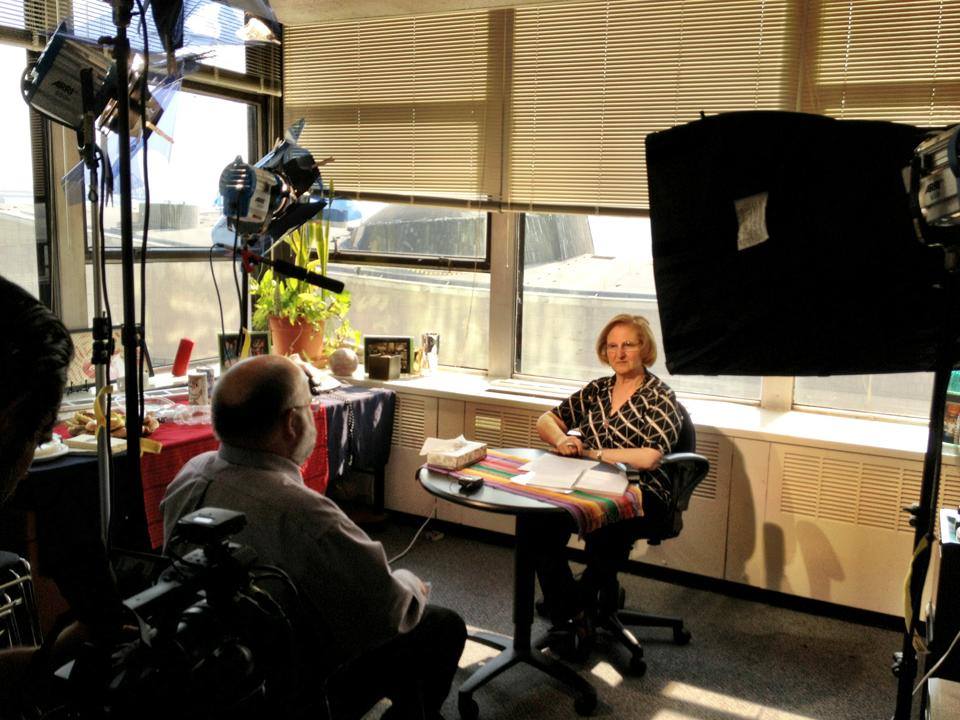
The videos are excerpts from a conversation Mary and I had at the office of the Presbyterian Ministry at the United Nations on September 11, 2013 with David Barnhart (who took the photo of the interview) and Scott Lansing doing the video work.

Share the links widely.

See you along the Trail.

1 Comment

Filed under Current Events, Presbyterian Church (U.S.A.), Presbyterian Ministry at the United Nations

Awareness

At times, we participate in profound moments unaware. Only in retrospect do we realize the significance of what we are a part.

Other times, we know – at least partly. We may not know all the details and nuances, but we recognize that matters of deep import surround us and we play our tiny part.

IMG_0247 (800x600)This past week, I had the privilege to accompany Dr. Mary Mikhael as she made an amazing witness for peace and justice in Syria. Mary is from the National Evangelical Synod of Syria and Lebanon.  Until 2011, she served as the president of the Near East School of Theology in Beirut. After her retirement,the church has named her their interpreter and communicator in this time of tragedy and crisis for the people of Syria.

In that role, she traveled to the United States for the month of September. She spent last week in New York where I had the privilege to accompany her as she told the story of her church and her people, as she witnessed to her faith, as she advocated for peace and justice.

Mary went to Washington, DC on Tuesday. The Presbyterian Office of Public Witness arranged for her to speak at their Second Tuesday Briefing and to meet with aides of five elected officials and a State Department official.

Wednesday saw her in New York with the Presbyterian Ministry at the United Nations. We did extensive video work with my friend and colleague David Barnhart and my new friend Scott Lansing. The video links will be shared when they are posted. That afternoon, Mary spoke to a public event attended by church members, UN agency staff members, and representatives of nongovernmental organizations.

On Thursday, Mary met with staff members of two Permanent Missions to the UN – missions that sit on the Security Council. She also met with representatives of the Inter-Agency Task Force for the Syrian Crisis Core Group made up of UN agencies working in Syria.

As we rode uptown toward the place where Mary was staying, her relief was obvious. She had witnessed well and she was tired.

Then the phone of my colleague Ryan Smith buzzed. An offer arrived for Mary to meet with a representative of the  Office of the Special Representative of the Secretary-General on Sexual Violence in Conflict on Friday.

“Would you do one more meeting?” Ryan asked.

No hesitation. Mary replied, “How can I say no?”

Ryan and I looked at each other. “You can say no because you are tired and this is one extra meeting and you had other plans.”

“How can I say no?” Mary repeated.

We conceded. “You can’t.”

“But can it be early in the day?” Mary asked.

Ryan confirmed the meeting and on Friday morning, it took place.

Mary and I then went uptown and for a moment said farewell. We will meet again, I am sure.

I give thanks for the time we shared.

And I gave thanks for Dr. Mary Mikhael.

And I gave thanks for her witness, her courage, her grace, and her faith as she told stories of horror and proclaimed hope.

And I give thanks for the small role I played in these profound moments.

See you along the Trail.

1 Comment

Filed under Current Events, Presbyterian Church (U.S.A.), Presbyterian Ministry at the United Nations, United Nations

Come tomorrow

I knew Mary Mikhael before, but what we did together today – or more accurately what I witnessed her do – has forged a new level of friendship.

Mary is from the National Evangelical Synod of Syria and Lebanon.  Until 2011, she served as the president of the Near East School of Theology in Beirut. After her retirement,the church has named her their interpreter and communicator in this time of tragedy and crisis for the people of Syria.

Today Mary and I went from New York to DC to meet five legislators and a State Department Official. Catherine Gordon in the Presbyterian Office of Public Witness arranged the visits.

I am now standing, well actually I am sitting on a train back to NYC, in awe of Mary’s courage and grace and strength as she told the story of heartbreak and horror and hope six times. A story she has lived. A story she is living. A story that develops as she tells it. She is exhausted and sleeps beside me.

Come tomorrow, she will again tell the story of the people and church of Syria. This time she will tell the story for a video project and in the UN community.

Come tomorrow, she will recall and relieve the tragedy.

Come tomorrow, she will renew the hope.

Come tomorrow, she will again exhaust herself in witness to her faith and on behalf of her people and church and country.

Come tomorrow, I will again stand in awe.

Come tomorrow, I will weep and smile and pray for peace and justice.

Come tomorrow.

See you along the Trail.

3 Comments

Filed under Current Events, Presbyterian Church (U.S.A.)

PC(USA) church partners support call for no military action in Syria

From the Presbyterian News Service:

The General Secretary of the National Evangelical Synod of Syria and Lebanon, a longtime church partner of the Presbyterian Church (U.S.A.), sent a letter to the PC(USA) yesterday, expressing appreciation for PC(USA)’s “prophetic stand against all kinds of violence in Syria and your condemnation of the use of chemical attacks no matter who was the user.” He also affirms the Synod’s opposition to the use of force by the United States or any international power as it “will only multiply the suffering,” and warns that “what happened in 2003 [war against Iraq] must be a lesson for all.” Click here to download the full letter.

The Christian Palestinian group, Kairos Palestine issued a statement on the situation in Syria on September 2, 2013. “We are certain that any military response will merely escalate the situation and increase civilian disaster,” Kairos shared, as they urged churches worldwide “to stand in opposition to this intended war which will not herald any just peace.” Click here to download the statement.

Last week, the Stated Clerk of the General Assembly, the Rev. Gradye Parsons issued a statement in the wake of the escalating violence in Syria, calling upon U.S. and world leaders to refrain from military action. The Clerk’s statement emphasizes the need for a negotiated approach involving all parties in the region in response to a violation of international law.

The Office for Public Witness issued an action alert asking constituents to send messages to their congress representative indicating their opposition to military action in Syria.

The 220th General Assembly (2012) approved a resolution “On Prayer and Action for Syria” and a statement “For Human Rights and Civic Freedom: Movements for Democratic Change in the Arab World” both of which speak to the current situation in Syria.

You can learn more about PC(USA) mission and history in Syria at World Mission’s Syria page.

See you along the Trail.

Leave a comment

Filed under Current Events, Presbyterian Church (U.S.A.)

Stated Clerk issues statement in the wake of the escalating violence in Syria

This story originally appeared on the Web pages of the Presbyterian News Service:

The Presbyterian Church (U.S.A.) Office of Public Witness provides an opportunity to tell President Obama and Congress to refrain from a military response in Syria.

LOUISVILLE

The Rev. Gradye Parsons, Stated Clerk of the General Assembly of the Presbyterian Church (U.S.A.) issued a statement today (August 30) in the wake of the escalating violence in Syria, calling upon U.S. and world leaders to refrain from military action.

“For everything there is a season, and a time for every matter under heaven.” (Ecclesiastes 3:1)

We are deeply concerned about events in Syria. We grieve for our brothers and sisters who have suffered so deeply for so long. We yearn for an end to the bloodshed and renew our call for a cease-fire and a mediated process involving all parties to provide new choices for all Syrians.

We condemn the use of chemical weapons. Regardless of who perpetrated the attack, such a usage violates a longstanding international norm.  We recognize the authority and the responsibility of the United Nations Security Council to deal with this violation of international law. We call all nations to encourage the Security Council to address this illegal and immoral act. We do not doubt that justice is needed, but question the unilateral and inevitably selective role the United States has too often played, too often leading to greater violence, terrorism, and instability.

We call upon the President and the members of Congress to follow the example of other strong leaders in the past by exercising the courage and wisdom to refrain from military action that is likely to escalate the conflict further, and to bring our country directly into another war in the Middle East.

We applaud the President’s efforts to consult widely, conferring with international leaders and with Congress.  Now we ask him to spend time over this holiday weekend listening to what Americans want and fear.

Now is not the time to feed the violence and instability that has claimed the lives of over 100,000 Syrians, driven 3.4 million Syrians from their country, and displaced an additional 6.8 million Syrians from their homes. Most people affected by the conflict are noncombatants. Expanding the conflict will increase the suffering of the innocent.

Now is the time to heed the voices of our church partners who pray and call and work for peace. Our partners look to us to challenge policies of our government that help to fuel conflict in Syria and proxy wars across the Middle East.

Now is the time to reflect on the lessons of 12 years of involvement in conflict in the Middle East by the United States. Limited engagement is never truly limited.

Now is the time to support the peacemakers of Syria who seek to end the violence and build a future. In any Congressional deliberations, we urge that nonviolent forms of intervention be considered, and that next steps beyond military force be grounded in defensible cooperative goals for the region.

Now is the time for all outside parties to cease all forms of military intervention in Syria. States and and non-state actors must stop feeding the conflict in Syria by sending weapons to the government and to opposition forces.

Now is the time to renew the efforts for a diplomatic solution. The United States must work with the United Nations and other governments to contain the violence, restore stability in the region, provide humanitarian assistance, and encourage the building of an inclusive society in Syria that protects the rights of all its citizens.

Now—in the grimmest of situations—is the time to build a coalition of nations and peoples willing to do the long, hard, and essential work of establishing interfaith relationships of respect and understanding.

Now—for Syria and all its neighbors—is the time to seek a new vision of cooperation and nonviolence that will support an intervention with the power of impartial justice that will lead to a just and lasting peace.

Now is the time to pray for wisdom for leaders, for courage to turn from violence, for grace to build and nurture relationships, for justice to roll down like waters, and for peace to prevail in Syria.

“For everything there is a season, and a time for every matter under heaven.” For the people of Syria, may it now be a time for peace.


1 Comment

Filed under Current Events, Presbyterian Church (U.S.A.), United Nations

To a community of accountability – thank you!

My friend Laura Mariko Cheifetz has recently written twice about communities of accountability. As she notes:

I could operate all by myself as an individual, but that would be a lie. I am who I am because of the communities that form(ed) me and support(ed) me.

Laura notes that in some instances, she reports to communities of accountability. In other cases, while that word might be too strong, she still exist in, and nurtures, relationship with that community.

After reflecting on some of the communities to which she is accountable, Laura poses the question:

What are your communities of accountability? Your church? Your neighborhood? How do you stay accountable to them?

I would name a number of such communities in my life. The list that follows is not necessarily in order of importance. It is the communities in the order that they occur to me – bearing in mind that I am on a new allergy medication at the moment. I am accountable to:

  • family
  • the Presbytery of New York City
  • the Presbyterian Church (U.S.A.)
  • the staff of the Presbyterian Ministry at the United Nations
  • the Compassion, Peace, and Justice Ministry
  • the Presbyterian Mission Agency Board
  • colleagues within the UN community and across the church who work for justice
  • the community where I live
  • a circle of friends built through the years – a circle that expands and contracts as we move through life
  • people of color (and white people) with whom I seek to challenge racism
  • women (and men) with whom I seek to challenge sexism
  • LGBT sisters and brothers (and straight brothers and sisters) with whom I seek to challenge heterosexism
  • young people (and older people) with whom I seek to challenge ageism

How do I stay accountable? In different ways with different groups at different times. Sometimes accountability comes in filling in forms and making reports. Sometimes accountability comes through being together and engaging in conversation. Sometimes accountability comes from recalling lessons taught and values shared. Sometimes accountability comes in remembering – allowing people’s faces and voices to fill my mind when we are far apart.

Two areas for further work come to me as I reflect on communities of accountability:

  1. Where do my communities intersect? Who is part of more than one community? What does that mean? Is it something to nurture intentionally? How would I do that?
  2. Where do I need to build new communities of accountability? The area of economic justice and injustice is one area that comes to mind immediately. Where else? What will that take on my part?

I have much to ponder. And I am grateful to Laura for opening this area of thought for me.

But before I close, I want to give a shout-out to a community of accountability that means a great deal to me at the moment. About two months ago, I decided to make another effort at self-care. I have made some remarkable progress although a long, long, long way remains to go. The effort combines exercise (walking at the moment) and reducing calories. I regularly bore Facebook with the information about my exercise for each day. That simple act somehow helps hold me accountable. Friends comment from time to time – different friends each time. Their feedback matters; but it is the posting that makes the difference.

I have also created a community of accountability – pulling together a number of friends and family who have expressed concern for my health – and who have voiced support for my efforts. This group receives weekly and monthly updates on my progress in terms of eating and exercise and weight loss and blood sugar control.

Some individuals have asked to be part of the group. Others I have drafted. I blind copy the group with the emails so they do not necessarily know who else is a member.

Each report receives a few responses – no one responds all the time – everyone responds once in a while. I deeply appreciate the responses. But even more deeply, I appreciate that the group members are willing to receive my updates.

To the members of this accountability group – to my family and friends – I say thank you. With your support, I have made a great start. The journey continues.

See you along the Trail.


3 Comments

Filed under Antiracism, Exercise, Family, Food, Friends, Presbyterian Church (U.S.A.), Presbyterian Ministry at the United Nations

Pray for peace on Korean Peninsula

My friends Hyeyoung Lee and Kurt Esslinger serve as the Young Adult Volunteer coordinators in Daejeon, Republic of Korea for the Presbyterian Church (U.S.A.). They offer this prayer for PC(USA) members to use during the season of prayer called for by the statement on the Peace of the Korean Peninsula. It is posted here with their permission.

God of the universe, God of the nations,
The people of the Korean Peninsula are crying out,
They no longer wish to live in the shadow of war,
They no longer wish to have resources diverted from life toward death,
They no longer wish to live in fear of the next possible misjudgment in calculation and rhetoric,
They yearn for healing and truth,
You call us to be a people of light, of life, and of peace,
But we have stood silent as our country perpetuates the machinations of death, darkness, and war.
How long, O Lord, must the Korean people live in a state of war?
We confess that we stood by and watched as we split an unwilling country into two,
We confess that those we voted into office ignored the context of a people tired of colonization,
We confess that our military has taken advantage of Korean gratitude,
We confess that our SOFA agreement denies justice to all those harmed by our representatives,
We confess that military presence comes hand in hand with the presence of brothels and sex trade,
We confess that we would much rather pretend this is “their problem,”
We confess that we believe we have no responsibility,
We confess that we hope to continue a policy of isolation despite its ineffectiveness,
We confess that we find it easier to continue the tired old song of hostility than to boldly move toward peace,
Help lead us into a future with the possibility of life,
A future where tools of death are laid down and the call of life,
Rise up a passion for justice, for peace, and for advocacy in your children,
Give our leaders the creativity to find new effective steps toward peace,
Give us the will to reunite families,
Help us lift up the voices of peace within the Korean Peninsula,
Gracious God of forgiveness and healing,
May we be transformed into effective agents
in partnership with the people of Korea
in making your Heavenly Commonwealth of Peace a reality on this planet.
Amen.

May it be so.

See you along the Trail.

1 Comment

Filed under Presbyterian Church (U.S.A.)

Time for an end after 60 years

IMG_2732 (533x800)On June 25, 1950, conflict broke out on the divided Korean Peninsula. North Korean troops crossed the 38th parallel, an artificial line of demarcation chosen by the winning superpowers after World War II, invading South Korea.

The police action, the Korean Conflict, the Korean War expanded to include forces from South Korea, North Korea, the United States, and the People’s Republic of China. Fifteen other countries provided combat troops to the United Nations Command, created by UN Security Council Resolution 83, recommending that members of the United Nations aid South Korea.  Several other countries provided humanitarian aid. The Soviet Union aided North Korea with advisers and  material assistance.

The fighting ranged up and down the Korean Peninsula with neither side gaining an advantage. The number of killed and wounded among combatants and non-combatants is disputed. CNN suggests that:

The toll of the war included about 1.2 million deaths in South Korea, 1 million deaths in North Korea, 36,500 deaths for U.S. troops and 600,000 deaths for Chinese soldiers.

After more than three years, an armistice was signed on July 27, 2013 – sixty years ago. This armistice was a truce, a ceasefire. A treaty ending the war has never been signed. Military commanders from the People’s Republic of China and North Korea signed the armistice with the US-led United Nations Command signing on behalf of the international community. South Korea did not sign.

The truce has generally held, but many of the people living on the Korean Peninsula want a true peace. They view such a peace as the an important step toward the end of the periodic tensions and confrontations that arise. In this anniversary year, efforts to seek such a peace are increasing.

The ecumenical community in the United States has created a Korean Peace Petition to send to the Obama Administration. The petition, which you can download and sign, encourages the administration to move toward a path to peace and reconciliation

The Presbyterian Church (U.S.A.) and the Presbyterian Church of Korea issued a Joint Statement on the Peace of the Korean Peninsula that called members and congregations to join in a Season of Prayer for peace in Korea. My friends Kurt Esslinger and Hyeyoung Lee serve as mission co-workers in South Korea. They have written a prayer for the Season of Peace that begins:

God of the universe, God of the nations,
The people of the Korean Peninsula are crying out,
They no longer wish to live in the shadow of war,
They no longer wish to have resources diverted from life toward death,
They no longer wish to live in fear of the next possible misjudgment in calculation and rhetoric,
They yearn for healing and truth,
You call us to be a people of light, of life, and of peace,
But we have stood silent as our country perpetuates the machinations of death, darkness, and war.
How long, O Lord, must the Korean people live in a state of war?

Check out the whole prayer. Use it. Use other prayers. Pray for the peace of Korean Peninsula.

See you along the Trail.

2 Comments

Filed under Current Events, Presbyterian Church (U.S.A.), United Nations