Category Archives: National Park

Fossils and a Peak

Started the day late – largely because I did too much work – and I remain way behind. But eventually I stopped, and vacation began.

We started with a journey to Florissant, CO and Florissant Fossil Beds National Monument. This involved a drive over Ute Pass. We ate at the Swiss Chalet in Woodland Park – an interesting town – definitely worth checking out further should the Trail ever wend this way again.

Florrisant Fossil Beds was an interesting mix of pine forest (pictures added to the pine cone collection photo album), fossils large (petrified wood) and small (insects), and frontier history (the Adeline Hornbek homestead). The petrified wood is from redwood trees – 35 million years or so ago, volcanic eruptions (they must have been huge as the volcano in question was some distance away) buried the valley – it was apparently quite lush and feature major redwoods. The eruptions buried a significant part of the redwoods – the tops died and decayed over the years – the stumps petrified. The volcanic activity also created a lake in the valley; the bottom of the lake became the resting place for insects and plants which became fossilized. Adeline Hornbek, a single mother of four, claimed land under the Homestead Act. She pushed the boundaries on traditional gender roles and became a prosperous rancher and a community leader.

From pondering fossils, petrified wood, and homesteading, we returned to Manitou Springs and the Pikes Peak Cog Railway for a journey above the timberline. We observed changing environs as the train climbed some 6,000 feet. Two elk, viewed from a distance, highlighted the trip – first time I have ever seen elk in the wild. Several deer were viewed as were numerous marmets.

Tomorrow is a little unplanned – it involves travel to Greeley, CO where we will have dinner with Sue Brown. We will see what else the day brings.

See you along the Trail.
Leave a comment

Filed under National Park, Photo

Thinking is needed


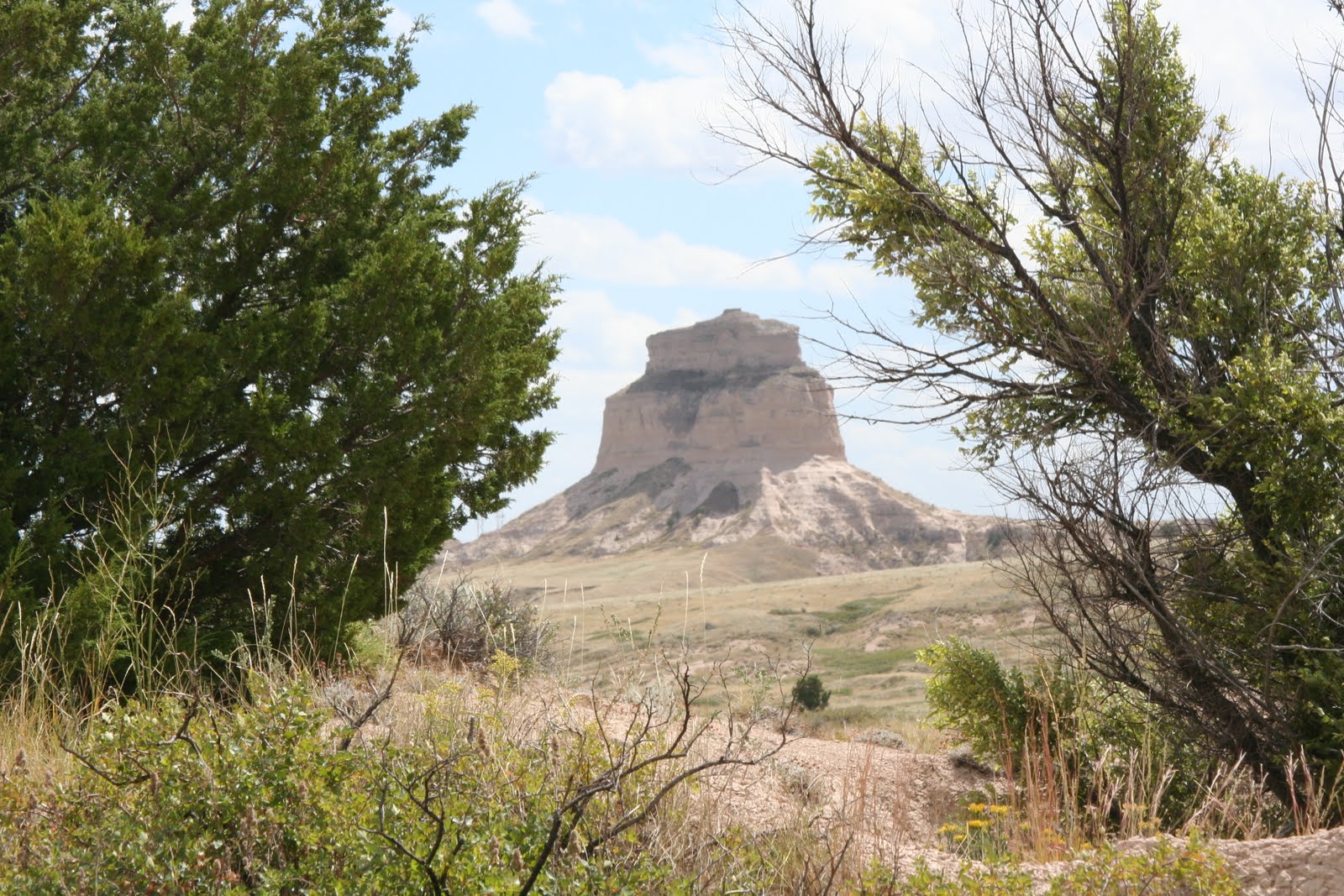
Today brought the final National Park (some day I have to figure out the different categories – National Park, National Historic Site, etc.) on this trip: Scotts Bluff National Monument.

The day started at Penny’s Diner – a restaurant near the Oak Tree Inn in Morrill, NE. It was a good place to stay and a good place to eat.

From there, we journeyed to the Riverside Zoo in Scottsbluff. And then on to the monument.

As are many of the parks, it is an interesting place with much to ponder. The bluffs served as a landmark on trails west. From the European point of view those trails were about emigration and expansion. From the point of view of the Native Americans those trails were about invasion. A great deal to sort through when one thinks about it. And a great deal of thinking is needed.

Travel continued to Denver. Tickets have been purchased for the Colorado Rockies game tomorrow. A visit to the Denver Aquarium is also in order.

11,602 steps.

See you along the Trail.

Leave a comment

Filed under Baseball, National Park, Travel

The old goat, er, sheep

Driving through the Badlands (9/3/10),

Tricia and I came across a number of creatures,

including some Bighorn Sheep.

Good stuff.

See you along the Trail.

Leave a comment

Filed under National Park, Travel

Taft, Underground Railroad, snow


I am back – at least back writing – after a hiatus that included not eating well, not getting to the gym, not making 10,000 steps.

The good news is that many of those days were spent in Cincinnati with Tricia. We met on Friday. Saturday we went to the William Howard Taft National Historic Site. That is not one of the national parks that had been on my “must-do” list, but it is here and it is one more off the list. My passport stamp total is now 96. It will be interesting to see what is the stamp 100. I have been to more parks than those for which I have stamps having visited a number before I started using the passport. Some of the larger parks also have more than one stamp so the park count is not the same as the passport stamp count. Taft appears to have been an interesting dude. Besides being the only person to serve as President and Chief Justice of the Supreme Court, he was also the first President to throw out the opening pitch at a baseball game.

We returned to the Homewood Suites (it’s a really good place with nice folks so it gets a product placement) in Milford to watch Duke basketball. We followed that by going to see Avatar. Still processing that one. I have heard a great number of comparisons to the Pocahontas story. One parallel that occurred to me that I have not heard (which does not mean it has not been repeatedly made): as the clans gathered, I thought of the efforts of Tecumseh (Tecumtha) and Tenskwatawa to create a confederacy of the indigenous peoples in the early 1800s in what was then known as the Northwest Territory. An episode of the PBS series American Experience: We Shall Remain tells that story. I need to check it out.

Yesterday saw a trip to the National Underground Railroad Freedom Center. It is a haunting, wrenching, and painful experience. The human capacity for brutality and inhumanity – on an individual and corporate level is staggering. Even when one is aware of that capacity, it is staggering to see it revealed. At the same time, the stories told by the Center are affirming and inspiring. The human capacity to endure and persevere – the human capacity for courage and cooperation are even more impressive. What the people who were enslaved endured, touched me deeply. Processing this experience will continue for some time.

This morning we woke to damp streets – now two hours later those streets are snow-covered. Our decision to stay put and not try to get back to Cleveland and Louisville respectively makes sense. There is a fitness center here which I will soon visit.

1 Comment

Filed under National Park

Stones


Nashville, TN

I am not attending the meeting of the Association of Presbyterian Church Educators. I am hanging out with Tricia – doing some minimal work around the edges – but actually kind of vacationing to some extent.

I slept in until 10:30 or so. Then went to the fitness center at the Renaissance Hotel. I did 2.39 miles on the treadmill.

The afternoon saw the continuation of the quest to visit National Parks. I drove to Murfreesboro to visit Stones River National Battlefield. On December 31, 1862 and January 2, 1863, forces under the command of Gen. Bragg (CSA) and Gen. Rosecrans (USA) clashed along Stones River. The battle was fought on cotton fields and among cedar timbers and in places remembered after as The Slaughter Pen and Hell’s Half Acre. 3,000 men died; killed, wounded, and missing totaled over 23,000.

I go to and come away from such places with mixed emotions: horror, sorrow, pain, pride and more intermingle. The place seems hallowed in ways I can never describe. Walking alone on the boundary trail, every rustling leaf and every squirrel moving on the ground made me feel surrounded by ghosts.

Some particularly poignant moments:

The area has been struck by tornadoes in the not too distant past. Trees are torn apart, knocked over, strewn across the parts of the park. I wondered what it looked like when the trees were torn apart, knocked over, and strewn across the ground by cannon and rifle fire.

The park contains the nation’s oldest intact Civil War monument. A square column, erected by the survivors of Colonel William B. Hazen’s brigade, stands surrounded by a stone block fence. The dead lie with the comrades of their respective regiments.

Outside the fence is the grave are two additional graves – those of Sgt. William Holland and William Harlan. Sgt. Holland served in the U.S. Colored Infantry, not in Hazen’s brigade during the Civil War. He lived until 1909. At that time, the U.S. military was segregated. He was not buried with the others, either around Hazen’s monument or in the National Cemetery across the road. This apparently was by his choice, not a continuation of segregation. The story told by the National Park Service and in an article in the Murfreesboro Post, is that Holland picked his own burial plot – on a small farm he owned next to Hazen’s Monument. William Harlan was his grandson.

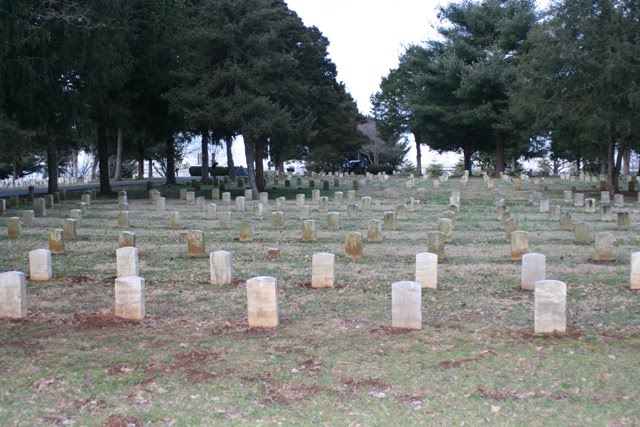
The Stone River National Cemetery is directly across the road from the battlefield. Looking at the rows of white crosses and recalling the number of charges made by Confederates and Federals alike, I imagined the cemetery as the place where the last charge at Stones River took place. It was also striking how many stones bore only initials.

Lots to mull. That’s part of the appeal of national parks.

Step count: 16, 284.

Leave a comment

Filed under National Park