Category Archives: Human Rights

How much doubt is reasonable?

Earlier this week, the Columbia Human Rights Law Review published its Spring 2012 issue with an article that strongly suggests Carlos DeLuna was innocent of the crime for which the State of Texas executed him.

Today, Michael McLaughlin writes in The Huffington Post that

A Texas judge who reviewed the controversial 2004 execution of Cameron Todd Willingham planned to posthumously exonerate the father who was put to death for killing his three daughters in a house fire.

When the conversation turns to the possible execution of an innocent person, Willingham’s name and case is often cited. Willingham’s home in Corsican, Texas burned on 23 December 1991. His three daughters, trapped inside, died. He escaped. His wife was away at the time.

The investigation concluded the fire was deliberately set and an accelerant used. Two weeks after the blaze, the authorities arrested Willingham. He maintained his innocence and turned down a plea bargain that offered him life in prison.

At his 1992 trial, the fire investigators testified Willingham had set the fire. A jailhouse informant also asserted that he had heard Willingham admit to the act while they were in jail together. The jury convicted Willingham. His execution took place in 2004.

Doubts about Willingham’s guilt persisted through the years. The informant recanted in 2000. Forensic evidence has developed over the years.

Shortly before Willingham’s execution, his attorney contacted Gerald Hurst a fire science expert and chemist who does  pro bono arson defense work. In a 2010 interview related to a Frontline film titled Death by Fire, Hurst defines his role as seeing “that the defendant gets a fair trial; that all the cards are put on the table.”

Hurst submitted a report days before Willingham’s execution that stated the house fire was not arson although it did not identify a cause. He sums up the report in the 2010 interview:

But what I do know 100 percent is that there is not a single bit of evidence that this was an incendiary fire, that it was started by human hands.

Texas Gov. Rick Perry received the report. He denied a reprieve and the execution took place.

Michael McLaughlin, writing today in The Huffington Post, reports that the new arson evidence and the change in the testimony of the jailhouse witness convinced District Court Judge Charlie Baird in 2010 that “Texas wrongfully convicted” Willingham. Baird even went so far as to put together a document exonerating Willingham. The order “never became official, because a higher court halted the posthumous inquiry while it considered whether the judge [Baird] had authority to examine the capital case.” McLaughlin continues:

While waiting for permission to finish the case from the Third Court of Appeals, Baird put together the document that “orders the exoneration of Cameron Todd Willingham for murdering his three daughters,” because of “overwhelming, credible and reliable evidence” presented during a one-day hearing in Austin in October 2010.

“You can’t do anything for Willingham except clear his name,” Baird told The Huffington Post. “When they tried Willingham, I’m convinced that everyone worked in good faith. The problem is that up until the execution, everything had changed so dramatically that you realized the science relied upon at trial was not reliable enough to take a man’s life.”

Baird’s intended order never came to light because the court of appeals criticized his handling of the case  and prevented him from resuming work on it before he left the bench at the end of 2010 after choosing not to seek re-election. No one asked him for it after the court of appeals blocked him, he said.

Lawyers for Willingham’s family continue to pursue a pardon that would clear his name, working with The Innocence Project.

The revelations of the week lead me to wonder: does it take absolute proof that an innocent person has been executed to lead our society to ponder seriously the abolition of the death penalty? Or is reasonable doubt enough? If so, how much?

See you along the Trail.

1 Comment

Filed under Capital Punishment, Current Events, Death Penalty, Human Rights

Hunger strike for Palestinian human rights: update

On Monday, May 14, Palestinian prisoners and Israeli authorities reached an agreement that ended the  hunger strike by the Palestinian prisoners.

Reports from today indicate that either three or four prisoners remain on hunger strikes, continuing their nonviolent resistance of refusal.

Thanks are in order for this development and for all who helped make it possible. Prayers are in order for those who have been on the hunger strike – for their health and wellbeing – for their nonviolent witness. Work is in order to recognize and respect the human rights of Palestinians. The effort to establish a just and durable peace for Palestinians and Israelis continues.

Agreement Signed Between Palestinian Prisoners and Israeli Prisons’ Administration – Palestinian News Network

On Monday, 14th May, Head of Palestinian Prisoners’ Society, Qadura Fares, announced that an agreement between the Prisoners’ Committee in Ashkelon Prison and Israeli Prisons’ administration has been signed.
Fares confirmed that all the parties signed the agreement to end the open hunger strike that 1600 Palestinian prisoners have started since 28 days, with the presence of the representative of the Egyptian government

Palestinian prisoners end hunger strike as agreement reached with Israeli officials – Haaretz

Israel Prison Services reported on Monday that Palestinian prisoners have agreed to end their hunger strike. Senior sources within the Palestinian Prisoner’s Club told Haaretz that an agreement was forged between the Israel Prison Services and the prisoners, containing three main chapters concerning administrative detainees, solitary confinement policy, and visits from family members residing in Gaza.

Lawyer: Administrative detainees agree to end strike – Ma’an News Agency

Prisoners on long-term hunger strike agreed late Monday to join a deal ending the strikes in exchange for improved conditions, a lawyer said.

The Egyptian-brokered deal to end the mass hunger strike in Israeli jails will see the prisoners — including Bilal Diab and Thaer Halahla on a 77-day strike — released at the end of their administrative detention term.
Ofir Gendelman, spokesman for Israeli Prime Minister Benjamin Netanyahu, told Ma’an that all prisoners must end the hunger strike within 72 hours, and not later refuse food, for the deal to hold.

Palestinian inmates in Israel end mass hunger strike – BBC

Palestinian prisoners in Israeli jails have agreed to end a mass hunger strike, which has been going on for more than two months.
More than 1,500 Palestinians have been refusing food to demand an improvement in conditions.
Under a deal, Israel conditionally agreed not to renew detentions without charge, which had been a key grievance.

Israel, Palestinian prisoners ink deal to end strike – Jerusalem Post

Israel and Palestinian security prisoners on Monday signed an Egyptian-mediated deal to end a 28-day hunger strike by inmates.
According to the terms of the agreement, Palestinian prisoners committed to refrain from involvement in “activities against security” within prison walls. In exchange, previously suspended benefits will be reinstated by the Prisons Service, including the renewal of familial visits and allowing inmates held in separate cells to return to the general prison population.

Deal reached over Palestinian hunger strike – Al Jazeera

Palestinian prisoners on hunger strike have agreed on a deal with Israel to end their fast in return for an easing of their conditions, officials on both sides said.
The deal was reached after talks mediated by Egypt and the Palestinian Authority and made possible by the agreement of Palestinian groups “outside the prisons,” Israel’s Shin Bet internal security agency said in statement on Monday.

See you along the Trail.

Leave a comment

Filed under Current Events, Human Rights

Refusal

I like to eat. I do it well. I like it too much and do it to well according to most doctors. Perhaps that is why the idea of a hunger strike carries such a fascination for me. Putting one’s body and life on the line by refusing to eat is an incredible nonviolent witness that has been used by many people through the years.

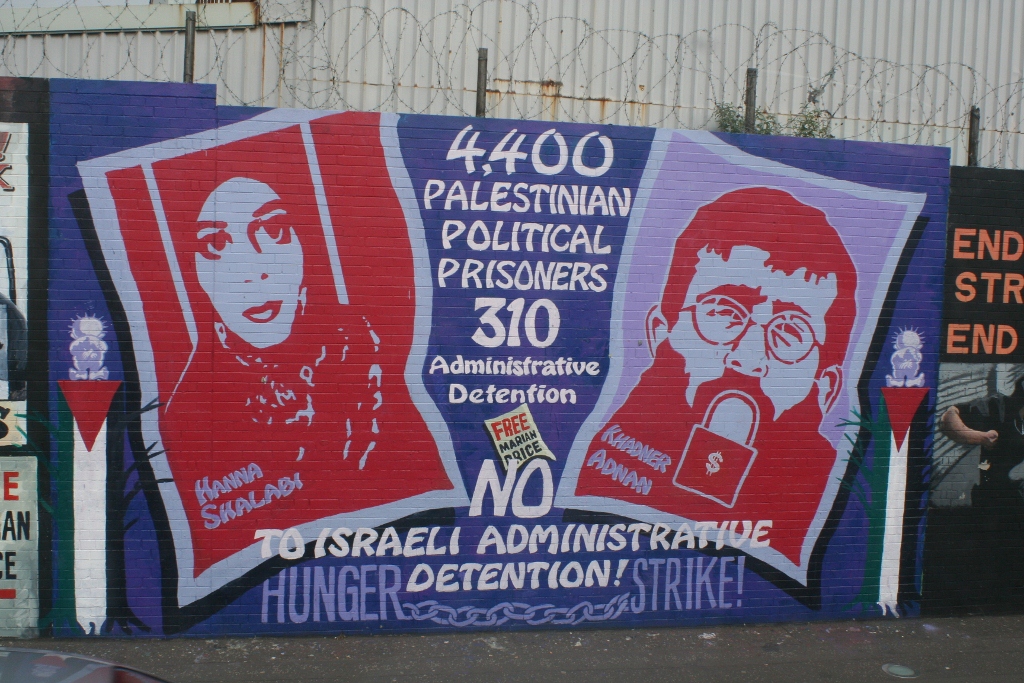
During a recent trip to Belfast, I recalled the example of Bobby Sands MP and the nine others who died in Northern Ireland on hunger strike in 1981. As expected, I saw murals of Sands and the Republicans. What I had not expected to find among the murals was this expression of solidarity:

This image stayed with me all day as I thought and wrote about the Palestinians on hunger strike today.

Amnesty International has issued a call for urgent action that asks people around the world to contact Israeli authorities on behalf of Bilal Diab and Thaer Halahla, two Palestinian men who are at risk of death as they engage in the nonviolent action of a hunger strike. Both are being held without charge or trial by Israel.

They are not alone. Palestinians detained in Israeli prisons are staging a mass hunger strike to protest prison conditions and the practice of administrative detention. According to prison officials, at least 1,600 of the 4,600 Palestinians held by Israel are refusing food. Palestinians say about 2,500 strikers are striking.

The hunger strike calls for an end to administrative detention (a procedure that allows the Israeli military to hold prisoners indefinitely on secret information without charging them or allowing them to stand trial). Additional demands are:

  1. An end to the policy of solitary confinement and isolation which has been used to deprive Palestinian prisoners of their rights for more than a decade.
  2. To allow the families of prisoners from the Gaza Strip to visit prisoners. This right has been denied to all families for more than 6 years.
  3. An improvement in the living conditions of prisoners and an end to the ‘Shalit’ law, which outlaws newspapers, learning materials and many TV channels.
  4. An end to the policies of humiliation which are suffered by prisoners and their families such as strip searches, nightly raids, and collective punishment.

General Assemblies of the Presbyterian Church (U.S.A.) are among those who have called for an end to the use of administrative detention and who have urged the use of nonviolence as the way to pursue peace.

I pray for those who place their lives on the line through their refusal. I pray for those who are held in prisons. I pray for those who imprison others. I pray for those who manage prisons. I pray that human rights are honored, justice is done, and peace rolls down for Palestinians and Israelis alike. 

See you along the Trail.

1 Comment

Filed under Current Events, Human Rights, Ireland

Sometimes in April

Cover of "Sometimes in April"

Cover of Sometimes in April

Every year in April the raining season starts.
And every year, every day in April…
The haunting emptiness descends over our hearts.
Every year in April, I remember how quickly life ends.
Every year, I remember how lucky I should feel to be alive.
Augustin
Sometimes in April

April 6 marks the anniversary of the beginning of 100 days of genocide during which 800,000 Tutsis and moderate Hutus were killed. On April 6, 1994, a plane carrying Rwandan President Habyarimana and the Burundian President was shot down near Kigali Airport. The killings begin that night.

The tensions had built over a number of years. Their beginning is often traced to 1916, when the Belgians took control of Rwanda and they produced identity cards classifying people according to their ethnicity.

The BBC reports:

The Belgians considered the Tutsis to be superior to the Hutus. Not surprisingly, the Tutsis welcomed this idea, and for the next 20 years they enjoyed better jobs and educational opportunities than their neighbours.

Resentment among the Hutus gradually built up, culminating in a series of riots in 1959. More than 20,000 Tutsis were killed, and many more fled to the neighbouring countries of Burundi, Tanzania and Uganda.

When Belgium relinquished power and granted Rwanda independence in 1962, the Hutus took their place. Over subsequent decades, the Tutsis were portrayed as the scapegoats for every crisis.

Building up to genocide

This was still the case in the years before the genocide. The economic situation worsened and the incumbent president, Juvenal Habyarimana, began losing popularity At the same time, Tutsi refugees in Uganda – supported by some moderate Hutus – were forming the Rwandan Patriotic Front (RPF), led by Mr Kagame. Their aim was to overthrow Habyarimana and secure their right to return to their homeland.

Habyarimana chose to exploit this threat as a way to bring dissident Hutus back to his side, and Tutsis inside Rwanda were accused of being RPF collaborators.

In August 1993, after several attacks and months of negotiation, a peace accord was signed between Habyarimana and the RPF, but it did little to stop the continued unrest.

The international community knew of the unrest – knew of the potential for violence. Peace talks held in August 1993 in Arusha, Tanzania resulted in the creation of UNAMIR (United Nations Assistance Mission for Rwanda). The UNAMIR commander Major General Roméo Dallaire of Canada learned from an informant of Hutu plans being made to exterminate Tutsis; to provoke and kill Belgian troops to guarantee Belgium’s withdrawal from Rwanda; and the location of Interahamwe arm caches.

In January, 1994, General Dallaire cabled the UN asking for protection for the informant and permission to seize the arms caches. His superiors denied his request. Other warnings were also ignored.

April 1994 followed.

I chose to mark this anniversary today – on Good Friday – by watching three movies about Rwanda.

First – Sometimes in April. This film tells the story through the lens of two Hutu brothers – Honoré who worked for the radio station that inflamed the violence and Augustin who served in the Rwandan army. Augustin had married a Tutsi woman  Jeanne, and had three children with her: Anne-Marie, Yves-André, and Marcus. As the plot line jumps back and forth in time and space, the brothers bear witness to the events that led to the genocide as well as the genocide and its aftermath in different ways.

The film begins with an overview of the roots of the genocide. It makes it clear that it did not just begin that one day in April.

The film deals with the failure of the world to respond. It includes a clip of the famous question: “How many acts of genocide does it take to make genocide.”

It deals with the failure of the church to protect the people and shows a mass killing at a school for girls. When ordered to divide themselves between Hutus and Tutsis, the girls refuse. All are shot. Their affirmation of a  common humanity contrasts with the horror of their murder.

It deals with guilt. For all else that he has done, Honoré agrees to lead Augustin’s family to safety. He tries.  But fails.

Ultimately Honoré is captured and brought before the tribunal prosecuting crimes committed during the genocide. His crime is inciting the people. Not all those who bear responsibility put their hand to a machete. There is also a bitter, heart-wrenching (at least my heart) irony in seeing those who failed to intervene to stop the slaughter now addressing it in a court room. Of course prosecution is needed. But what about prevention?

Augustin goes to the tribunal. Through the hotel wall, he talks with a woman who will later testify about the use of rape in the genocide.

The brothers meet. The story of Honoré’s failure and the murder of Jeanne and two of Augustin’s children is told. Both brothers weep. The scene between the brothers ends with rain. God’s tears? Healing, cleansing water? No words – no summary. It works well to leave the situation unresolved and to leave us wondering if forgiveness took place on any level.

The film touches briefly on Rwandan efforts to work for reconciliation. It shows a gacaca court at work. Through the history of Rwanda, neighbors have settled disputes by adjourning to the gacaca (“on the grass”) to sit, discuss and mediate personal and community problems. Is it working? Time will tell for sure, but in many ways it appears to be doing so. Another film and book explore that story: As We Forgive. That’s a film for another day.

A well acted film, Sometimes in April explores many dimensions of a horrific experience and provides no easy answers. Therein lies much of its power.

Beyond the Gates (originally titled Shooting Dogs) is next. Hotel Rwanda follows.

See you along the Trail.


1 Comment

Filed under Human Rights, Movie

Maundy Thursday 2012 makes me wonder

Maundy Thursday this year fell on an interesting day on the calendar. Wednesday marked the anniversary of the assassination of the Rev. Dr. Martin Luther King, Jr. Friday marks the anniversary of the beginning of the Rwandan genocide.

On the night of his arrest, the night before his execution, Jesus shared bread and the cup and gave his followers a new commandment: “I give you a new commandment, that you love one another. Just as I have loved you, you also should love one another (John 13:34).”

On the night before his assassination, Dr. King proclaimed that he had been to the mountaintop.

Like anybody, I would like to live a long life. Longevity has its place. But I’m not concerned about that now. I just want to do God’s will. And He’s allowed me to go up to the mountain. And I’ve looked over. And I’ve seen the Promised Land. I may not get there with you. But I want you to know tonight, that we, as a people, will get to the promised land!

On the night before Juvénal Habyarimana and Cyprien Ntaryamira died in a plane crash, the night before hell engulfed Rwanda, what did the people do? What did they feel? What did they think?

I wonder.

See you along the Trail

1 Comment

Filed under Human Rights

Ask for clemency in Oklahoma

Something rare has happened in Oklahoma.

Oklahoma Pardon and Parole Board has voted to recommend clemency (mercy) for a person facing execution. They do not do that often, but they did so by a vote of 4 to 1 in the case of Garry T. Allen. The State of Oklahoma is scheduled to execute Allen on Thursday, April 12, 2012 for his murder of Lawanna Gail Titsworth. A number of reasons are cited to support the vote.

  • Allen does not recall the crime. This could result from either  extreme intoxication and/or being shot in the head when apprehended.
  • Despite this lack of memory, Allen has accepted responsibility for shooting Lawanna Gail Titsworth in a domestic dispute.
  • His behavior during the shooting when Allen asked Titsworth her if she was all right, and later, at the hospital, he asked where she was point to Allen being mentally impaired at the time of the crime.
  • Allen’s family reported instances of delusional thinking even as a child. It is also reported that he suffered head injuries during a beating. It is further reported that the “frontal lobe of Allen’s brain, the part involved in planning and moderating behavior, is damaged, perhaps because of earlier head injuries or perhaps because of the gunshot in the head, or both.”
  • Allen accepts the fact that he killed Titsworth – though he does not remember but was told by others that he committed the crime. In an effort to spare both Titsworth’s and his own family painful legal proceedings, Allen plead guilty to the crime.

I grieve for the family, friends, and all who loved Lawanna Gail Titworth. They have suffered a loss I cannot imagine.

But I fail to see how executing Garry T. Allen serves a purpose other than revenge. And the State of Oklahoma – any state – should be better than that. The State of Oklahoma should not execute this mentally ill and remorseful man. He should serve the remainder of his life in an appropriate state facility.

I signed a petition asking Governor Mary Fallin of Oklahoma to show mercy and, as the Oklahoma Pardon and Parole Board recommends, to grant clemency to Gary T. Allen.

You too can sign the petition.

See you along the Trail.

I regret that I have not made time to address issues of capital punishment and the death penalty over the last couple months.

Leave a comment

Filed under Capital Punishment, Death Penalty, Human Rights

Remembering

Ghosts pass through this week – they probably do so every week – this week they seem more real.

April 4 – the assassination of the Rev. Dr. Martin Luther King, Jr. Thanks be to God for his life and witness and for all who follow in his footsteps.

April 6 – genocide commenced in Rwanda. Thanks be to God for all who seek to rebuild their lives and country.

The fires of memory burn.

Painful, wrenching though it be, I remember.

See you along the Trail.

Leave a comment

Filed under Human Rights

Lend a leg …

… to raise awareness about landmines.

April 4 is the International Day for Mine Awareness and Assistance in Mine Action.

Here are several things to do:

Roll up your pant leg as part of the Lend Your Leg campaign.

Ask the Obama Administration to submit the Mine Ban Treaty to the Senate for ratification.

Support the International Campaign to Ban Landmines.

Make the Trail safer – ban landmines.

See you along the Trail.


Leave a comment

Filed under Human Rights

Another point of view

The New York Times posted an article today that contains information from George Zimmerman who shot Trayvon Martin:

In an account given to Sanford police that was passed on to the state attorney’s office, George Zimmerman, the neighborhood watch volunteer who shot 17-year-old Trayvon Martin on Feb. 26, said that Trayvon had punched him and then repeatedly slammed his head into the sidewalk in the moments leading up to the shooting.

It is a reminder that there is at least one other point of view in this story. And a reminder of why a full, fair, transparent investigation is needed so that justice can be done for all who are involved.

See you along the Trail.

Leave a comment

Filed under Human Rights

Not the answer

Vigilante justice is not the answer.

The Boston-Herald reports that, “Members of the New Black Panther Party are offering a $10,000 reward for the ‘capture’ of George Zimmerman, the Neighborhood Watch volunteer who shot Trayvon Martin … The bounty announcement came moments after members of the group called for the mobilization of 10,000 black men to capture Zimmerman, who shot Trayvon in a gated Sanford community on Feb. 26.”

Wrong. Wrong. Wrong. Wrong.

Vigilante justice is not the answer.

This way of vengeance fails to honor Trayvon Martin. It further tears at a wounded community. It fuels the cycle of violence.

A fair, full, transparent investigation of the events that led to Trayvon’s death is needed. Such an investigation can determine what steps should be taken to seek justice for all. Justice is the answer.

On the Southern Poverty Law Center‘s website the New Black Panther Party is identified as a black-separatist group founded in 1989, that is “virulently racist and anti-Semitic” and whose leaders have “encouraged violence against whites, Jews and law officers.”

Vigilante justice is not the answer.


Leave a comment

Filed under Human Rights