Category Archives: Friends

Show up for each other

The Rev. Dr. Neal Presa, Moderator of the Presbyterian Church (U.S.A.) participated in the orientation for Presbyterian delegation to the 58th Session to the Commission on the Status of Women.

After being in New York, he flew to Whitworth University in Spokane, WA for the Third Moderator’s Conversation on Unity with Difference on Race, Gender, and Religious Differences.

The Rev. Laura Mariko Cheifetz was among the speakers at the conversation. As always, Laura made an insightful, challenging, hopeful presentation on Power and the Black-White Binary: Forging Authentic Church Identities in the Midst of White Supremacy, Patriarchy, and Being “Other Asian”.

Laura provides the following summary of her presentation:

Being church together is challenged by the ways in which various church communities and individual church members interact with power based on race and gender, not to mention class status and regional identity. The church, particularly the PC(USA), includes people with diverse capacities for a real conversation. Through exploring the place of Asian Pacific Islander Americans (who in the PC(USA) can check either “Korean” or “Other Asian” for demographic information on some forms) and others dislocated by the black-white binary in church and U.S. society, together we seek a way to move forward toward being a church that allows for complexities of identity and addresses real inequalities.
A couple of passages should encourage you to read the whole presentation:
Race and gender themselves are not the problems obstructing unity. The problems here are racism and sexism. Who we are isn’t the problem, but how we live into oppressive constructs that separate us from one another is. What I will say this morning is part of a longer conversation we in the church need to have with one another, because even though we have been in this conversation for decades, we have yet to diminish our capacity to sin when it comes to relationship with one another.
Our conversation cannot depend upon a generic experience of racism (usually defined by blackness) or sexism (usually defined by middle-aged white women) imposed upon other experiences. Racism is not just about color. It is also about language, culture, colonialism, national origin, and citizenship status. Sexism is not just about how many women get to be heads of staff of tall steeple churches or directors of church agencies. It is about how we continue to think about gender identity and gender roles, and how those thoughts are embedded in our culture and our policies. It is about earning potential; church policies around work hours, compensation, and family leave; about how well churches minister to the lived realities of women in their employ and women who choose to be part of churches. It is about the culture of church leading change in the culture of this country instead of propping up legal and cultural patriarchy.
 
Social issues are theological. It is a theological problem if Christians believe employment opportunity for those with varying levels of education, immigration, the criminal justice system, gun control, political gerrymandering, disenfranchisement, voter ID laws, the financial services sector, hunger, poverty, and economic inequality are not the business of the church. These are things that have a disproportionate impact on the lives of people of color. These are the problems that keep us from attaining a shot at racial justice. These are the problems that shape our lives because we’re always negotiating with banks to allow our in-laws to keep their homes, or finding lawyers so our mothers can stay in the country, or finding people to write letters attesting to the character of our wrongfully accused sons, or looking for ways to feed our families. We have to worry about elected officials who don’t look like us or care about our communities. This takes up a lot of time and energy, and it is our faith that keeps us going. These are the circumstances we bring with us to church every single Sunday.
Laura also identifies resources for further conversations:
I have read Laura’s presentation several times. I will read it several more as I seek ways to respond to her invitation and challenge:
So if we of varying races, genders, and religious groups show up for each other, and if we of varying spiritual gifts show up for each other, maybe that is a way of finding how to be authentically church. Maybe that is how we can create change.
See you along the Trail.
Leave a comment

Filed under Antiracism, Friends, Presbyterian Church (U.S.A.)

On my heart and mind: children

Child soldiersA while back, I posted a sermon about children. Grieving the many places where children endure unimaginable violation, it affirms our call to care for children:

In this place, I am reminded that God is at work in all places. And that sustains and challenges me to look for how God is at work and, as the Holy Spirit gives me grace, to join in that work.

Children have been in my heart and on my mind this week.

Faith in God in Christ have put them there.

And in this place, God invites us all to join in caring for the children. The children of this congregation. The children of this community. All the children, all God’s children of the world. May we hear and respond.

Today, my friend Laura Mariko Cheifetz posted a reflection on children “Children Aren’t Disposable“. She reaches a similar conclusion:

I think children matter. I think everyone’s child matters. I do not believe that parents or communities or even children need to be virtuous or free of fault in order to think their children and perhaps even their parents deserve protection and generosity. You can make all the bad decisions you want, but I still believe you and your children deserve life. I extrapolated this from the lesson my parents drummed into me: You do not have to earn grace. It has already been given.

Children matter. Their families matter. Grace has already been given. Let’s act like it.

And she does a better job of lifting up ways to act:

Support the Children’s Defense Fund. They do great work at a policy level.

Read Toxic Charity. Consider changing your mission to be less charity and offers more agency to people. Bulk discounts (for your Sunday school or book group) are available. http://www.thethoughtfulchristian.com/Products/9780062076212/toxic-charity–paperback-edition.aspx

Write letters to migrant children. http://www.groundswell-mvmt.org/faithshare/people-are-writing-letters-to-the-migrant-children-and-they-are-beautiful/

Advocate for immigration reform that will allow people dignity and a path to regularization. Congress has recessed for August, so there isn’t legislation to advocate for. But you can still leave a message with your U.S. and state congresspeople urging them to support meaningful immigration reform and humane immigration processes, particularly for children and their parents who may be eligible for asylum, rather than increased criminalization and security measures. TheThoughtfulChristian.com has many books and downloadable studies to help you and your church talk about immigration and take action.

Oppose zero-tolerance policies in schools, stop and frisk public policing, and other ways that disproportionately criminalize black and brown youth.

You may give to UNICEF and UNRWA, who work with children in Gaza and the occupied territories. You can also ask your congresspeople to reconsider our typical military aid package to the nation of Israel. You could work with local peace organizations to advocate for an end to the blockade and the occupation.

Children matter. Join in caring for them.

See you along the Trail.

1 Comment

Filed under Current Events, Friends

Samuel Johnson

I remembered Samuel Johnson today and I was revived.

The Samuel Johnson I remembered was not the English author – I did not pick up a copy of Boswell. I met this Samuel Johnson almost fifteen years ago during a hot summer week in Orangeburg, SC. He and I have been accompanying each other in the Communion of Saints ever since.

On Palm Sunday of that year, in a quiet grove of trees about eight miles outside of Orangeburg, the Butler Chapel AME Church burned. Four young men admitted responsibility for the fire, although they maintained that it was accidental. The fire did not totally destroy the church. It did cause enough damage that the church could neither be used nor repaired. After a season of prayer and discussion, the members of Butler Chapel determined to build a new church.

Volunteers came from across the country to work on the church; their labor coordinated by the Church of the Brethren. That August, a group of us went to Orangeburg from Cleveland; some of my friends from Louisville joined us. We spent a week working in extreme heat. We installed insulation and drywall and windows. We finished drywall. We laid brick. Each day was a little different. Each day had some elements in common – mostly the people of Butler Chapel – the wonderful people who welcomed us and fed us, prayed with us and worked beside us. Among them was Samuel Johnson.

Samuel Johnson was a big man. Once he had been a strong man. A long-time member of Butler Chapel AME Church, Samuel had attended school in the building as a child. Samuel worked throughout his life. Worked well and hard. . . as a farmer . . . for the gas company.

When I met him, a stroke had stolen much of his strength. He walked with a cane.  He walked better when he can use his cane and someone’s shoulder. I remember. A couple of times he used mine.

Although the stroke had taken much of his one arm and leg, it did not take his mind or voice or spirit. Unable to stay away while his church was being rebuilt, he came to the work site as often as he could. He watched. He visited. And from time to time, his eyes filled with tears of frustration as he wished that one more time he could swing a hammer.

Toward the middle of a hot afternoon (they were all hot – I can’t remember which one), I was working alone on insulation. A friend’s voice interrupted me.  “Mark, go to the fellowship hall.”

“I’m busy.” I said.  “I want to get this finished.”

Bob persisted.  “Mark, stop what you are doing.  Go to fellowship hall.  You have to see what is going on.  Take a camera.”

Reluctantly I got up. I found the camera went to the fellowship hall.

There, on a 2” x 10”  board that rested on two overturned five-gallon paint buckets, sat Samuel Johnson.  Around him, on the concrete slab, sat many of the young people of our group.  Softly and slowly, Samuel spoke . . . telling them of his life . . . his family . . . his work . . . telling them of Orangeburg and his beloved church.  As he spun stories and answered questions, tears filled my eyes.  I was helping build a physical church; Samuel was building Christ’s body.

Why did I remember this story today? Who knows?

Perhaps it is because I have been thinking about the hurts of God’s people – the violence in Gaza and Israel, the children who flee Central America to come to the United States, bombing in South Kordofan, hunger around the world particularly in South Sudan and North Korea, gunfire on our country’s streets, on and on the list goes. It does not seem to end.

In the face of such violations, suffering, and pain, my efforts seem so small and insignificant. But Samuel Johnson reminds me of the importance of perspective.

I can look at life in terms of what I do not have – what I lack – what I cannot do. This is the view of scarcity.

In the case of Samuel Johnson, such a view has little time for an older man whose physical abilities appear to have been limited by a stroke. It would say he no longer has much to offer.

Alternately, I can choose to look at life in terms of what I have – what I can do – what I can share – the gifts I bear. This view is the view of abundance. When viewed in this way, the incredible gifts that Samuel has and shares leap into view. Samuel’s presence is an inspiration; Samuel’s prayers a source of strength; Samuel’s stories create and nurture community.

For me, the assumption of abundance frees me from working about what I cannot do – to focus on doing what I can – whatever that might be.

Remembering Samuel renews my spirit and challenges me to look at the gifts I have and figure out how to use those gifts. That work has begun and will continue and I expect I will bump into Samuel and a whole bunch of other saints as I do.

See you along the Trail.

1 Comment

Filed under Antiracism, Friends

The story so far

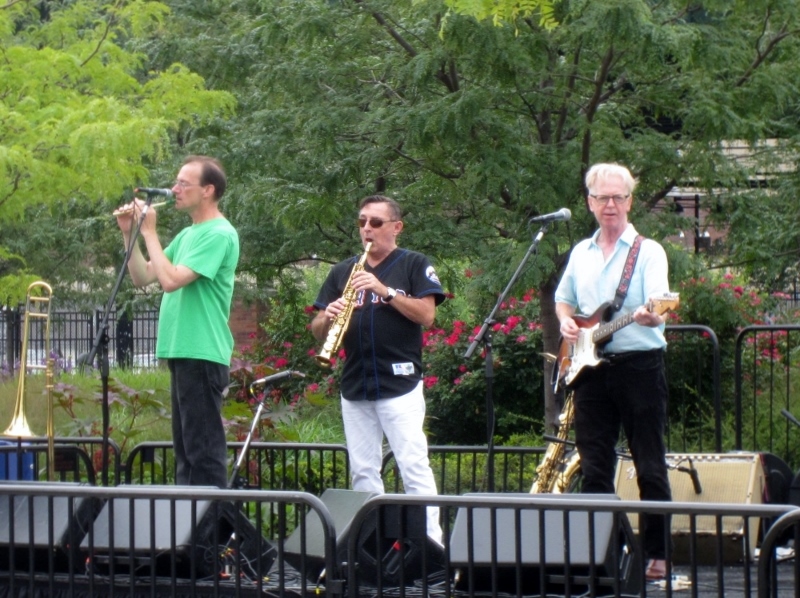
IMG_1553 (800x600)They began making music in 1989. I discovered them in 1993 or so with their album Fire of Freedom. The combination of Celtic Rock, Irish Republican sympathies, intriguing instrumentation (guitar, uilleann pipes, saxes, and trombone), and broad influences (reggae, hip hop, folk, and jazz) grabbed me. Named after the worst year of the Great Potato Famine, Black 47 has been one of my favorites since. I have seen them in Irish festivals and bars. I have dragged friends along.

About a year ago, the band members announced the time had come for Black 47 to call it quits. They recorded a final album, The Last Call, and embarked on the Last Call Tour that will culminate on November 15 at the B.B. King Bar and Grill in New York.

On August 1, they played for Irish Night at Citi Field prior to the Mets game. Tricia went with me for one more, one last concert. In the words of their song, “Rocking the Bronx“: “that’s the story so far.” I am glad to have experienced a part of the story.

See you along the Trail.

Leave a comment

Filed under Family, Friends, Music, New York, Photo

Why I like New York 40: places to show friends

There is always something new to show friends who come to New York. Today, Grace Ji-Sun Kim and I went to Bryant Park. It was her first visit to the park. Great fun to see places in the city through first time visitors.

photo (78) (800x578)


See you along the Trail.

Leave a comment

Filed under Friends, New York, Photo

Purple flowers: guest collection #8

2014-07-08 14.40.41 (600x800)

8 July 2014
Dublin, Ireland

Joel Hanisek

Leave a comment

Filed under Friends, Photo

Purple flowers: guest collection #7

2014-07-08 14.40.29 (600x800)

8 July 2014
Dublin, Ireland

Joel Hanisek


Leave a comment

Filed under Food, Friends

Theological Reflections on “Gangnam Style”: Endorsements

Check out this information about my friend Grace Ji-Sun Kim’s new book. I am looking forward to reading it – hope you are too.

gracejisunkim's avatarGrace Ji-Sun Kim

ShowJacket.aspMy new book, Theological Reflections on “Gangnam Style”: A Racial, Sexual and Cultural Critique (Palgrave Macmillan) co-written with Joseph Cheah is now available for pre-order on Amazon.

This new book is the first one in the book series, “Asian Christianity in the Diaspora“(Palgrave Macmillan) for which Joseph Cheah and I are both serve as co-editors.  Special thanks to our editor Burke Gerstenschlager for his guidance, trust and encouragement.

View original post 828 more words

1 Comment

Filed under Antiracism, Friends

Cheering section

We both stopped short as we came to the corner. I walked close to the building, too close I admit. Perhaps Ralph and Sally did, too. But we both stopped short; we averted a collision.

“Mark. You are losing weight again. Well done,” Ralph gushed.

His excitement and enthusiasm has remained with me all day. I have reflected on the experience all day.

Today marks the ninth day I have worked at self-care. This time. I have made many efforts in recent years as well. Sometimes I do well for a stretch and then everything falls apart. Eight days, soon nine, represents one of my longer efforts.

Ralph’s encouraging words, reminded me of how this time is different from earlier efforts and how this time is the same.

What is different, is this time I am working with a doctor with whom I feel connected. I have liked my earlier doctors. I have trusted them. But this time, something clicked with my new doctor from my first visit in May. I had a pretty good run after the appointment. Then I spent two weeks eating everything that did not move while at the Presbyterian Church (U.S.A.)’s General Assembly. My second visit took place on June 23. She gave me advice and now I try to apply it.

What is the same, is the community of accountability that surrounds and sustains and supports me. It includes friends and family who have expressed concern for my health – and who have voiced support for my efforts. Some in the group comment on my Facebook posts or follow the blog where I make reports or engage me in conversations, virtual and real. They have made their support known to me and I appreciate it them deeply. They serve as my personal cheering section. Others, such as Ralph, cheer me on even when I am unaware of their presence.

To all the members of this accountability group, family and friends, known and unknown, I say thank you. With your support, I have made a great start. The journey continues.

See you along the Trail.

Leave a comment

Filed under Exercise, Family, Food, Friends, Presbyterian Church (U.S.A.)

Purple flowers: guest collection #6

pf deborah wright

Thanks to Deborah Wright

Leave a comment

Filed under Friends, Photo